


Using a software recruiting firm makes sense when you need to hire quickly without sacrificing quality, when you’re filling senior roles that require discretion, when your internal recruiting team lacks bandwidth or specialized networks, or when you’ve struggled to make successful hires on your own. The right recruiting partner brings industry expertise, established candidate relationships, and pattern recognition that accelerates your hiring while reducing mis-hire risk.
Not every hire requires external help. But for critical roles where the cost of a bad hire is high and the talent pool is competitive, working with specialists often produces better results than going it alone.
This guide covers the signs you need recruiting help, what software recruiting firms do differently than generalists, how to evaluate potential partners, and how to get the most value from the relationship.
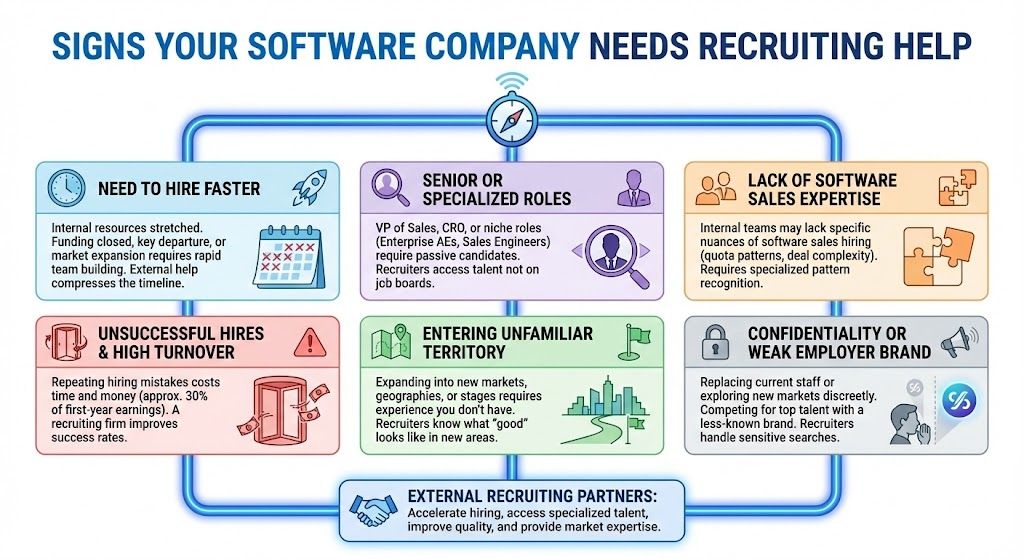
Signs Your Software Company Needs Recruiting Help
Some hiring situations are straightforward. Post the job, screen applicants, make a hire. Others are more complex. Here’s when bringing in a recruiting firm typically makes sense.
You need to hire faster than internal resources allow. Maybe you just closed a funding round and need to build a sales team in 90 days. Maybe a key person left unexpectedly and you need a replacement before pipeline suffers. Maybe you’re expanding into a new market and need feet on the ground quickly.
Internal recruiting takes time. Building job descriptions, sourcing candidates, screening resumes, coordinating interviews. If your timeline is aggressive, external help compresses the process significantly.
The role is senior or specialized. VP of Sales searches, CRO recruiting, and other leadership hires require access to candidates who aren’t actively job hunting. These people don’t apply to job postings. They respond to recruiters they trust presenting opportunities worth considering.
Specialized roles like enterprise AEs selling into specific verticals, sales engineers with particular technical backgrounds, or GTM leaders with experience at specific company stages also benefit from specialized recruiting.
Your internal team lacks software sales expertise. Your talent acquisition team might be excellent at hiring engineers, marketers, or customer success managers. But software sales hiring has specific nuances. Understanding quota attainment patterns, evaluating deal complexity experience, and assessing sales methodology fit requires pattern recognition that comes from placing hundreds of sales candidates.
You keep making unsuccessful hires. If you’ve hired three AEs in the past year and two didn’t make it past six months, something in your process is broken. Maybe you’re sourcing from the wrong places. Maybe your evaluation criteria are off. Maybe you’re overselling the opportunity and creating expectation mismatches.
According to research from the Society for Human Resource Management, the average cost of a bad hire is roughly 30% of that employee’s first-year earnings. For software sales roles with high OTEs, that number adds up quickly. A recruiting firm that improves your success rate pays for itself.
You’re entering unfamiliar territory. Expanding into a new market segment, geography, or company stage means hiring people with experience you don’t have internally. If you’ve never hired enterprise AEs before, you don’t know what good looks like. A recruiter who has placed hundreds of enterprise AEs knows immediately whether a candidate’s experience is genuinely relevant.
The role is confidential. Sometimes you need to hire a replacement before the current person knows they’re being replaced. Sometimes you’re exploring a new market and don’t want competitors to know. Recruiters handle confidential searches with discretion that’s hard to maintain when posting public job listings.
Your employer brand isn’t strong enough. Candidates at top companies get recruited constantly. If your company isn’t well-known, competing for these candidates is harder. Recruiters can sell your opportunity to candidates who wouldn’t respond to a cold outreach from an unknown company.
What Software Recruiting Firms Do Differently
Not all recruiting firms are created equal. Firms that specialize in software bring capabilities that generalist agencies lack.
Deep industry networks. Specialized software recruiters have spent years building relationships with software sales professionals. They know who the top performers are at major companies. They’ve placed candidates who have gone on to become sales leaders. These networks take years to build and provide access to candidates you’d never find through job postings.
Pattern recognition for software sales. What does a successful enterprise software salesperson actually look like? How do you evaluate whether someone’s quota attainment is impressive or just average for their territory? What red flags predict failure in early-stage sales environments versus established companies?
Recruiters who focus on software sales develop pattern recognition from seeing thousands of candidates. They can assess fit faster and more accurately than someone hiring for their first software sales role.
Understanding of software sales compensation. Software sales compensation is complex. OTE, quota structures, accelerators, equity. Specialized recruiters understand market rates, can advise on competitive packages, and help you structure offers that attract strong candidates without overpaying.
Credibility with passive candidates. The best candidates aren’t job hunting. They’re employed, earning good money, and fielding recruiter calls weekly. Most of those calls get ignored. But when a recruiter they trust calls with a relevant opportunity, they listen.
Specialized recruiters have earned this trust by consistently presenting quality opportunities and treating candidates professionally. Their calls get answered. Yours might not.
Ability to assess technical fit. Software sales roles often require technical fluency. Can the candidate hold their own in conversations with technical buyers? Do they understand the technology well enough to sell it credibly? Recruiters who specialize in software can evaluate this in ways generalists cannot.
Market intelligence. Good recruiters know what’s happening in the market. Which companies are growing? Which are struggling? What’s happening to compensation? Where is talent moving? This intelligence helps you position your opportunity competitively and anticipate challenges.
Contingency vs Retained Search Explained
When engaging a recruiting firm, you’ll typically choose between two models. Understanding the differences helps you select the right approach for your situation.
Contingency search. In this model, you only pay if you hire a candidate the firm presents. There’s no upfront commitment. The fee, typically 20% to 25% of first-year compensation, is due only upon successful placement.
Advantages of contingency:
- No payment unless successful
- Lower financial risk
- Can work with multiple firms simultaneously
- Good for roles where there’s a large talent pool
Disadvantages:
- Less dedicated attention since payment isn’t guaranteed
- Recruiters may prioritize searches more likely to close
- Quality of candidates can be more variable
- May see candidates who are actively looking rather than passive talent
- Multiple firms working the same search can create candidate confusion
Retained search. In this model, you pay the firm an upfront retainer, with additional payments at milestones or completion. The firm commits dedicated resources to your search and typically works exclusively with you on this role.
Advantages of retained:
- Dedicated consultant attention
- More thorough candidate research and outreach
- Better access to passive candidates
- Alignment of interests throughout the process
- Appropriate for senior or confidential searches
Disadvantages:
- Higher cost if search fails or you hire through another channel
- Upfront financial commitment
- Process can feel slower due to thoroughness
Which model makes sense?
Contingency works well for individual contributor roles where there’s a reasonable supply of qualified candidates and speed matters more than exhaustive search. If you need to hire three AEs and any of several qualified profiles could work, contingency makes sense.
Retained works better for senior roles, specialized positions, and confidential searches. VP of Sales and CRO searches almost always benefit from retained engagement. The candidates you want require dedicated outreach and professional representation.
Some firms offer hybrid models. Priority contingency, for example, gives your search elevated attention in exchange for exclusivity, but still ties payment to successful placement. Discuss options with potential partners to find the structure that fits your needs.
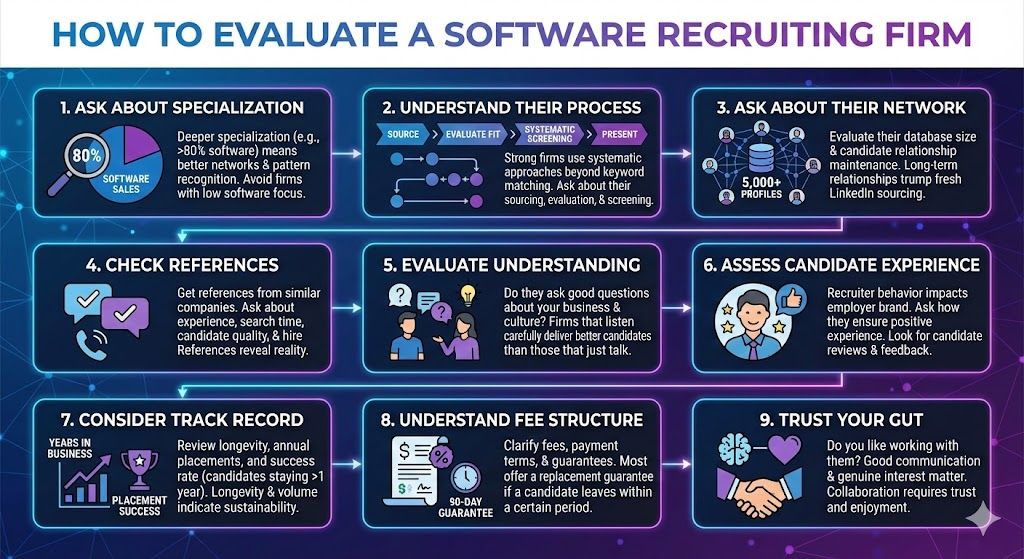
How to Evaluate a Software Recruiting Firm
Not every firm that claims software expertise actually has it. Here’s how to evaluate potential partners.
Ask about their specialization. How much of their business is software sales specifically? A firm that does 80% software and 20% other industries is different from one that does 10% software. Deeper specialization usually means better networks and pattern recognition.
Understand their process. How do they source candidates? How do they evaluate fit? What does their screening process look like? Strong firms have systematic approaches that go beyond keyword matching on resumes.
Ask about their network. How many software sales professionals are in their database? How do they maintain relationships with candidates over time? A firm with 5,000 software sales candidates they’ve built relationships with over 10 years is different from one sourcing fresh from LinkedIn for each search.
Check references. Ask for references from companies similar to yours. What was the experience like? How long did searches take? What was the quality of candidates? Did the hired candidates succeed? References reveal reality that sales pitches don’t.
Evaluate their understanding of your needs. In your initial conversations, do they ask good questions about your business, culture, and specific requirements? Or do they just talk about their process and fees? Firms that listen carefully and probe for detail will deliver better candidates.
Assess their candidate experience reputation. How do candidates feel about working with this firm? Recruiters who treat candidates poorly damage your employer brand. Ask the firm how they ensure positive candidate experience. Look for reviews or feedback from candidates they’ve worked with.
Consider their track record. How long have they been in business? How many placements do they make annually? What’s their placement success rate (candidates who stay beyond one year)? Longevity and volume indicate sustainability and experience.
Understand their fee structure. Get clarity on fees, payment terms, and guarantee periods. Most firms offer guarantees where they’ll replace a candidate who leaves within a certain period (typically 90 days) at no additional charge. Understand what’s included and what isn’t.
Trust your gut. Do you like working with these people? Do they communicate well? Do they seem genuinely interested in your success? The recruiting relationship requires ongoing communication and collaboration. Work with people you trust and enjoy.
What to Expect from the Recruiting Process
Understanding the typical process helps you plan and participate effectively.
Intake and kickoff. The engagement starts with a detailed intake conversation. The recruiter needs to understand your company, culture, the specific role, must-have versus nice-to-have requirements, compensation range, timeline, and interview process. The more context you provide, the better candidates you’ll see.
Expect this conversation to take 60 to 90 minutes for a senior role. Don’t rush it. The quality of candidates depends on the quality of this briefing.
Sourcing and outreach. The recruiter begins identifying and reaching out to potential candidates. For retained searches, this typically includes both database candidates and fresh research. For contingency, the emphasis is often on known candidates who might fit.
You won’t see candidates immediately. Sourcing, outreach, and initial screening take time. Expect one to two weeks before seeing the first candidates for most roles.
Candidate presentation. The recruiter presents screened candidates with their assessment of fit. This typically includes a summary of the candidate’s background, relevant experience, compensation expectations, and the recruiter’s evaluation of strengths and potential concerns.
Review candidates promptly. Delays at this stage lose good candidates to other opportunities. Provide specific feedback on why you’re passing on candidates so the recruiter can refine the search.
Interview coordination. The recruiter typically coordinates interview scheduling, which saves your team significant administrative time. They also prep candidates for interviews and debrief with them afterward.
After your interviews, provide feedback quickly. The recruiter can address concerns with candidates, gather additional information, and keep the process moving.
Offer and close. When you’re ready to make an offer, the recruiter helps you understand the candidate’s expectations and advises on competitive positioning. They often present the offer to the candidate and help navigate negotiation.
Good recruiters help close candidates. They address concerns, reinforce the opportunity’s appeal, and maintain momentum through the offer process. This support is especially valuable for competitive candidates weighing multiple options.
Post-placement follow-up. Quality firms check in after placement to ensure the hire is going well. This helps catch problems early and demonstrates commitment beyond just making the placement.
Maximizing Your Investment in Recruiting Services
Working with a recruiting firm is an investment. Here’s how to get the most value from it.
Be specific about what you need. Vague requirements produce vague candidates. The more clearly you define the role, ideal candidate profile, and evaluation criteria, the better results you’ll see. Take time upfront to articulate exactly what you’re looking for.
Provide thorough context about your company. Help the recruiter sell your opportunity effectively. Share what makes your company compelling, what the growth trajectory looks like, why this role matters, and what success enables for the person who takes it. The recruiter becomes an extension of your employer brand.
Be responsive and decisive. When candidates are presented, review them promptly. After interviews, provide feedback immediately. When you find someone strong, move to offer quickly. Delays kill deals. Candidates lose interest. Competitors make offers. Responsiveness is one of the biggest factors in successful placements.
Give honest feedback. If candidates aren’t right, explain specifically why. “Not a fit” doesn’t help the recruiter calibrate. “We need someone with more enterprise experience; this candidate’s largest deal was $50K” gives them actionable direction.
Treat it as a partnership. The best recruiting relationships are collaborative, not transactional. Share information openly. Discuss challenges honestly. Ask for the recruiter’s perspective on market conditions, compensation, or candidate perception. Their insights can improve your hiring beyond just this specific search.
Communicate changes promptly. If the role requirements change, if budget shifts, if timeline moves, tell your recruiter immediately. They may be working candidates who no longer fit or missing candidates who now do. Keeping them informed keeps the search on track.
Think long-term. A good recruiting relationship becomes more valuable over time. The recruiter learns your culture, your preferences, what works and what doesn’t. They build a pipeline of candidates who fit your company. Treating the relationship as ongoing rather than one-off produces better results.
Evaluate results honestly. After placements, assess whether the hires succeeded. Share this feedback with your recruiter. Understanding what predicts success at your company helps them improve future searches.
Making the Decision
Not every hire requires a recruiting firm. But for critical software sales roles where the cost of failure is high and the talent market is competitive, working with specialists often produces better outcomes.
Consider the true cost of a bad hire: salary, benefits, training, management time, lost deals, damaged customer relationships, and starting over. Compare that to the cost of a recruiting fee that improves your success rate.
If you’re building a software sales team, recruiting enterprise salespeople, or hiring SaaS account executives, the specialized expertise of a software recruiting firm can make the difference between a transformative hire and an expensive mistake.
Neva Recruiting has spent over 25 years building relationships with software sales professionals and helping software companies find the talent they need. If you’re facing a hiring challenge and want to discuss whether recruiting support makes sense for your situation, reach out to start a conversation.
The right talent is out there. The question is whether you have the time, network, and expertise to find them on your own.
Leave a Reply