


VP of Sales recruiting for SaaS companies requires finding a leader who can build and manage a sales organization, develop repeatable processes, and hit aggressive growth targets. The right hire brings experience scaling revenue at similar-stage companies, a track record of building high-performing teams, and the operational discipline to create predictable pipeline. Getting this hire wrong is one of the most expensive mistakes a SaaS company can make, often setting growth back by 12 to 18 months.
The VP of Sales role sits at a critical junction. Too senior for most founders to manage closely, too important to get wrong. The stakes are high because this person will shape your sales culture, hire your team, and own your revenue number.
This guide covers when to hire your first VP of Sales, what qualifications actually matter, how to run an effective search, what compensation to expect, and how to onboard for success.
The VP of Sales Role in SaaS Organizations
The VP of Sales owns revenue execution. While the CEO or CRO may set overall strategy, the VP of Sales translates that strategy into quotas, territories, processes, and results.
Core responsibilities include:
Team leadership and development. The VP of Sales hires, coaches, and manages the sales team. This includes frontline AEs and often SDRs, sales managers, and sales operations. They’re responsible for performance management, including the difficult work of exiting underperformers and developing high-potential reps.
Sales process and methodology. They establish how the team sells. What’s the qualification framework? How are deals staged? What does a good discovery call look like? The VP of Sales creates consistency and rigor where informal approaches existed before.
Pipeline and forecasting. They own the accuracy of the forecast. This means understanding what’s really happening in deals, not just what reps report. Strong VPs have a nose for pipeline risk and course-correct before problems become crises.
Quota setting and territory design. They work with finance and leadership to set quotas that are ambitious but achievable. They design territories that give reps a fair chance at success while covering the market efficiently.
Cross-functional alignment. Sales doesn’t operate in isolation. The VP of Sales works with marketing on lead quality and handoff processes, with customer success on expansion and retention, and with product on roadmap priorities based on customer feedback.
Revenue accountability. At the end of the day, the VP of Sales owns a number. They’re accountable for hitting targets and explaining variances. This accountability distinguishes the role from sales management positions without P&L responsibility.
The scope varies by company size. At a Series A company with five reps, the VP of Sales might be player-coach, carrying their own quota while building the team. At a Series C company with 40 reps, they’re managing managers and focused entirely on leadership.
When to Hire Your First VP of Sales
Timing this hire correctly is one of the most important decisions for a SaaS company. Hire too early and you waste money on someone who can’t operate without infrastructure. Hire too late and you struggle with scaling challenges that overwhelm your existing team.
Signs you’re ready:
You have repeatable sales motion. This is the most important criterion. If you’re still figuring out who to sell to, what messaging works, or how long deals take, you’re not ready. A VP of Sales can scale what’s working. They can’t figure out what works in the first place. That’s founder work.
You have two to four producing AEs. According to research from Bowery Capital, the optimal time to hire a VP of Sales is when you have two to four AEs generating consistent revenue. This gives you enough data to know your sales motion works and enough team size to warrant dedicated leadership.
The CEO can’t keep doing it. Many founding CEOs lead sales themselves in the early days. They’re often the best salesperson because they know the product and market deeply. But this becomes unsustainable as the company grows. When sales leadership consumes time needed for product, fundraising, or company building, it’s time to hire.
You’re preparing to scale significantly. If you’ve just raised a growth round with expectations to double or triple the team, you need someone who has done this before. Scaling a sales org requires skills most founders don’t have. Bring in experience before you need it.
You have the budget. VP of Sales compensation is significant. If hiring this role strains your runway or prevents other critical hires, you might need to wait. More on compensation later in this guide.
Signs you’re not ready:
No product-market fit. If customers aren’t buying or aren’t staying, a VP of Sales won’t fix that. They’ll churn out quickly or, worse, build a team around a motion that doesn’t work.
No sales data. You need enough closed deals to understand your sales cycle, win rates, average deal size, and customer profile. Without this data, a VP of Sales is guessing rather than optimizing.
Founder hasn’t sold yet. If the founders haven’t closed customers themselves, they don’t understand the sales motion well enough to evaluate or manage a VP of Sales. Founders should close the first 10 to 20 customers before hiring sales leadership.
Only one or two reps. At this stage, the founder can manage the team directly. Adding a VP creates unnecessary cost and complexity. Focus on proving the model before adding leadership.
The pattern of hiring a VP of Sales too early is common and expensive. They arrive expecting to build on a foundation that doesn’t exist. They spend months trying to create what should already be in place. Eventually they leave or are pushed out, and you’re starting over with less runway and more skepticism from the board.
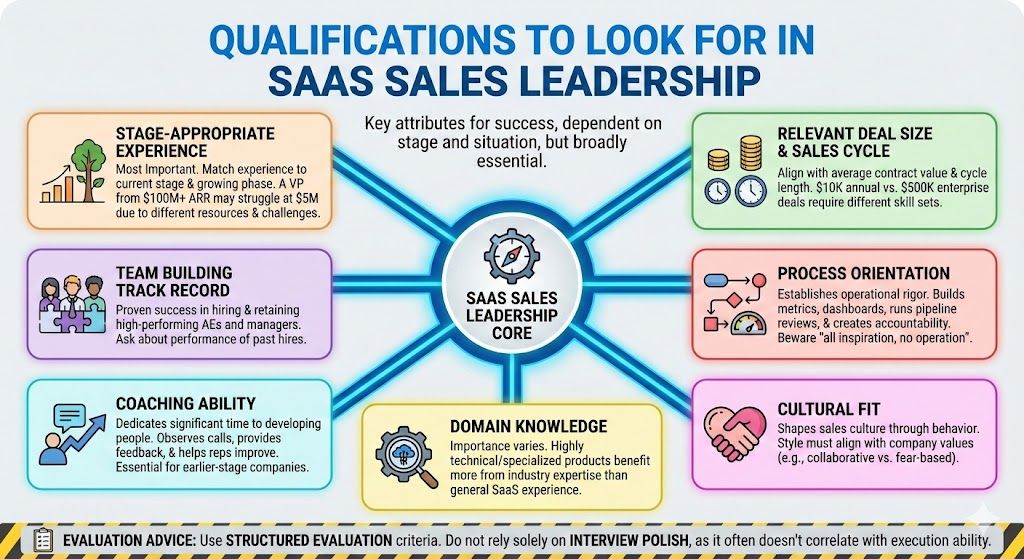
Qualifications to Look for in SaaS Sales Leadership
What makes someone qualified to lead sales at a SaaS company? The answer depends on your specific stage and situation, but certain qualifications matter broadly.
Stage-appropriate experience. This is the single most important qualification. A VP of Sales who has only operated at $100M+ ARR companies will likely struggle at a $5M company. The resources, processes, and challenges are completely different. Look for candidates who have operated at or slightly above your current stage and grown through the phase you’re entering.
Relevant deal size and sales cycle. Selling $10K annual contracts is different from selling $500K enterprise deals. Someone excellent at one may struggle with the other. Match the candidate’s experience to your average contract value and sales cycle length.
Team building track record. Have they hired successfully? Ask specifically about AEs and managers they’ve brought in. How did those hires perform? Are any still at the company? A VP of Sales who can’t hire well creates problems that compound quickly.
Process orientation. Strong VPs bring operational rigor. They establish metrics, build dashboards, run effective pipeline reviews, and create accountability. Ask about the systems and processes they’ve implemented. Be wary of candidates who are all inspiration and no operation.
Coaching ability. The best VPs spend significant time developing their people. They observe calls, provide feedback, and help reps improve. Some VPs are great at strategy and hiring but neglect coaching. For earlier-stage companies where AE development matters more, coaching ability is essential.
Cultural fit. A VP of Sales shapes your sales culture through their own behavior. If they operate through fear and pressure, your team will too. If they’re collaborative and growth-oriented, that spreads as well. Make sure their style fits what you’re trying to build.
Domain knowledge. How important industry expertise is depends on your product. Highly technical products sold to specialized buyers benefit from VPs who know the space. More horizontal products can succeed with VPs who have strong general SaaS sales experience.
When evaluating sales leadership candidates, use structured evaluation criteria rather than relying on interview polish. Sales leaders are often excellent at interviewing. That skill doesn’t always correlate with execution ability.
The Search Process for VP of Sales Candidates
Finding and hiring a VP of Sales requires a more deliberate process than hiring individual contributors. Here’s how to approach it.
Define the role before you search. Write a detailed job description that goes beyond generic requirements. What specifically will this person own? What are the first-year priorities? What does success look like at 6 and 12 months? What authority will they have? Clear definition helps you evaluate candidates and helps candidates evaluate you.
Decide on search approach. VP of Sales candidates typically come through three channels:
Your network. Referrals from investors, advisors, and executives often produce strong candidates. These come pre-vetted and already have context on your company.
Internal recruiting. If you have a strong talent acquisition function, they may be able to source VP-level candidates. This works better at larger companies with established employer brands.
External recruiters. For most SaaS companies, working with specialized software sales recruiters produces the best candidate pool. The strongest VPs aren’t job hunting. They need to be identified and approached professionally.
Plan for a 90 to 120 day process. VP searches take time. You’ll likely need to see 30 to 50 candidates to find 5 to 8 worth interviewing seriously, leading to 2 to 3 finalists. Add time for interviews, references, and negotiation. If you need someone in seat by Q3, start the search in Q1.
Structure your interview process. A typical VP of Sales interview process includes:
- Initial screen (recruiter or internal HR)
- Deep dive with CEO on experience, approach, and fit
- Meeting with peer executives (VP Marketing, VP Product, etc.)
- Session with board member or investor
- Presentation or case study exercise
- Reference checks (both provided and back-channel)
- Final conversation with CEO
Involve the right stakeholders. The CEO typically owns this hire, but other voices matter. If you have a board member with sales expertise, involve them. If you have existing sales managers, they should meet finalists. Their input and buy-in affects the new VP’s success.
Assess thoroughly but move with purpose. Dragging the process out for months signals dysfunction and loses good candidates. Each interview should have a clear purpose. Make decisions promptly after each stage. When you find someone strong, accelerate.
Sell the opportunity. Strong candidates have options. They’re evaluating you while you evaluate them. Be prepared to articulate why this is a compelling opportunity. What’s the market size? What’s the product differentiation? Why is this the right time to join? What will they be able to build? Top candidates want to do something meaningful, not just collect a paycheck.
Compensation Expectations for SaaS VP of Sales Roles
VP of Sales compensation varies significantly based on company stage, location, and candidate experience. Here’s what to expect.
Base salary ranges:
- Series A (under $5M ARR): $200,000 to $275,000
- Series B ($5M to $20M ARR): $250,000 to $325,000
- Series C+ ($20M+ ARR): $300,000 to $400,000+
These ranges assume major tech markets. Adjust down 10% to 20% for lower cost-of-living areas.
Variable compensation. Most VP of Sales roles include variable compensation tied to team performance. This typically ranges from 30% to 50% of base salary at target. Some companies offer uncapped variable, while others cap at 150% to 200% of target.
Total cash compensation (at target):
- Series A: $260,000 to $375,000
- Series B: $325,000 to $475,000
- Series C+: $400,000 to $600,000+
Equity. This is often the largest component of total compensation, especially at earlier stages. VP of Sales equity grants typically range from 0.25% to 1.5% depending on stage, with earlier-stage companies offering larger grants to offset risk and lower cash compensation.
Equity vests over four years with a one-year cliff in most cases. Some companies offer accelerated vesting on change of control.
What affects compensation:
Company stage. Earlier-stage companies typically offer lower cash but more equity. Later-stage companies pay more cash with smaller equity grants.
Geography. Bay Area, New York, and other major tech hubs command premium compensation. Remote-friendly companies sometimes pay based on company location, sometimes based on candidate location.
Candidate experience. VPs with track records of scaling successful companies command premiums. First-time VPs accept lower compensation to get the title and experience.
Urgency. If you need to hire quickly, expect to pay more. Candidates know when they have leverage.
Understanding software sales compensation structures helps you design packages that attract strong candidates while aligning incentives appropriately.
Negotiate in good faith. When you find the right candidate, negotiate fairly. Squeezing every dollar out of the negotiation creates resentment before day one. Pay competitively for the caliber you want. The difference between a good VP and a great VP is worth far more than the difference in their compensation.
Onboarding a New VP of Sales for Success
Hiring well is only half the battle. How you onboard your VP of Sales significantly affects their success.
Share context before day one. Give them access to materials before they start. Board decks, sales data, competitive analysis, customer research. The more context they have walking in, the faster they’ll get up to speed.
Plan the first 90 days. Work with your new VP to create a 90-day plan. What should they learn in the first 30 days? What decisions should they make in days 30 to 60? What results should they produce by day 90? Written plans create alignment and accountability.
Introduce them properly. The CEO should announce the hire and frame it positively for the existing team. If reps are anxious about new leadership, address that directly. Set the new VP up for success by demonstrating organizational support.
Give them access to information. New VPs need data to make good decisions. Give them access to your CRM, dashboards, pipeline reports, and historical performance data. Don’t make them hunt for information they need.
Create space for learning. Encourage your new VP to listen before acting. They should ride along on sales calls, talk to customers, and understand the current state before implementing changes. VPs who arrive with “the answer” before understanding the situation usually fail.
Set clear expectations about authority. What decisions can they make independently? What requires CEO approval? What requires board visibility? Ambiguity here creates friction. Clarify authority up front so they can move with confidence.
Schedule regular check-ins. For the first 90 days, meet with your VP at least weekly. Discuss what they’re learning, what concerns them, and where they need support. These conversations catch problems early and build the relationship.
Be patient but attentive. Most VPs need six to nine months to reach full effectiveness. They’re learning the product, the market, and the team. Give them time to ramp while monitoring for signs of misfit. If concerns emerge, address them directly rather than letting them fester.
Support their team building. If the VP needs to make changes to the team, support those decisions. New leaders sometimes need to exit underperformers or restructure roles. Blocking these moves undermines their authority and effectiveness.
The companies that onboard VPs well see faster results and longer tenure. The companies that throw new VPs into the deep end without support often cycle through multiple hires before finding someone who sticks.
Getting the Hire Right
Hiring a VP of Sales is one of the most consequential decisions for a SaaS company. The right person accelerates your growth trajectory. The wrong person sets you back more than a year and burns resources you can’t recover.
Take the time to hire correctly. Make sure you’re actually ready for the role. Define what you need specifically. Search thoroughly using the right channels. Evaluate candidates against clear criteria. And once you’ve made the hire, invest in their success.
If you’re building a SaaS sales organization and need help finding qualified VP of Sales candidates, working with recruiters who specialize in software sales leadership can help you reach passive candidates and evaluate fit more effectively.
The right VP of Sales is out there. Your job is to find them, convince them to join, and set them up to succeed.
Leave a Reply