


Building a software sales team from scratch requires a clear structure, the right hiring sequence, and realistic timelines. Most early-stage software companies should start with one or two senior account executives who can close deals independently, then add supporting roles like SDRs and sales engineers as deal flow increases. Rushing to build a large team before you have repeatable sales processes usually leads to wasted money and painful turnover.
The decisions you make when building your first sales team will shape your revenue trajectory for years. Hire too senior too early and you’ll burn cash on people who can’t operate without infrastructure that doesn’t exist yet. Hire too junior and you’ll lack the experience needed to close complex deals and establish your sales motion.
This guide walks through how to structure your team, who to hire first, what timelines to expect, and the mistakes that trip up most startups.
Determining Your Sales Team Structure
Before you hire anyone, you need to think about what kind of sales team you actually need. The right structure depends on your product, your price point, and your target customer.
Consider your average deal size. This is the single biggest factor in determining team structure. Research from OpenView Partners found that SaaS companies with average contract values under $5,000 tend to use high-velocity sales models with larger teams of lower-cost reps. Companies with ACVs above $50,000 typically use smaller teams of experienced enterprise sellers.
Think about your sales cycle length. A product that sells in two weeks needs different people than one that takes six months. Shorter cycles favor efficiency and volume. Longer cycles favor relationship building and complex deal management.
Assess your buyer complexity. Are you selling to a single decision maker or a buying committee? A product purchased by individual users on a credit card needs minimal sales support. A product that requires sign-off from IT, legal, finance, and the business unit needs salespeople who can navigate organizations.
Common structures for early-stage software companies:
The solo closer model. One or two experienced AEs handle everything from prospecting to closing. This works when you’re still figuring out your sales motion and don’t have enough deal volume to justify specialists. Most companies should start here.
The AE plus SDR model. Account executives focus on closing while sales development reps handle outbound prospecting and inbound qualification. This works once you have enough pipeline opportunity to keep AEs busy with qualified conversations.
The full stack model. AEs, SDRs, sales engineers, and a sales manager. This makes sense when you’ve proven the sales motion and need to scale. It’s overkill for most companies under $3M in ARR.
Don’t copy the org chart of a company ten times your size. Build for where you are now with an eye toward where you’ll be in 12 months.
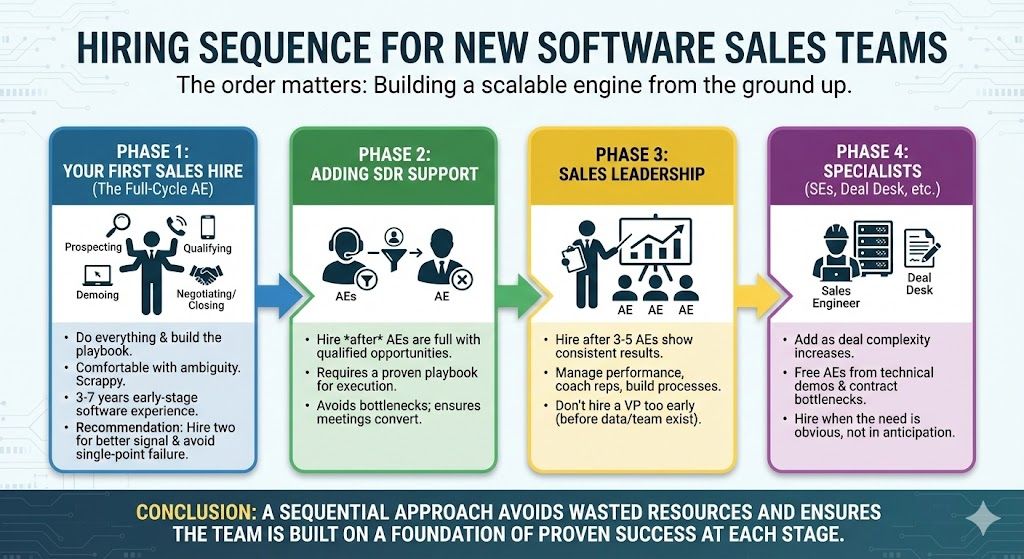
Hiring Sequence for New Software Sales Teams
The order in which you hire matters more than most founders realize. Get it wrong and you’ll have expensive people sitting around waiting for work or junior people struggling without guidance.
Phase 1: Your first sales hire.
Your first sales hire should be someone who can do everything. Prospecting, qualifying, demoing, negotiating, closing. They need to be comfortable with ambiguity because your processes don’t exist yet. They’ll be building the playbook while they sell.
This person should be experienced enough to close deals independently but scrappy enough to thrive without support infrastructure. Look for someone with 3 to 7 years of software sales experience who has worked at early-stage companies before. Someone coming from a large enterprise sales org with established processes often struggles in this environment.
If possible, hire two people in this first phase rather than one. You’ll get more signal on what’s working and what isn’t. You’ll also avoid the problem of building your entire sales motion around one person’s idiosyncratic approach.
Phase 2: Adding SDR support.
Once your AEs have more qualified opportunities than they can handle, it’s time to add SDRs. Not before. Hiring SDRs when your AEs aren’t busy creates a bottleneck in the wrong place. You’ll have meetings being set that never convert because your AEs are still figuring out the sales motion.
SDRs work best when there’s a proven playbook they can execute. If your AEs are still experimenting with messaging, target personas, and qualification criteria, SDRs won’t know what good looks like.
Phase 3: Sales leadership.
Many founders try to hire a VP of Sales too early. This often fails because experienced sales leaders expect to inherit or build a team, not carry a bag themselves. They also expect data, processes, and infrastructure that don’t exist yet.
The right time to hire sales leadership is when you have 3 to 5 AEs producing consistent results. At that point, you need someone to manage performance, coach reps, and build scalable processes. Before that point, the founder or a sales-minded executive should manage the team directly.
Phase 4: Specialists.
Sales engineers, solution consultants, deal desk analysts. These roles become necessary as deal complexity increases. If your AEs are spending 40% of their time on technical demos and implementation scoping, a sales engineer will free them to focus on selling. If contracts are getting stuck in negotiation, deal desk support helps.
Add specialists when the need is obvious, not in anticipation of future scale.
Defining Roles: AE, SDR, SE, and Sales Leadership
Clear role definitions prevent confusion and conflict. Here’s what each role typically owns in a software sales team.
Account Executive (AE). AEs own the sales cycle from qualified opportunity to closed deal. They run demos, manage stakeholder relationships, handle negotiations, and close contracts. In most SaaS sales team structures, AEs are measured primarily on closed revenue and quota attainment.
An experienced AE should be able to manage complex sales cycles with multiple stakeholders and navigate procurement processes independently. Depending on your structure, they may also do their own prospecting or rely on SDRs for pipeline generation.
Sales Development Rep (SDR/BDR). SDRs focus on the top of the funnel. They handle outbound prospecting, respond to inbound leads, qualify opportunities, and book meetings for AEs. They’re measured on activity metrics (calls, emails, meetings booked) and qualified pipeline generated.
The SDR role is often an entry point for people building careers in software sales. When hiring SaaS sales reps at the SDR level, look for coachability, work ethic, and communication skills over experience.
Sales Engineer (SE). SEs provide technical expertise during the sales process. They run technical demos, answer detailed product questions, scope implementation requirements, and help AEs navigate technical objections. SEs typically support multiple AEs and are measured on the deals they support rather than closing directly.
Sales Manager. Frontline sales managers coach reps, run pipeline reviews, forecast accurately, and drive day-to-day performance. They’re responsible for quota attainment across their team and for developing individual contributors. A good sales manager spends most of their time coaching, not doing administrative work.
VP of Sales/Head of Sales. This role owns the entire sales function. They set strategy, build processes, hire the team, and are accountable for overall revenue performance. In early-stage companies, this person may also manage AEs directly. As the team grows, they shift to managing managers.
Director of Sales. This is often a mid-level leadership role between frontline managers and the VP. Not every company needs this layer. It makes sense when you have multiple teams that each have their own manager and need coordination.
Keep your structure as flat as possible in the early days. Layers add communication overhead and slow decision making.
Setting Realistic Timelines for Sales Team Buildout
Building a sales team takes longer than most founders expect. Set realistic timelines and communicate them clearly to investors and stakeholders.
Hiring timeline. Finding a strong sales hire typically takes 60 to 90 days from when you start searching to when an offer is accepted. Add another two weeks for notice periods. If you need someone in seat by Q2, start the search in Q4 of the previous year.
Ramp timeline. New AEs don’t produce at full capacity immediately. Typical ramp periods look like this:
- Month 1 to 2: Learning the product, market, and sales process
- Month 3 to 4: Building pipeline, taking initial meetings
- Month 5 to 6: Working active opportunities, closing first deals
- Month 7 and beyond: Full productivity
For enterprise sales with longer cycles, extend these timelines. A rep selling 9-month deals may not close anything meaningful until month 9 or 10.
Team scaling timeline. A common mistake is trying to double the sales team every quarter. This creates hiring bottlenecks, strains onboarding resources, and dilutes your culture. A sustainable growth rate is adding one to two AEs per quarter for early-stage teams, scaling up as you build hiring and onboarding infrastructure.
Process development timeline. Expect to spend 6 to 12 months developing a repeatable sales motion before you’re ready to scale. During this period, you’re learning what messaging resonates, which personas to target, what objections come up, and what the actual sales cycle looks like. Scaling before this learning is complete means you’ll be training new reps on processes that might change next month.
Don’t promise investors hockey-stick growth if you haven’t built the team and processes to deliver it. Overpromising leads to desperate hiring, which leads to mis-hires, which leads to missed targets.
Working with a Software Recruiting Firm for Team Builds
At some point, most growing software companies benefit from external recruiting help. Understanding when and how to use software recruiting firms helps you get better results.
When external help makes sense:
Speed is critical. If you’ve just closed a funding round and need to build a team quickly to hit milestones, you probably don’t have time to build sourcing infrastructure from scratch. Recruiting firms have existing networks and can surface candidates immediately.
You’re hiring for senior roles. VP of Sales and other leadership searches require discretion and access to passive candidates. Experienced sales leaders aren’t browsing job boards. They respond to recruiters they trust with opportunities worth considering.
Your internal team is at capacity. If your talent acquisition resources are stretched across engineering, product, and other functions, they may not have bandwidth to source sales candidates effectively. Specialized help fills the gap.
You keep making unsuccessful hires. If your sales turnover is high or reps aren’t hitting quota, something in your evaluation process may be broken. External recruiters bring pattern recognition from placing hundreds of candidates and can help you calibrate.
How to work with recruiters effectively:
Be specific about what you need. The more clearly you define the role, target profile, and evaluation criteria, the better candidates you’ll see. Vague briefs produce vague candidate slates.
Provide feedback quickly. When you see candidates, tell your recruiter what’s working and what isn’t. This helps them refine their search and stops them from spending time on profiles that won’t fit.
Move fast on strong candidates. Recruiters are showing good candidates to multiple companies. If you take three weeks to schedule interviews, you’ll lose people to competitors who move faster.
Treat it as a partnership. The best recruiter relationships are collaborative. Share context about your company, culture, and goals. The more they understand, the better they can represent you to candidates.
Common Pitfalls When Building Sales Teams at Software Startups
Watching companies build sales teams over time reveals patterns. These mistakes are common and avoidable.
Hiring a VP of Sales too early. This is probably the most expensive mistake. A strong VP of Sales expects to lead a team, not be the team. Hiring this role before you have product-market fit and a repeatable sales motion usually results in an expensive mis-hire. They’ll want to bring in their own playbook, which may not fit your market. Wait until you have 3 to 5 producing AEs and need someone to build process and scale.
Copying larger companies. The sales structure at Salesforce or HubSpot exists because of their specific market, product, and scale. Copying it when you’re a 20-person startup makes no sense. Build for your current reality, not someone else’s.
Hiring too fast after funding. Investors want to see you deploy capital into growth. But hiring six AEs in one quarter when you’ve never hired sales reps before is a recipe for problems. You won’t onboard them well. Your processes won’t support them. Some will be mis-hires. Start with one or two, learn from the experience, then scale.
Neglecting onboarding. Hiring is only half the equation. Without structured onboarding, even strong hires struggle to ramp. They don’t learn the product deeply enough. They don’t understand the buyer well enough. They don’t know how to navigate internal resources. Invest in onboarding from your very first hire.
Ignoring quota attainment data. If less than half your team is hitting quota, you have a problem. It might be the people you’re hiring. It might be your quotas. It might be your product-market fit. But assuming you can solve it by hiring more people rarely works. Fix the underlying issues before scaling.
Not documenting what works. Your first successful AEs are creating a playbook in their heads. If they leave and you haven’t captured what they learned, you’re starting over. Document winning messaging, common objections, successful discovery questions, and competitive positioning. This documentation becomes your training program.
Underinvesting in sales ops and tools. AEs should spend their time selling, not fighting with CRM data or building their own reports. Even early teams benefit from basic sales infrastructure: a clean CRM setup, automated activity logging, simple dashboards. These investments multiply AE productivity.
Building a startup sales team is one of the highest leverage activities in early-stage companies. Get it right and you’ll have a revenue engine that powers your growth for years. Get it wrong and you’ll burn cash, miss targets, and create organizational debt that takes years to unwind.
Take the time to build intentionally. Hire carefully. Develop processes before you scale. And don’t be afraid to ask for help when you need it.
If you’re building a software sales team and want access to candidates with proven track records in early-stage environments, working with specialists who understand the unique challenges of startup sales hiring can accelerate your progress significantly.
Leave a Reply