


When hiring a SaaS account executive, you need someone who can manage a full sales cycle, build relationships with multiple stakeholders, and consistently hit quota in a metrics-driven environment.
The right AE understands how to sell recurring revenue products, can articulate value in business terms, and thrives in the fast pace of software sales.
But finding that person is harder than it sounds. SaaS sales has specific demands that other sales roles don’t share. The compensation structures are different. The buyer expectations are different. The skills that predict success are different.
This guide covers what makes a good SaaS AE, the experience benchmarks that matter, interview questions that reveal true capability, and the red flags that should make you pause.
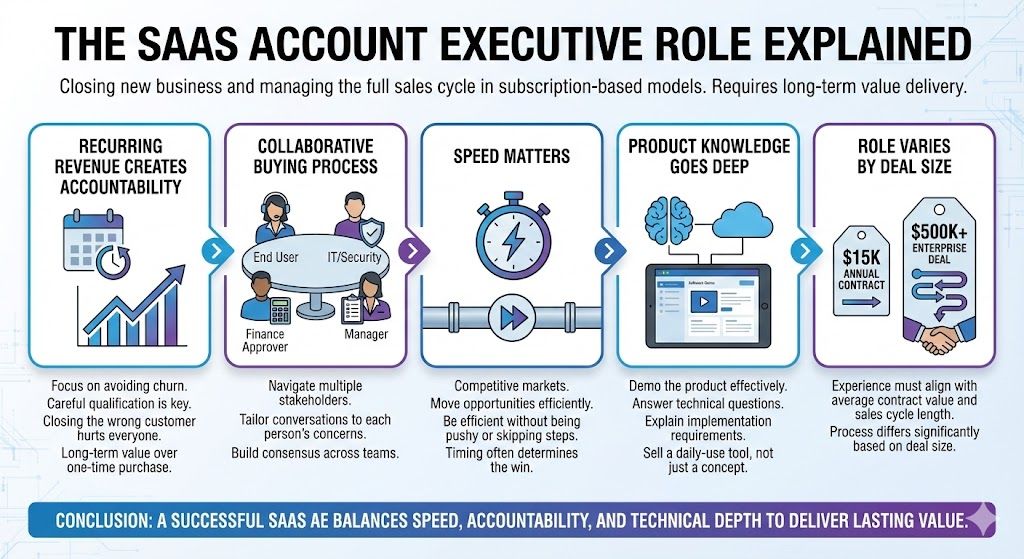
The SaaS Account Executive Role Explained
A SaaS account executive is responsible for closing new business and, in many organizations, managing the full sales cycle from qualified lead to signed contract. Unlike transactional sales roles where the goal is a one-time purchase, SaaS AEs are selling subscriptions that need to deliver ongoing value.
This changes the nature of the job in important ways.
Recurring revenue creates accountability. When customers pay monthly or annually, a bad-fit deal becomes obvious quickly. Churn reflects back on the sales team. The best SaaS AEs qualify prospects carefully because they know that closing the wrong customer hurts everyone.
The buying process is collaborative. SaaS purchases typically involve multiple people. Even for mid-market deals, you’ll often see an end user, a manager, someone from IT or security, and a finance approver. The AE needs to navigate all of these relationships and tailor the conversation to each stakeholder’s concerns.
Speed matters. SaaS companies often operate in competitive markets where timing can determine who wins the deal. AEs need to move opportunities through the pipeline efficiently without being pushy or skipping important steps.
Product knowledge goes deep. SaaS AEs need to demo the product, answer technical questions, and help prospects understand implementation requirements. They’re not just selling a concept. They’re selling something the customer will use every day.
The role varies based on deal size. An AE selling a $15,000 annual contract operates differently than one selling $500,000 enterprise deals. When you’re hiring, make sure the candidate’s experience aligns with your average contract value and sales cycle length.
Essential Skills for SaaS Account Executives
What makes a good SaaS AE? The skills cluster into a few categories that you should evaluate separately.
Discovery and qualification. Strong AEs spend more time asking questions than talking about features. They uncover the prospect’s real problems, understand who else is involved in the decision, and figure out whether this opportunity is worth pursuing. Poor qualification is the root cause of most pipeline problems.
Research from RAIN Group found that 82% of B2B buyers accept meetings with salespeople who reach out to them, but only when the seller provides relevant insights. This means your AEs need to do homework before conversations and bring value from the first interaction.
Value articulation. Features don’t close deals. Business outcomes close deals. A skilled SaaS AE can translate what your product does into what it means for the prospect’s business. They talk about time saved, revenue gained, risk reduced, and problems solved. They connect your solution to the metrics that matter to the buyer.
Pipeline management. SaaS sales hiring often focuses on closing skills, but pipeline discipline matters just as much. Good AEs maintain accurate forecasts, know which deals are real and which are wishful thinking, and prioritize their time toward opportunities most likely to close.
Technical fluency. They don’t need to write code, but they need to understand how your product works and how it integrates with other tools. They should be comfortable discussing APIs, security protocols, and implementation timelines without constantly deferring to technical resources.
Resilience. SaaS sales involves a lot of rejection. Deals fall through. Prospects ghost. Budgets disappear. The AEs who succeed long-term don’t take these setbacks personally. They learn from losses, adjust their approach, and keep building pipeline.
Coachability. This might be the most important skill for AEs who are still developing. Can they take feedback? Do they implement suggestions? Do they ask questions when they’re stuck? An AE with raw talent and high coachability will outperform a polished AE who thinks they have nothing to learn.
Experience Benchmarks for SaaS AE Candidates
How much experience does a SaaS account executive need? It depends on the complexity of your sale.
For SMB and velocity sales (ACV under $25,000): One to three years of SaaS sales experience is typically sufficient. Candidates from SDR or BDR roles who have been promoted to AE often do well here. The emphasis is on volume, efficiency, and consistent execution of a defined sales process.
For mid-market sales (ACV $25,000 to $100,000): Three to five years of experience with a track record of hitting quota. Look for candidates who have managed longer sales cycles, worked with multiple stakeholders, and demonstrated ability to handle more complex deals.
For enterprise sales (ACV over $100,000): Five or more years of experience with documented success in large deal environments. These candidates should have experience with complex enterprise software sales, procurement processes, and extended buying cycles.
Beyond years of experience, look at these benchmarks:
Quota attainment history. Ask for specifics. What was their quota each year? What percentage did they hit? How did they rank against peers? Be skeptical of vague answers. Strong performers know their numbers.
Deal size alignment. Someone who has been closing $10,000 deals will need significant ramp time to succeed at $200,000 deals. The skills don’t transfer automatically. Look for candidates whose historical deal sizes match what you’re asking them to sell.
Sales cycle familiarity. A 30-day sales cycle requires different skills than a 9-month cycle. Make sure candidates have operated in similar timelines.
Industry relevance. This matters more for some products than others. If you’re selling to a highly specialized buyer, industry experience helps. For horizontal SaaS products, transferable sales skills often matter more than vertical expertise.
Interview Questions for SaaS Account Executive Candidates
Generic interview questions get generic answers. Use these questions to dig into how candidates actually operate.
On discovery and qualification:
- Walk me through how you qualify an opportunity in the first two conversations.
- Tell me about a deal you chose not to pursue. Why did you walk away?
- How do you identify who the real decision maker is when you’re getting mixed signals?
On deal management:
- Pick one of your closed deals from the last year. Walk me through every stakeholder involved and how you managed each relationship.
- Tell me about a deal that stalled. What happened and how did you get it moving again?
- How do you prioritize your pipeline when you have more opportunities than time?
On handling adversity:
- Tell me about a quarter where you were behind on quota. What did you do?
- Describe a deal you lost that you thought you were going to win. What happened?
- How do you stay motivated during a tough stretch?
On product and technical knowledge:
- How did you learn the technical aspects of your current product? How long did that take?
- Tell me about a time when a prospect raised a technical objection you couldn’t answer. What did you do?
On process and coachability:
- What’s one piece of feedback from a manager that changed how you sell?
- Walk me through your typical week. How do you structure your time?
- What’s your approach to keeping your CRM data accurate?
Listen for specifics in their answers. Candidates who give vague or theoretical responses may not have the depth of experience they’re claiming. Structured interviews with consistent questions help you compare candidates fairly.
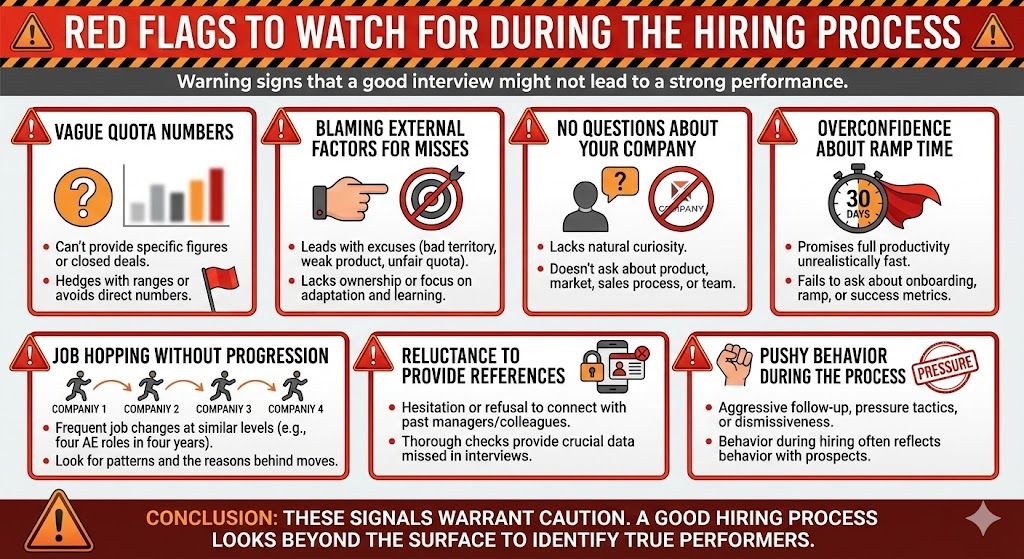
Red Flags to Watch for During the Hiring Process
Not every candidate who interviews well will perform well. Watch for these warning signs.
Vague quota numbers. Strong AEs know exactly what they carried and what they closed. If a candidate can’t give you specific figures or hedges with ranges, dig deeper. Sometimes there’s a good explanation. Often there isn’t.
Blaming external factors for misses. Bad territory. Weak product. Poor leads. Unfair quota. These might all be true. But candidates who lead with excuses rather than what they learned or how they adapted often repeat the pattern.
No questions about your company. Good salespeople are curious. If a candidate doesn’t ask about your product, market position, sales process, or team, they’re either not serious about the opportunity or not naturally curious. Neither is a good sign.
Overconfidence about ramp time. Candidates who promise they’ll be at full productivity in 30 days don’t understand the complexity of SaaS sales hiring. Realistic candidates ask about onboarding, ramp expectations, and how success is measured early on.
Job hopping without progression. Changing companies every year can signal problems. Sometimes there are legitimate reasons. But if someone has had four AE roles in four years at similar levels, ask why. Look for patterns.
Reluctance to provide references. Strong performers have managers and colleagues who will vouch for them. Hesitation around references warrants caution. Thorough reference checks provide data you won’t get from interviews alone.
Pushy behavior during the process. How candidates conduct themselves during the hiring process reflects how they’ll conduct themselves with prospects. Aggressive follow-up, pressure tactics, or dismissiveness toward your team are signals worth taking seriously.
How to Assess Cultural Fit for SaaS Sales Teams
Cultural fit matters, but it’s often assessed poorly. The goal isn’t finding someone you’d want to grab a drink with. It’s finding someone who will thrive in your specific sales environment.
Collaboration vs. competition. Some sales cultures are intensely competitive. Reps fight for leads and celebrate individual wins. Other cultures emphasize team success and knowledge sharing. Neither is wrong, but a mismatch creates friction. Ask candidates what environment they prefer and probe for specifics.
Process adherence. Some organizations run tight ships with defined playbooks, required fields in the CRM, and structured sales stages. Others give reps autonomy to run their own process. A process-oriented rep in a loose environment may feel unmoored. A free spirit in a rigid environment may feel micromanaged.
Tolerance for ambiguity. Early-stage SaaS companies change constantly. Territories shift. Products evolve. Compensation plans get revised. Some reps thrive in this environment. Others need stability. Be honest about where your company falls on this spectrum.
Communication style. How does your team communicate? Slack all day? Minimal interruptions? Weekly pipeline reviews? Daily standups? Make sure candidates understand what to expect and seem comfortable with it.
Manager relationship. Consider how the candidate’s working style aligns with their future manager. A candidate who wants frequent coaching paired with a hands-off manager will struggle. The reverse is also true.
When assessing cultural fit, use scenarios. Imagine you’re working here and your territory gets cut in half because we hired another rep. How would you react? There are no right answers, but the responses reveal how candidates process situations.
Making the Right Hire
SaaS sales hiring is both critical and difficult. The right account executive will build pipeline, close deals, and contribute to a winning sales culture. The wrong one will burn leads, miss quota, and leave within a year.
Take the time to define what you’re actually looking for. Screen for the skills and experience that match your specific sales environment. Ask questions that reveal how candidates have operated in real situations, not just how well they interview.
And move quickly when you find the right person. Strong SaaS AEs have options. If your process drags on for weeks, they’ll accept an offer from someone faster.
If you’re looking for SaaS account executives who can hit the ground running, working with specialists who focus on software sales talent can help you find qualified candidates faster. The right hire is out there. Your job is to find them before your competition does.
Leave a Reply