


CRO recruiting for software companies requires finding an executive who can own the entire revenue function, from lead generation through customer expansion. The right Chief Revenue Officer aligns sales, marketing, and customer success around a unified growth strategy. They bring both strategic vision and operational discipline. Getting this hire wrong sets your company back 12 to 18 months and can cost millions in missed revenue.
The CRO role has become increasingly common in software companies over the past decade. But not every company needs one, and the timing matters enormously. Hiring a CRO too early creates expensive overhead without corresponding value. Hiring too late means struggling with misaligned teams and stalled growth when you need momentum most.
This guide covers when software companies actually need a CRO, what qualifications to prioritize, how to run an effective search, and whether retained or contingency recruiting makes sense for this level of hire.
The Chief Revenue Officer Role in Software Companies
The Chief Revenue Officer is an executive responsible for all revenue-generating activities within an organization. In software companies, this typically means ownership of sales, and often includes marketing, customer success, partnerships, and revenue operations.
The CRO role emerged because traditional organizational structures created silos between functions that should work together. Sales blamed marketing for bad leads. Marketing blamed sales for not following up. Customer success operated independently. Revenue suffered because no one owned the full picture.
A CRO breaks down these silos by creating unified accountability. One executive owns the entire customer journey from first touch through renewal and expansion.
Core CRO responsibilities in software companies:
Revenue strategy. The CRO sets the overall approach to revenue growth. Which markets to prioritize. How to balance new business versus expansion. What the ideal customer profile looks like. How to allocate resources across segments and geographies.
Sales leadership. Even with a VP of Sales reporting to them, the CRO is ultimately accountable for sales performance. They set quotas, approve compensation plans, and ensure the sales organization has what it needs to execute.
Go-to-market alignment. The CRO ensures marketing generates the right pipeline, sales converts it effectively, and customer success retains and expands accounts. When these functions report to different executives with different goals, alignment happens by accident if it happens at all.
Forecasting and accountability. Boards and investors look to the CRO for revenue predictability. They need to forecast accurately, identify risks early, and course-correct when performance deviates from plan.
Team development. CROs build the leadership team beneath them. They hire VPs, develop future executives, and create a culture that attracts and retains top revenue talent.
According to research from SBI Growth, companies with CROs who own both sales and marketing functions achieve 15% to 20% higher revenue growth rates than those with siloed structures. The alignment benefit is real, but only when the CRO has the skills to actually integrate these functions.
When Software Companies Need a CRO
Not every software company needs a CRO. The role makes sense at certain stages and in certain situations. Hiring one at the wrong time creates problems.
Signs you’re ready for a CRO:
You’ve hit $10M to $20M in ARR. Below this threshold, you probably don’t have enough organizational complexity to justify the role. A strong VP of Sales can handle revenue leadership while marketing and customer success report elsewhere. Once you pass $10M to $20M, coordination challenges increase and unified leadership becomes more valuable.
Sales, marketing, and CS are misaligned. If these teams are working at cross purposes, blaming each other for results, or optimizing for metrics that don’t connect, a CRO can create alignment. But only if they have the authority and skill to actually integrate these functions.
You’re preparing for significant scale. If you’ve just raised a growth round and need to double or triple revenue over 18 to 24 months, a CRO who has done this before brings experience you don’t have internally. They can build the systems, processes, and team to execute an aggressive growth plan.
The CEO can’t keep doing it. Many founding CEOs handle revenue leadership themselves in the early stages. They’re the best salesperson, they set marketing direction, they jump on customer calls. This works until it doesn’t. When the CEO’s time becomes the bottleneck, delegating revenue leadership to a CRO frees them to focus on product, fundraising, and company building.
Signs you’re not ready:
You haven’t found product-market fit. A CRO can scale what’s working. They can’t figure out what works in the first place. If you’re still iterating on your product, target market, or sales motion, you need to solve those problems before bringing in revenue leadership.
You don’t have a sales team yet. CROs lead organizations. If you have two AEs and no marketing team, you don’t need a CRO. You need to build a software sales team first. Bring in the CRO once there’s something to lead.
You can’t afford the compensation. CROs at growth-stage software companies typically earn $350,000 to $500,000 or more in total compensation, plus significant equity. If that expense strains your runway, you’re hiring too early.
Your VP of Sales is strong. Sometimes companies hire a CRO because they think they’re supposed to, not because they need one. If your VP of Sales is performing well and can handle expanded responsibilities, consider promoting them or expanding their scope rather than layering a CRO on top.
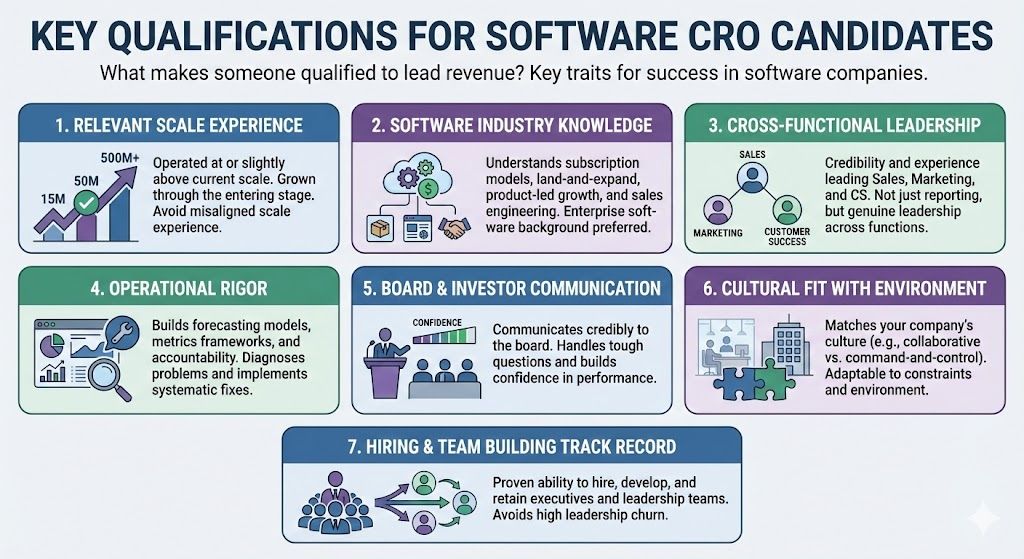
Key Qualifications for Software CRO Candidates
What makes someone qualified to lead revenue at a software company? The answer depends on your specific situation, but certain qualifications matter across contexts.
Relevant scale experience. A CRO who has operated at $50M ARR can probably help you grow from $15M to $50M. A CRO whose entire career has been at $500M+ companies may struggle with the resource constraints and ambiguity of a $15M company. Look for candidates who have operated at or slightly above your current scale and grown through the stage you’re entering.
Software industry knowledge. Software sales, marketing, and customer success have specific dynamics. Subscription revenue models, land-and-expand strategies, product-led growth, sales engineering support. A CRO from a different industry can learn these dynamics, but it takes time. Candidates with enterprise software sales backgrounds already understand the environment.
Cross-functional leadership. If your CRO will own sales, marketing, and customer success, they need credibility and experience with all three. A career VP of Sales can sometimes grow into this, but not always. Look for candidates who have genuinely led multiple functions, not just had them reporting to them nominally.
Operational rigor. CROs need to build forecasting models, establish metrics frameworks, and create accountability systems. They need to diagnose problems quickly and implement fixes systematically. Pure vision without operational capability leads to inspiring strategy that never gets executed.
Board and investor communication. CROs represent revenue performance to the board. They need to communicate credibly, handle tough questions, and build confidence. Candidates who have never presented to a board may struggle with this aspect of the role.
Cultural fit with your environment. A CRO from a command-and-control culture may clash with a collaborative startup. A CRO used to unlimited resources may struggle with constraint. Assess how candidates have operated in environments similar to yours.
Hiring and team building track record. CROs build the leadership team beneath them. Ask about specific executives they’ve hired, developed, and retained. A CRO who churns through VPs every year creates instability you don’t need.
The CRO Search Process for Software Companies
Hiring a CRO is not like hiring an individual contributor. The search process looks different and takes longer.
Define the role clearly. Before you start, document exactly what this CRO will own. Which functions report to them? What are their first-year priorities? What does success look like at 12 and 24 months? What authority will they have over budget, headcount, and strategy? Ambiguity here creates problems later.
Build your candidate profile. Based on your situation, what experience matters most? Write it down. Be specific about must-haves versus nice-to-haves. This profile guides your search and helps you evaluate candidates consistently.
Decide on search approach. CRO searches typically require proactive outreach to candidates who aren’t actively looking. This usually means working with executive recruiters who specialize in software. More on this in the next section.
Plan for a longer timeline. Executive searches take time. Expect 90 to 120 days from search kickoff to accepted offer. Add 30 to 60 days for notice periods. If you need a CRO in seat by Q3, start the search at the beginning of Q1.
Involve the right stakeholders. CRO candidates will want to meet the CEO, board members, and peers they’ll work with. Plan your interview process in advance. Who needs to be involved at each stage? What is each person evaluating? Disorganization at this level signals dysfunction.
The interview process typically includes:
- Initial screen with recruiter or internal HR
- Deep dive with CEO on strategy, experience, and fit
- Sessions with board members or investors
- Meetings with potential direct reports (VP Sales, VP Marketing, etc.)
- Peer conversations with other executives
- Reference checks (both provided and back-channel)
- Final session with CEO and possibly a board member
Sell the opportunity. Strong CRO candidates have options. They’re evaluating you as carefully as you’re evaluating them. Be prepared to articulate why this opportunity is compelling. What’s the market opportunity? What’s the product differentiation? Why is this the right time to join? What will success enable for their career?
Evaluating CRO Candidates: What Boards Should Consider
Boards often participate directly in CRO hiring. Here’s what to evaluate and how.
Track record analysis. What has this person actually accomplished? Dig into specifics. What was the revenue when they joined? When they left? What growth rate did they achieve? How did that compare to market growth? What was the quality of that growth (customer retention, unit economics, etc.)?
Be skeptical of candidates who take credit for tailwinds. Growing revenue 50% in a market that grew 80% is underperformance, not success. Conversely, candidates who maintained growth during market downturns deserve extra credit.
Strategy articulation. Ask candidates to present a 90-day plan. Not a detailed operating plan, but a framework for how they’d approach the role. How would they diagnose current state? What would they prioritize? How would they build relationships with the existing team? Strong candidates think systematically. Weak candidates give generic answers that could apply to any company.
Failure analysis. Ask about things that didn’t work. Every experienced executive has failures. You want to know what happened, what they learned, and how they’ve applied those lessons since. Candidates who can’t discuss failures candidly either lack self-awareness or are hiding something.
Reference depth. For CRO candidates, references matter enormously. Go beyond the provided list. Ask for former direct reports, peers, and board members they’ve worked with. Ask specifically about areas of concern that emerged during interviews. Listen for patterns across multiple references.
Using structured evaluation criteria helps board members assess candidates consistently rather than relying on gut feel.
Compensation expectations. Understand early whether you can afford this person. CRO compensation varies significantly based on company stage, location, and candidate experience. If expectations are misaligned, better to know that before investing weeks in the process.
Red flags to watch for:
- Blaming others for past failures
- Inability to discuss specific numbers and metrics
- Vague descriptions of what they personally contributed versus the team
- Excessive focus on process without results orientation
- Misalignment on company stage or resource constraints
- Poor references from direct reports
- Job tenure pattern of leaving before results become visible
Retained Search vs Contingency for CRO Recruiting
When engaging external help for a CRO search, you’ll typically choose between retained and contingency models. Each has tradeoffs.
Retained search. In this model, you pay the recruiting firm an upfront fee (typically one-third of the total fee), with additional payments at milestones or completion. The firm commits dedicated resources to your search and works exclusively with you on this role.
Advantages of retained search:
- Dedicated consultant attention
- More thorough candidate research and outreach
- Better access to passive candidates who are selective about which opportunities they consider
- Alignment of interests (they’re paid to find the right person, not just any person)
- Appropriate for confidential searches where discretion matters
Disadvantages:
- Higher cost if the search fails or you hire through another channel
- Upfront financial commitment before seeing results
- Process can feel slower because of thoroughness
Contingency search. In this model, you only pay if you hire a candidate the firm presents. There’s no upfront commitment. Multiple firms might work the same search simultaneously.
Advantages of contingency:
- No payment unless successful
- Lower risk if you’re uncertain about the role
- Can work with multiple firms to see different candidate pools
Disadvantages:
- Less dedicated attention since fee isn’t guaranteed
- May see candidates who are actively looking rather than passive talent
- Quality of candidates can be more variable
- Less appropriate for senior, confidential searches
What makes sense for CRO searches?
For most software CRO searches, retained search produces better results. The candidates you want aren’t job hunting. They need to be identified, approached professionally, and sold on the opportunity. That requires dedicated effort that contingency economics don’t support.
The exception might be if you have strong internal networks and just need help with a few specific candidate pools. In that case, a contingency arrangement or internal search might work.
When selecting a firm, look for recruiters with deep software industry experience. A generalist executive search firm may have a good process, but they won’t know the software CRO talent pool the way specialists do. They won’t recognize the names that should be on your target list or have the relationships to get those people on the phone.
Making the Final Decision
After running the process, you’ll hopefully have one or two strong finalists. Here’s how to make the final call.
Revisit your original criteria. Look back at the role definition and candidate profile you created at the start. Which candidate best matches what you said you needed? Sometimes the process leads you to redefine the role. That’s fine, but be intentional about it.
Weight recent performance. What someone did five years ago matters less than what they’ve done recently. Markets change. Skills atrophy. Prioritize evidence from the last two to three years.
Trust references over interviews. Strong candidates interview well. So do candidates who are all polish and no substance. References reveal how someone actually operates day-to-day. When references are lukewarm or raise concerns, take that seriously.
Consider onboarding success factors. Will this person integrate well with your team? Do they have the patience to learn your business before implementing changes? The first 90 days set the trajectory. A candidate who is right on paper but wrong for your culture will struggle to succeed.
Make the decision, then commit. Once you’ve decided, move quickly. Extend the offer, negotiate in good faith, and get the person started. Lingering doubt after a decision often becomes a self-fulfilling prophecy.
Hiring a CRO is one of the most consequential decisions a software company makes. Take the time to get it right. Define what you need. Search thoroughly. Evaluate rigorously. And when you find the right person, set them up to succeed.
If you’re preparing to search for revenue leadership at your software company, working with specialists who understand this specific market can help you reach the right candidates faster and evaluate them more effectively.
Leave a Reply