


Software sales compensation typically combines a base salary with variable pay tied to quota attainment, often expressed as OTE or on-target earnings. For account executive roles, the split usually falls between 50/50 and 60/40 base to variable, though this varies by company stage, deal complexity, and seniority level.
Understanding how these structures work puts you in a much stronger position when evaluating offers and negotiating terms.
Too many candidates focus only on the OTE number without understanding what it actually takes to earn it. They accept offers without asking the right questions and end up surprised when their paychecks don’t match their expectations.
This guide breaks down how software sales compensation really works, what to look for in an offer, and how to negotiate effectively.
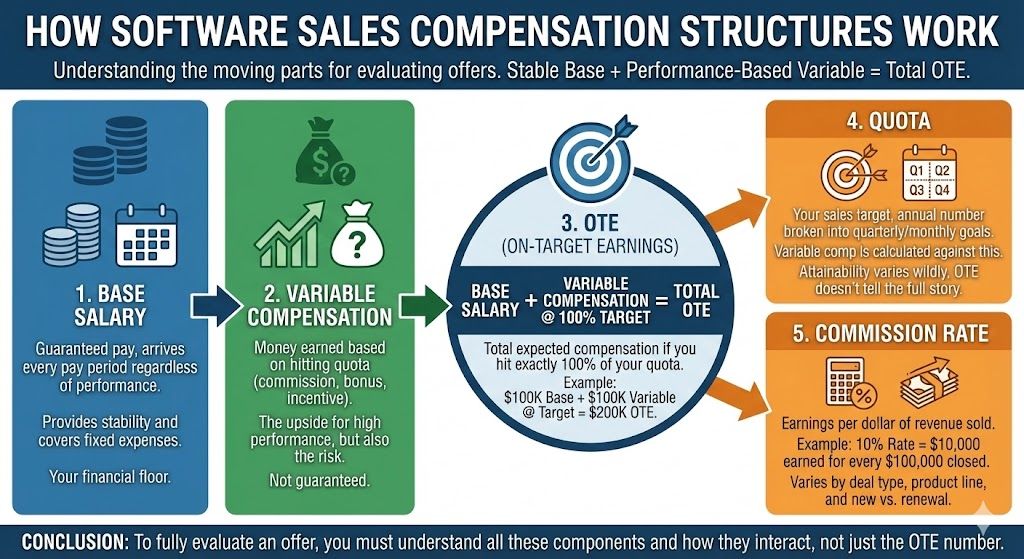
How Software Sales Compensation Structures Work
Software sales compensation has more moving parts than most other roles. Before you can evaluate an offer, you need to understand the components.
Base salary. This is your guaranteed pay regardless of performance. It arrives in your paycheck every pay period whether you close deals or not. Base salary provides stability and covers your fixed expenses.
Variable compensation. This is the money you earn based on hitting quota. It might be called commission, bonus, or incentive pay depending on the company. Variable comp is where the upside lives, but it’s also where the risk sits.
OTE (On-Target Earnings). This is your total expected compensation if you hit 100% of your quota. OTE equals base salary plus variable compensation at target. When a job posting says “$200,000 OTE,” that means you’ll earn $200,000 if you hit exactly 100% of plan.
Quota. This is your sales target, usually expressed as an annual number broken into quarterly or monthly goals. Your variable compensation is calculated based on your performance against quota. Quota attainability varies wildly between companies, which is why OTE alone doesn’t tell you the full story.
Commission rate. This determines how much you earn per dollar of revenue sold. A 10% commission rate means you earn $10,000 for every $100,000 you close. Commission rates vary based on deal type, product line, and whether you’re selling new business or renewals.
According to research from the Alexander Group, variable pay for quota-carrying sales roles typically represents 40% to 60% of total target compensation, with the exact split depending on role complexity and sales cycle length.
Base Salary vs OTE in Software Sales
When evaluating a software sales offer, look at both numbers carefully. They tell you different things about the role and the company’s expectations.
What base salary signals. A higher base relative to OTE suggests the company expects a longer ramp time, a more complex sale, or wants to reduce risk for candidates. Enterprise roles with 9-month sales cycles often have higher base percentages because it takes time to build pipeline and close deals.
A lower base relative to OTE signals a faster sales cycle where reps can start earning commission quickly. It also means more of your compensation depends on performance.
What OTE signals. The OTE number reflects what the company believes a successful rep in this role should earn. But OTE is a target, not a guarantee. The question you need to answer is whether that target is realistic.
Questions to ask about OTE:
- What percentage of the current team hit 100% of quota last year?
- What does the distribution look like? Are most reps clustered around quota, or is there wide variance?
- How long does it typically take for new reps to reach full productivity?
- Has the quota increased from last year? By how much?
If only 20% of the team hits quota, that $250,000 OTE is more fantasy than reality. If 70% of the team hits or exceeds quota, you can plan around that number with more confidence.
The ramp period. Most software sales roles include a ramp period where you receive guaranteed compensation while building pipeline. This might be a full draw against future commissions or a reduced quota for the first two to four quarters. Ask specifically what the ramp structure looks like and what happens if you don’t hit ramp targets.
Understanding Accelerators and Decelerators
The best earning potential in software sales comes from accelerators. These are enhanced commission rates that kick in once you exceed quota.
How accelerators work. Let’s say your base commission rate is 10% up to 100% of quota. Your plan might include an accelerator of 15% for everything between 100% and 150% of quota, and 20% for anything above 150%. This means your marginal earnings increase as you exceed your target.
Accelerators reward top performers disproportionately. A rep who hits 150% of quota doesn’t earn 1.5x their variable comp. They might earn 1.8x or 2x because of accelerated rates on the overachievement.
Why accelerators matter for your evaluation. Companies with aggressive accelerators are signaling that they want to reward top performance. If the accelerator structure is weak or nonexistent, the company either doesn’t expect many reps to exceed quota or doesn’t prioritize rewarding those who do.
Decelerators work in reverse. Some plans reduce your commission rate if you fall below a certain threshold. You might earn 10% commission if you’re at 80% or above, but only 5% if you’re below 80%. Decelerators protect the company but add risk for reps. Ask whether the plan includes decelerators and at what thresholds they apply.
Caps and limits. Some compensation plans cap total earnings or accelerators. A cap might say that regardless of performance, you cannot earn more than 200% of your variable target. Caps limit your upside and can discourage top performers from pushing beyond a certain point. Ask whether any caps exist and where they’re set.
Equity Considerations for Software Sales Roles
Equity compensation is common in software sales, especially at earlier-stage companies. Understanding how equity works helps you evaluate the full picture of an offer.
Stock options. These give you the right to purchase company stock at a set price (the strike price) after they vest. If the company’s value increases above your strike price, your options become valuable. If the company doesn’t grow or goes under, options can be worthless.
RSUs (Restricted Stock Units). These are grants of actual shares that vest over time. Unlike options, RSUs have value as long as the stock has any value at all. RSUs are more common at later-stage and public companies.
Vesting schedules. Equity typically vests over four years with a one-year cliff. This means you receive nothing if you leave before one year, then your equity vests monthly or quarterly over the remaining three years. Some companies offer accelerated vesting or shorter schedules to attract talent.
Questions to ask about equity:
- What is the current 409A valuation or stock price?
- How many total shares are outstanding? (This tells you what percentage of the company your grant represents.)
- What was the valuation at the last funding round?
- What is the vesting schedule, and is there any acceleration on change of control?
How to think about equity value. Early-stage equity is high risk, high reward. The shares might become worth a lot, or they might become worthless. Later-stage or public company equity is lower risk but also lower upside. Don’t discount equity entirely, but don’t count on it as guaranteed income either.
For candidates considering opportunities at different company stages, the mix of cash and equity should reflect your personal risk tolerance and financial situation.
How to Research Compensation Benchmarks
Before negotiating, you need to know what the market actually pays for your role. Several sources can help you build this picture.
Compensation databases. Platforms like Levels.fyi, Glassdoor, Blind, and RepVue aggregate self-reported compensation data. These give you ranges for specific roles at specific companies. The data isn’t perfect, but it provides useful benchmarks.
Recruiter conversations. Recruiters talk to candidates and companies all day. They have real-time visibility into what companies are paying. Even if you’re not actively job searching, conversations with software industry recruiters can help you understand your market value.
Your network. People are often more willing to discuss compensation than you might expect, especially with peers they trust. Ask former colleagues, mentors, and contacts at target companies. Frame it as asking for advice rather than asking for their specific numbers.
Job postings. Some states now require salary ranges in job postings. Even if your state doesn’t, many companies include ranges voluntarily. These ranges tend to be wide, but they tell you the band the company is working within.
What to benchmark against:
- Role type (SDR, AE, Enterprise AE, Manager)
- Geography (compensation varies significantly by region)
- Company stage (seed, Series A, growth, public)
- Deal complexity and average contract value
- Your years of relevant experience
When you have a clear sense of the market, you can evaluate whether an offer is competitive and identify which elements have room for negotiation.
Negotiation Strategies for Software Sales Offers
You’re in sales. Negotiating your own compensation is a chance to demonstrate the skills you’ll use every day on the job. Companies expect you to negotiate. Don’t leave money on the table.
Negotiate after you have the offer. Don’t discuss specific compensation expectations until you have a written offer. Once they’ve decided they want you, you have more leverage. Before that, giving a number can anchor the conversation too low or screen you out unnecessarily.
Lead with enthusiasm, then negotiate. Express genuine excitement about the opportunity before raising concerns or asking for changes. This isn’t manipulation. It’s acknowledging that negotiation happens between two parties who want to work together.
Know your priorities. Decide in advance what matters most to you. Is it base salary? OTE? Equity? Title? Ramp structure? You probably won’t get everything you ask for. Knowing your priorities helps you make tradeoffs.
Ask questions before making demands. Instead of saying “I need a higher base,” try “Can you help me understand how you arrived at this base salary? Is there flexibility there?” Questions invite dialogue rather than creating positional standoffs.
Use competing offers carefully. If you have another offer, you can reference it. But don’t bluff. If you claim to have an offer you don’t have, or inflate the numbers, you risk damaging trust before you’ve even started. Be honest about your situation.
Consider the full package. Sometimes companies have less flexibility on base salary but can improve other elements. Additional equity, a signing bonus, a better ramp structure, or accelerated review timelines can add significant value even if the base stays flat.
Get it in writing. Verbal agreements mean nothing if they don’t show up in your offer letter. Any changes negotiated should be reflected in the written offer before you accept.
Things you can negotiate:
- Base salary
- Variable compensation or commission rate
- OTE
- Signing bonus
- Equity grant
- Vesting schedule
- Ramp structure and duration
- Start date
- Title
- PTO or other benefits
Don’t negotiate every single element. Pick the two or three things that matter most and focus your energy there.
What Happens After You Accept
Your negotiation doesn’t end when you sign the offer letter. Several things happen next that affect your actual earnings.
Understand your plan document. Most companies provide a formal sales compensation plan document. Read it carefully. Make sure it matches what was discussed in your offer conversations. Ask questions about anything unclear before your start date.
Track your own numbers. Don’t rely solely on the company’s systems to track your performance and commissions. Keep your own records of deals closed, commission earned, and payments received. Discrepancies happen, and catching them early is easier than sorting them out months later.
Know when plans change. Sales compensation plans often change annually. Quotas typically increase year over year. Commission rates may adjust. Accelerators may shift. Ask when plan changes typically happen and how they’re communicated.
Stay close to your attainment. Monitor your quota attainment throughout the year. If you’re falling behind, you need to know early so you can adjust. If you’re ahead, you can strategize about how to maximize accelerators. Surprises in either direction should be rare if you’re tracking closely.
Building a successful career in software sales means understanding compensation as a system, not just a number. The candidates who earn the most over time are the ones who understand how their pay works and make smart decisions about which opportunities to pursue.
If you’re exploring new software sales opportunities, take the time to understand the full compensation picture before accepting. And if you’re looking for ways to accelerate your career growth once you’re in the door, developing the right habits matters as much as hitting quota.
Your compensation reflects the value you create. Understanding how these structures work puts you in control of your earning potential.
Leave a Reply