


Every software startup begins with founder-led sales. You built the product, you understand the problem better than anyone, and early customers often buy because of your passion and vision. But at some point, you need to hand off the sales function to focus on other priorities. The challenge is that this transition has an exceptionally high failure rate.
According to First Round Review, the batting average for making a successful first sales hire is especially low, with sub-one-year tenures being ridiculously common. Getting this transition wrong can set your company back six months or more, burn through cash, and damage momentum at a critical growth stage.
Here’s how to navigate the transition from founder-led sales to your first sales hire successfully.
Why Founder-Led Sales Works Early On
Before discussing the transition, it’s worth understanding why founders should lead sales in the first place.
Deep product knowledge. No one understands what you built and why better than you. You can answer technical questions, pivot the conversation based on feedback, and make product commitments that employees can’t.
Credibility and authority. Decision-makers often want to talk to the person who built the product. Your title carries weight that a sales rep simply doesn’t have in early conversations.
Real-time learning. Every sales conversation teaches you something about your market, your messaging, and your product. That feedback loop is invaluable for refining product-market fit.
Flexibility and speed. You can adjust pricing, modify the product roadmap, or customize solutions on the spot. A sales hire needs to check with you first.
Passion that sells. Early customers often buy into your vision as much as your product. That authentic enthusiasm is hard to replicate.
The goal isn’t to escape founder-led sales as quickly as possible. It’s to stay in it long enough to build the foundation that makes your first sales hire successful.
Signs You’re Ready to Make the Transition
Timing matters enormously. Hire too early and your sales rep will flounder without a proven playbook. Wait too long and you’ll become the bottleneck limiting your company’s growth.
You have a repeatable sales process. You’ve closed enough deals to see patterns. Similar customers buy for similar reasons through a similar process. If every deal feels completely different, you’re not ready.
You know your ideal customer profile. You can clearly articulate who buys, why they buy, what problems they’re solving, and what their buying process looks like.
You’ve documented your approach. You have at least a basic playbook covering your pitch, common objections, competitive positioning, and deal stages. It doesn’t need to be perfect, but it needs to exist.
Your win rate is reasonable. A common benchmark is at least a 20% win rate on qualified opportunities. If you can’t close deals yourself, a sales hire won’t magically do better.
You’re turning down opportunities. You have more leads than you can handle, or you’re sacrificing other critical work to manage sales conversations.
You’ve done enough reps. Some experts suggest completing at least 50 sales demos before hiring. The exact number matters less than having enough experience to teach someone else your approach.
If you’re still figuring out who buys and why, you’re not ready. If you’ve proven the model but can’t scale it yourself, you’re in the right zone.
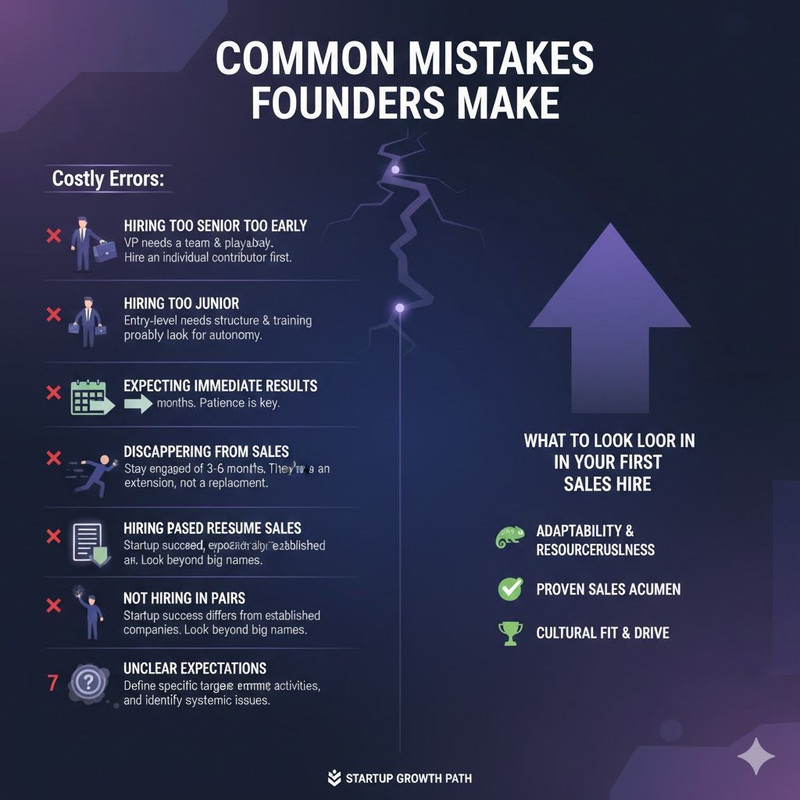
Common Mistakes Founders Make
The transition from founder-led sales is littered with costly errors. Avoid these common pitfalls:
Hiring too senior too early. A VP of Sales needs a team to manage and a proven playbook to scale. If you hire a sales leader before you have either, they’ll struggle to add value. Your first hire is typically an individual contributor who can sell, not a leader who manages.
Hiring too junior. On the flip side, an entry-level SDR needs structure, training, and management that you probably don’t have time to provide. Look for someone experienced enough to operate with some autonomy.
Expecting immediate results. Even great sales hires need time to learn your product, market, and process. Expect a ramp period of three to six months before they’re fully productive.
Disappearing from sales entirely. Your first sales hire isn’t a replacement for founder involvement. They’re an extension of it. Plan to stay engaged in deals, especially early on.
Hiring based on resume alone. A track record at established companies doesn’t guarantee startup success. Someone who sold for Salesforce may struggle without brand recognition, mature processes, and abundant resources.
Not hiring in pairs. If possible, hire two reps instead of one. This lets you compare performance, identify what works, and determine whether problems are individual or systemic.
Unclear expectations. Vague goals like “grow revenue” set everyone up for failure. Define specific targets, activities, and milestones from the start.
What to Look for in Your First Sales Hire
Your first sales hire is a unique role that requires a specific profile. They need to succeed in ambiguity while building the foundation for future hires.
Startup experience or mindset. They should be comfortable without established processes, brand recognition, or extensive support. Ask about their experience in unstructured environments and how they’ve built things from scratch.
Adaptability and learning agility. Your product, market, and process will evolve. They need to adapt quickly and provide feedback that helps you improve.
Self-sufficiency. They should be able to generate their own pipeline, manage their own deals, and solve problems without constant direction.
Documentation habits. Your first hire sets the foundation for your sales organization. Look for someone who naturally documents what works, what doesn’t, and why.
Coachability. They need to learn your product and approach quickly, which requires openness to feedback and willingness to adjust.
Reasonable expectations. Candidates who understand startup realities will ramp faster than those expecting enterprise-level resources and support.
Culture fit. Your first sales hire represents your company to the market and sets the tone for future sales team culture. Values alignment matters.
The ideal profile is often someone with three to seven years of experience who has worked at least one early-stage company. They’re experienced enough to execute but not so senior that they can’t get their hands dirty.
Structuring the Interview Process
Standard sales interviews often fail to reveal startup readiness. Use these approaches to evaluate candidates effectively:
Probe for ambiguity tolerance. Ask about times they’ve had to figure things out without clear direction. How did they approach it? What did they learn? Candidates who need structure to succeed will struggle.
Test for self-sourcing ability. Ask how they’ve built pipeline in the past. What percentage came from inbound versus their own outbound efforts? At an early stage, they’ll likely need to generate their own opportunities.
Explore their questions. Great candidates ask thoughtful questions about your product, market, customers, and sales process. Poor questions or lack of curiosity is a red flag.
Request a mock pitch. Give them basic information about your product and have them pitch you. This reveals their ability to learn quickly and communicate clearly.
Assign practical work. Consider an account planning exercise or prospecting assignment. See how they approach unfamiliar situations and present their thinking.
Check references carefully. Talk to previous managers about their performance in ambiguous situations, their documentation habits, and their coachability.
For more on structuring effective sales interviews, see our guide on building an interview process for sales candidates.
Compensation for First Sales Hires
Your first sales hire is taking a risk by joining an early-stage company. Compensation should reflect that reality.
Competitive base salary. Don’t try to underpay on base and make it up with variable. Good candidates have options and won’t accept below-market base compensation.
Reasonable OTE. Total on-target earnings should be competitive for your market and stage. A typical split is 50/50 base to variable, though some early-stage companies weight slightly toward base given pipeline uncertainty.
Achievable quotas. Nothing kills motivation faster than unattainable targets. Set quotas based on your own performance as a founder, adjusted for ramp time and the fact that they lack your credibility.
Meaningful equity. Early sales hires are taking startup risk. Give them equity that reflects their contribution to building the sales function. Consider 2-3x what you’d give a sales hire later.
Clear path to growth. Top candidates want to know where the role can lead. Be honest about growth opportunities as the company scales.
For current benchmarks on sales compensation, review our guide on designing sales compensation plans.
Onboarding Your First Sales Hire
How you onboard your first sales hire significantly impacts their success. Invest time upfront to accelerate their ramp.
Start with product immersion. Consider having them spend time with product, support, or customer success before jumping into sales. Deep product understanding pays dividends in customer conversations.
Shadow your sales process. Have them observe your sales calls and deal management. Let them see how you handle objections, position against competitors, and close deals.
Document as you go. Use their onboarding as an opportunity to formalize your playbook. Have them document what they’re learning as they learn it.
Start with warm opportunities. Give them inbound leads or existing relationships to work initially. Cold outbound can come once they’ve internalized your pitch and process.
Stay involved in deals. Join their early calls, provide feedback, and help close deals alongside them. Gradually reduce your involvement as they demonstrate competence.
Set clear milestones. Define what success looks like at 30, 60, and 90 days. Regular check-ins against these milestones help identify and address issues early.
For more comprehensive onboarding guidance, see our article on building an effective sales onboarding program.
Your Evolving Role
Hiring your first sales rep doesn’t mean you’re done with sales. Your role evolves rather than disappears.
Strategic deals. Continue to engage in larger opportunities, strategic accounts, or deals where founder credibility matters.
Coaching and support. Help your sales hire improve through regular one-on-ones, call reviews, and deal strategy sessions.
Product feedback loop. Stay connected to customer conversations to ensure product development stays aligned with market needs.
Sales enablement. Provide the content, competitive intelligence, and tools your sales hire needs to succeed.
Thought leadership. Use your founder platform to generate awareness and inbound interest that supports the sales function.
The goal is to shift from doing all the sales to enabling and supporting someone else to do most of it while staying engaged where you add unique value.
When to Hire Sales Leadership
After your first individual contributors prove successful, you may consider hiring sales leadership. The timing depends on several factors:
Two or more reps hitting quota. You need proven performance before bringing in someone to manage and scale the team.
Clear playbook to replicate. A sales leader should scale what works, not figure out what works from scratch.
Capacity to hire more reps. Sales leadership makes sense when you’re ready to grow the team significantly.
Founder bandwidth constraints. If managing the sales function is taking too much time from other priorities, leadership can help.
Don’t rush to hire a VP of Sales. Many companies do better with individual contributor hires managed directly by a founder until they reach meaningful scale.
Finding the Right First Hire
Sourcing your first sales hire can be challenging. They need startup DNA, relevant experience, and willingness to take a risk on an early-stage company.
Your network. Referrals often produce the best candidates. Ask investors, advisors, and other founders for recommendations.
Startup-focused job boards. Platforms that cater to startup talent often attract candidates with the right mindset.
Former colleagues. People you’ve worked with before reduce hiring risk since you know their capabilities and work style.
Recruiting partners. For specialized searches or when speed matters, working with a software recruiting firm can help access qualified candidates who might not be actively looking.
The Bottom Line
Transitioning from founder-led sales is one of the highest-stakes hiring decisions you’ll make. Get it right and you unlock scalable growth. Get it wrong and you lose months of momentum and burn precious resources.
Wait until you have a repeatable process, hire for startup readiness over pedigree, invest in thorough onboarding, and stay engaged as your role evolves. Your first sales hire isn’t replacing you. They’re extending what you’ve built into a scalable sales function that can grow with your company.
Leave a Reply