


Sales enablement has evolved from a nice-to-have support function into a strategic capability that directly impacts revenue. The data is compelling: according to Qwilr research, organizations implementing sales enablement strategies achieve a 49% win rate on forecasted deals compared to 43% for organizations without such strategies. Companies with effective sales training programs see 84% of sales reps achieving quota.
For software companies, where products are complex, markets evolve quickly, and sales cycles can be lengthy, strong enablement is essential. The right sales enablement hire can reduce ramp time for new reps, improve win rates across the team, and create sustainable systems for ongoing performance improvement.
Here’s how to hire sales enablement managers who can actually move the needle.
What Sales Enablement Managers Actually Do
Before hiring, understand the scope of modern sales enablement. The role has expanded significantly beyond its origins in training and content creation.
Onboarding and training. Designing and delivering programs that help new hires ramp to productivity faster. This includes product training, sales methodology, tool proficiency, and company knowledge.
Content creation and management. Developing, organizing, and maintaining sales content including presentations, battle cards, case studies, objection handling guides, and competitive intelligence.
Sales process optimization. Working with sales leadership to refine processes, identify bottlenecks, and implement improvements that increase efficiency and effectiveness.
Tool and technology enablement. Ensuring sales teams can effectively use CRM, sales engagement platforms, and other tools. This includes training, documentation, and adoption tracking.
Coaching support. Providing coaching resources, frameworks, and sometimes direct coaching to help managers develop their teams.
Performance analysis. Using data to identify skill gaps, content effectiveness, and areas for improvement. Translating insights into actionable programs.
Cross-functional coordination. Working with marketing, product, and customer success to ensure alignment and that sales has what they need to succeed.
The best sales enablement professionals operate as strategic partners to sales leadership, not just training administrators. They understand the business, know what drives sales success, and build programs that address real performance gaps.
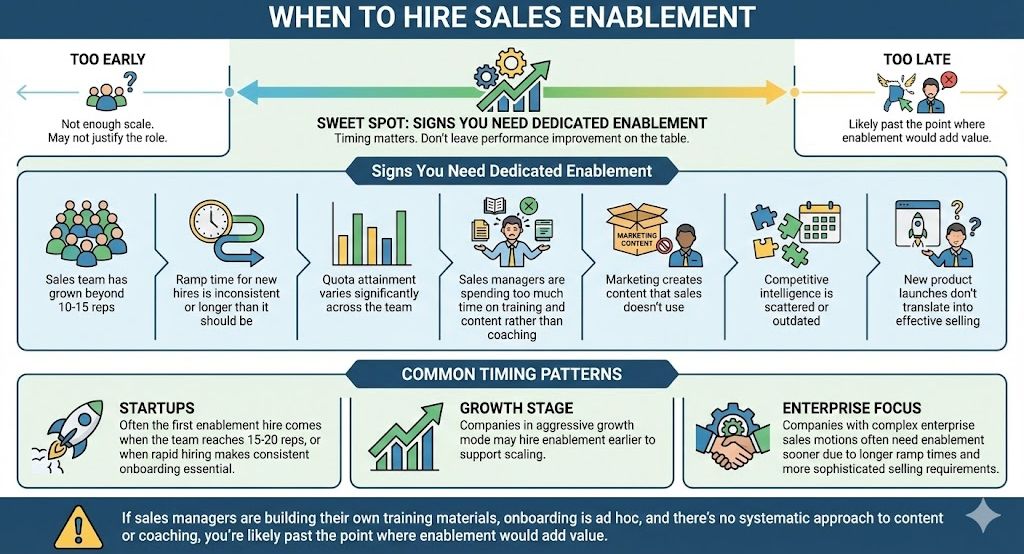
When to Hire Sales Enablement
Timing matters for sales enablement hires. Too early and you may not have enough scale to justify the role. Too late and you’re leaving performance improvement on the table.
Signs you need dedicated enablement:
- Your sales team has grown beyond 10-15 reps
- Ramp time for new hires is inconsistent or longer than it should be
- Quota attainment varies significantly across the team
- Sales managers are spending too much time on training and content rather than coaching
- Marketing creates content that sales doesn’t use
- Competitive intelligence is scattered or outdated
- New product launches don’t translate into effective selling
Common timing patterns:
- Startups. Often the first enablement hire comes when the team reaches 15-20 reps, or when rapid hiring makes consistent onboarding essential.
- Growth stage. Companies in aggressive growth mode may hire enablement earlier to support scaling.
- Enterprise focus. Companies with complex enterprise sales motions often need enablement sooner due to longer ramp times and more sophisticated selling requirements.
If sales managers are building their own training materials, onboarding is ad hoc, and there’s no systematic approach to content or coaching, you’re likely past the point where enablement would add value.
What to Look for in Candidates
Sales enablement requires a unique blend of skills. Great enablement professionals combine sales knowledge, training expertise, content capability, and strategic thinking.
Sales experience or deep sales understanding. They need credibility with the sales team. Candidates who’ve carried a bag themselves often have an advantage, though strong enablement experience can compensate.
Instructional design capability. They must know how to structure learning experiences that actually change behavior. This goes beyond creating slide decks to understanding adult learning principles.
Content creation skills. Strong writing, presentation design, and the ability to distill complex information into usable resources.
Analytical thinking. Enablement should be data-driven. Look for candidates who can measure program effectiveness and tie their work to business outcomes.
Cross-functional collaboration. They’ll work with sales, marketing, product, and leadership. They need to navigate different stakeholders and build relationships across the organization.
Technology proficiency. Modern enablement involves CRM, learning management systems, content platforms, and sales tools. They should be comfortable with technology.
Project management. Enablement involves managing multiple programs simultaneously. Strong organizational skills and the ability to drive initiatives to completion matter.
Communication skills. They need to present confidently to sales teams and executives, write clearly, and facilitate effective training sessions.
Interview Tactics for Enablement Candidates
Standard interviews often fail to reveal enablement capability. Use these approaches to evaluate candidates effectively:
Request portfolio examples. Ask candidates to share training programs, content pieces, or onboarding materials they’ve created. Review the quality, clarity, and practical utility of their work.
Present a scenario. Give candidates a realistic enablement challenge, such as reducing ramp time from six months to four months or improving win rates against a specific competitor. Have them walk through their approach.
Probe for data orientation. Ask how they’ve measured the effectiveness of past programs. What metrics did they track? How did they demonstrate ROI? Candidates who can’t articulate how they measure success may not be rigorous enough.
Test sales knowledge. Ask questions that reveal their understanding of sales processes, methodologies, and challenges. Enablement professionals who don’t understand sales struggle to create relevant programs.
Assess stakeholder management. Ask about times they’ve had to influence without authority or navigate competing priorities across departments. This reveals their collaborative capability.
Check facilitation ability. If possible, have candidates deliver a short training segment. Observe their presence, engagement techniques, and ability to handle questions.
Red Flags to Watch For
Several warning signs suggest a candidate may struggle in enablement:
- No measurable outcomes. If they can’t point to specific results from their programs, they may not be rigorous about effectiveness.
- Training-only focus. Candidates who only think about classroom training may miss the broader scope of modern enablement.
- Disconnection from sales reality. If their examples feel theoretical or disconnected from actual selling challenges, they may struggle to gain credibility with reps.
- Resistance to technology. Modern enablement is technology-enabled. Candidates uncomfortable with tools will be limited.
- Content without strategy. Creating lots of content isn’t the same as creating the right content. Look for strategic thinking about what sales actually needs.
- Inability to prioritize. Enablement teams often have more requests than resources. Candidates who can’t articulate how they prioritize may get pulled in too many directions.
Compensation Considerations
Sales enablement compensation varies based on scope, experience, and company stage:
Individual contributor enablement specialists typically earn $70,000-$120,000 base salary depending on experience and market.
Sales enablement managers leading programs or small teams typically earn $100,000-$150,000 base salary.
Directors or heads of enablement overseeing the function typically earn $140,000-$200,000 or more at larger organizations.
Most enablement roles are primarily base salary with smaller bonus components, unlike quota-carrying sales roles. Some companies tie a portion of compensation to sales team performance metrics, creating alignment with the outcomes enablement is meant to drive.
Review current software sales compensation data to ensure your enablement compensation is competitive relative to your overall sales organization.
Where to Find Enablement Talent
Sales enablement professionals come from several backgrounds:
- Other software companies. Candidates with SaaS enablement experience understand the unique challenges of software selling.
- Sales backgrounds. Former reps or managers who’ve moved into enablement bring selling credibility and practical understanding.
- Corporate training. Learning and development professionals can bring strong instructional design skills, though they may need to develop sales-specific knowledge.
- Marketing. Content marketers sometimes transition into enablement, bringing strong content skills.
- Consulting. Sales consulting or training firms produce candidates with broad exposure to different methodologies and companies.
For specialized enablement roles or when you need specific industry or methodology experience, working with a software recruiting firm can help access candidates with relevant backgrounds.
Setting Enablement Up for Success
Hiring is only the beginning. Enablement professionals need proper support to succeed:
Clear scope and authority. Define what enablement owns versus what sales leadership owns. Ambiguity creates confusion and limits effectiveness.
Executive sponsorship. Enablement recommendations often require changes from sales teams. Leadership support is essential for driving adoption.
Access to data. Enablement needs visibility into sales performance data, CRM activity, and other metrics to identify gaps and measure impact.
Budget for tools and resources. Effective enablement often requires learning management systems, content platforms, and other technology. Underinvesting in tools limits what enablement can accomplish.
Partnership with sales leadership. Enablement works best when tightly connected with sales managers and VP/Director level leadership. Create structures for regular collaboration.
Realistic expectations. Enablement impact takes time. Set expectations for what can be accomplished in the first 90 days versus the first year.
Building the Enablement Function
As your company grows, sales enablement often evolves from a single person to a team:
First hire. Typically a generalist who handles onboarding, content, and training across the board.
Second phase. May add specialists for content, training, or specific segments like enterprise versus SMB.
Mature function. Larger organizations may have enablement teams of 4-10 or more people with specialized roles for content strategy, learning development, sales tools, and coaching.
The average sales enablement team at Cloud 100 companies is four people. Scale your team based on the size of your sales organization, complexity of your products, and pace of change in your market.
If you’re building a sales team from scratch, consider when enablement should enter the picture as part of your overall hiring roadmap.
The Bottom Line
Sales enablement has become essential for software companies that want their sales teams to perform at their best. The right enablement hire brings structure to onboarding, ensures reps have the content and tools they need, and creates systems for continuous improvement.
Take time to find candidates with the right blend of sales understanding, instructional capability, and strategic thinking. Set them up with clear scope, executive support, and the resources they need. Measure their impact and invest in growing the function as your sales team scales.
Done well, sales enablement is a force multiplier that makes every seller on your team more effective. The investment in this capability pays dividends across your entire sales organization.
Leave a Reply