


Getting sales compensation right is one of the most important decisions a software company makes. Pay too little and you lose talent to competitors. Pay too much without proper structure and you erode margins while potentially rewarding the wrong behaviors. Get the balance right and compensation becomes a powerful tool for attracting talent, driving performance, and aligning your team with business goals.
The fundamentals are straightforward: combine base salary with variable compensation tied to quota attainment, then add accelerators for overperformance. But the details matter enormously, and software companies have unique considerations around deal structures, sales cycles, and recurring revenue models.
According to The Bridge Group’s 2024 SaaS AE Metrics Report, median annual on-target earnings for SaaS account executives reached $190,000 with a 53:47 base-to-variable split, up from $167,000 in 2022. OTEs have risen at more than 5% compounded annually over the past decade, reflecting the competition for sales talent in software.
Here’s how to design compensation plans that work.
Understanding On-Target Earnings
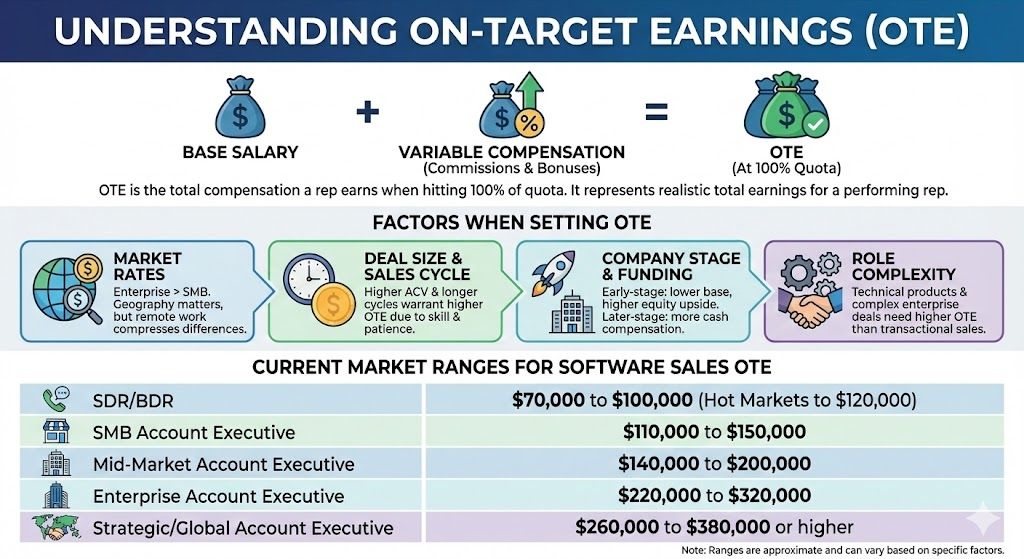
On-target earnings (OTE) is the total compensation a rep earns when hitting 100% of quota. It combines base salary and variable compensation (commissions and bonuses). OTE is the number that matters most when recruiting because it represents realistic total earnings for a performing rep.
When setting OTE, consider several factors:
Market rates for your segment. Enterprise reps command higher OTE than SMB reps. Geographic location still matters, though remote work has compressed some regional differences.
Your average deal size and sales cycle. Higher ACV deals with longer cycles typically warrant higher OTE because the role requires more skill and patience.
Company stage and funding. Early-stage startups may offer lower base with higher upside potential through equity. Later-stage companies typically pay more cash compensation.
Role complexity. Reps selling technical products to sophisticated buyers or managing complex enterprise deals need higher compensation than those running transactional sales motions.
Current market ranges for software sales OTE:
- SDR/BDR: $70,000 to $100,000, with hot markets reaching $120,000
- SMB Account Executive: $110,000 to $150,000
- Mid-Market Account Executive: $140,000 to $200,000
- Enterprise Account Executive: $220,000 to $320,000
- Strategic/Global Account Executive: $260,000 to $380,000 or higher
The Base and Variable Split
The ratio between base salary and variable compensation signals what kind of performance culture you’re building. A higher base provides stability and attracts risk-averse candidates. A higher variable component attracts competitive sellers confident in their abilities.
Common splits in software sales:
50/50 split. Standard for many SaaS account executive roles. Provides balance between stability and performance incentive.
60/40 split (60% base, 40% variable). More conservative, often used for longer enterprise sales cycles where reps need financial stability during extended deal timelines.
40/60 split (40% base, 60% variable). More aggressive, typically seen in transactional sales or roles with shorter cycles where reps can directly control outcomes.
The Bridge Group data shows the current median split at 53:47 for SaaS AEs. SDRs typically have higher base percentages (often 60-70% base) since their output is more activity-driven and less directly tied to revenue.
When choosing your split, consider your sales cycle length. Reps selling deals that take 9-12 months to close need higher bases to stay motivated and financially stable during long periods without commission checks.
Setting Quotas That Work
Quota is the performance target reps need to hit to earn their full variable compensation. Setting quota wrong undermines everything else in your comp plan.
The quota-to-OTE ratio. This measures how much revenue you expect per dollar of OTE. The current median ratio is approximately 4.2x, meaning for every $100,000 in OTE, you’re expecting roughly $420,000 in quota. Typical ranges fall between 3.2x and 4.8x depending on deal size and sales efficiency.
Quota should be achievable. If less than 50% of your team hits quota, your quotas are likely too aggressive. This demotivates reps and signals to candidates that OTE isn’t realistic. Aim for 60-70% of ramped reps hitting quota in a healthy sales organization.
Consider deal size when setting quota. Reps selling $25,000 ACV deals will have different quotas than those selling $250,000 ACV deals. Higher ACV typically means fewer deals but larger individual transactions.
Account for ramp time. New reps need reduced quotas during their ramp period. A typical approach is 25% quota in month one, 50% in month two, 75% in month three, then full quota from month four onward. Adjust based on your actual sales cycle and product complexity.
Commission Structures and Rates
Commission is the variable pay reps earn based on revenue they bring in. Several structures work in software sales:
Flat commission rate. Reps earn a consistent percentage on all deals. Simple to understand and administer. The median commission rate at 100% quota attainment is 11.5% of annual contract value, with typical rates ranging from 11% to 14%.
Tiered commissions with accelerators. Reps earn a base rate up to quota, then higher rates (accelerators) for deals beyond quota. For example, 10% up to quota, 15% from 100-150% of quota, 20% above 150%. This rewards top performers and creates strong incentive to exceed targets.
Decelerators below quota. Some plans reduce commission rates for reps significantly below quota. This is controversial and can demotivate struggling reps further. Use cautiously.
Multipliers for strategic priorities. Higher rates for new logo acquisition versus expansion, for multi-year deals, or for specific products you want to push. These align rep behavior with company priorities.
Compensation for Different Roles
Different sales roles require different compensation approaches:
SDRs/BDRs. Typically paid on meetings booked or qualified opportunities created rather than closed revenue. Common structures include per-meeting bonuses ($50-$200 per qualified meeting) or monthly/quarterly bonuses tied to opportunity targets. Base salary averages around $57,000 with OTE in the $70,000-$100,000 range.
Account Executives. Paid primarily on closed revenue with the structures described above. Base salary for AEs averages around $100,000, with significant variation by segment and geography.
Sales Engineers. Often have lower variable components (70/30 or 80/20 splits) since they support deals rather than own them directly. May be paid on team quota attainment or have smaller individual commission components. OTE typically ranges from $160,000 to $230,000.
Customer Success Managers. If carrying expansion or renewal targets, may have 70/30 or 80/20 splits with variable tied to net revenue retention, upsells, or renewals. Pure retention-focused CSMs may be all base salary.
Sales Managers. Paid on team performance rather than individual deals. Variable typically tied to team quota attainment, often with accelerators when the team exceeds targets. OTE ranges from $200,000 to $280,000 for first-line managers.
For detailed guidance on what candidates should expect, see our overview of software sales compensation from the candidate perspective.
Common Mistakes to Avoid
Several compensation design errors undermine sales performance:
Overly complex plans. If reps can’t calculate their expected commission on a deal, the plan isn’t motivating behavior. Keep it simple enough that reps understand exactly how they’re rewarded.
Changing plans mid-year. Nothing destroys trust faster than changing compensation after reps have built pipeline based on existing terms. Make changes at natural breakpoints and grandfather deals already in progress.
Capped commissions. Putting a ceiling on earnings tells top performers you don’t want them to exceed expectations. Uncapped plans with strong accelerators attract and retain your best people.
Misaligned incentives. If you want reps to sell multi-year deals but pay the same commission as annual deals, you’re sending mixed signals. Ensure your comp plan rewards the behaviors you actually want.
Ignoring quota attainment data. If only 20% of your team hits quota, the problem is likely your quotas or your enablement, not your people. Use attainment data to calibrate realistic targets.
Delayed commission payments. Reps are motivated by timely rewards. Monthly commission payments tied to monthly closes work better than quarterly payouts that feel disconnected from daily effort.
Building Competitive Packages
Compensation is more than base and commission. Consider the full package:
Equity. Stock options or RSUs can be meaningful, especially at growth-stage companies. Be realistic about potential value and vesting schedules.
Benefits. Health insurance, 401(k) matching, and other benefits matter to candidates evaluating total compensation.
Expense coverage. For field roles, clear policies on travel, entertainment, and expense reimbursement affect real take-home compensation.
SPIFFs and bonuses. Short-term incentives for specific behaviors (selling a new product, closing before quarter end) can supplement regular commission structures.
President’s Club and recognition. Non-monetary recognition like annual trips or awards can be powerful motivators for top performers.
Implementation and Communication
How you roll out and communicate compensation matters as much as the plan itself:
Document everything. Create clear compensation plan documents that spell out all terms, definitions, and edge cases. Ambiguity creates disputes.
Train managers. Ensure sales managers can explain the comp plan and answer questions. They’re the front line for compensation conversations.
Provide visibility. Give reps tools to track their performance against quota and forecast their expected earnings. Transparency builds trust.
Handle disputes fairly. Create clear processes for resolving commission disputes. Reps need to trust that they’ll be treated fairly.
Getting Help
Designing compensation plans requires balancing market competitiveness, internal equity, financial sustainability, and behavioral incentives. Many companies bring in compensation consultants or work with software recruiting firms who have deep visibility into current market rates.
If you’re building a sales team, getting compensation right from the start sets the foundation for everything that follows.
The Bottom Line
Effective sales compensation aligns rep behavior with company goals while providing competitive earnings that attract and retain top talent. Start with market-rate OTE for your segment, choose a base/variable split appropriate for your sales cycle, set achievable quotas, and structure commissions with accelerators that reward top performance.
Keep plans simple, communicate clearly, and pay promptly. Revisit your compensation structure annually to ensure it remains competitive and aligned with your evolving business priorities.
The companies that get compensation right build sales teams that consistently outperform. The ones that don’t spend their time replacing departing reps and wondering why quota attainment lags expectations.
Leave a Reply