


Solutions consultants and sales engineers are the people who turn complex software demos into closed deals. If your product requires any technical explanation, proof of concept, or customization discussion, you need someone who can bridge the gap between what your engineering team built and what your prospects actually need to hear.
According to the Consensus 2025 Sales Engineering Compensation & Workload Report, 70% of sales deals now require presales support. That number tells you everything about why this hire matters. Your account executives can build relationships and handle negotiations, but when a prospect asks how your API integrates with their legacy system or wants to see a custom demo for their specific use case, they need technical backup.
What Solutions Consultants and Sales Engineers Actually Do
The job titles vary across companies. You might see solutions consultant, sales engineer, presales engineer, solutions architect, or technical sales specialist. The core function stays the same: these professionals combine deep product knowledge with the ability to communicate technical concepts to non-technical buyers.
Day-to-day responsibilities typically include:
- Running product demonstrations tailored to prospect requirements
- Answering technical questions during sales calls
- Building proof-of-concept environments
- Responding to RFPs and security questionnaires
- Working with product teams to communicate customer feedback
- Supporting account executives throughout the sales cycle
- Creating technical documentation for prospects
The best solutions consultants do more than present features. They diagnose problems, map your product’s capabilities to specific business outcomes, and help prospects understand implementation requirements before they sign.
When Your Software Company Needs This Role
Not every software company needs a dedicated solutions consultant from day one. But there are clear signals that it’s time to make this hire.
You should consider hiring a solutions consultant when:
- Your founders or account executives spend significant time on technical demos instead of selling
- Deals stall because prospects have unanswered technical questions
- Your product requires integration, customization, or complex implementation
- You’re moving upmarket into enterprise sales
- Win rates drop when competitors bring technical experts to sales calls
- Your sales cycle involves multiple stakeholders with varying technical backgrounds
If your account executives are spending more time building demo environments than building pipeline, that’s a problem this hire solves.
The Skills That Actually Matter
Technical knowledge is table stakes. The differentiator is how well candidates can translate that knowledge into business value for prospects.
Technical requirements to evaluate:
- Hands-on experience with your technology stack or similar products
- Understanding of common integrations and APIs in your space
- Ability to build and troubleshoot demo environments
- Familiarity with your prospects’ technical infrastructure
Communication skills that separate great candidates:
- Explaining complex concepts without jargon
- Reading the room and adjusting presentations based on audience expertise
- Asking discovery questions that uncover real requirements
- Handling objections with patience rather than defensiveness
- Building credibility with both technical evaluators and business buyers
Consider a software company selling a data analytics platform. A solutions consultant might demo the same product to a CTO focused on architecture and security, then present to a VP of Marketing focused on campaign attribution. The technical knowledge stays constant; the framing changes completely.
Where to Find Qualified Candidates
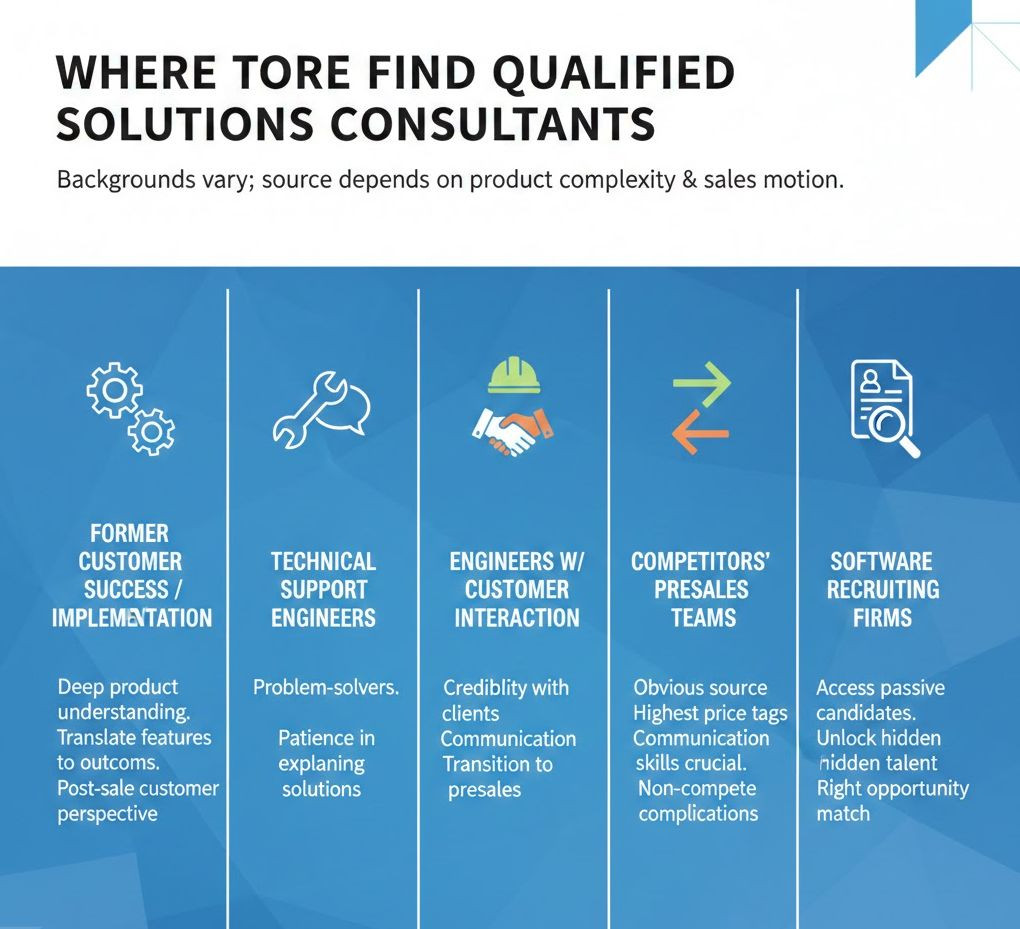
Solutions consultants come from several different backgrounds, and the right source depends on your product complexity and sales motion.
Former customer success or implementation professionals understand your product deeply and have experience translating features into outcomes. They’ve seen what actually matters to customers after the sale closes.
Technical support engineers who want client-facing roles often make strong candidates. They’ve solved real problems and developed patience for explaining solutions.
Engineers who enjoy customer interaction can transition into presales if they have communication skills. They bring credibility that pure salespeople lack.
Competitors’ presales teams are an obvious source, though they come with the highest price tags and potential non-compete complications.
Working with a software recruiting firm can help you access passive candidates who aren’t actively job searching but might consider the right opportunity.
Structuring Your Interview Process
Your interview process for solutions consultants should test both technical depth and communication ability. Don’t just ask candidates to tell you about their experience. Put them in situations that mirror the actual job.
A practical interview structure:
- Phone screen: Assess communication skills and career motivation. Why presales? Why your company?
- Technical conversation: Have an engineer evaluate their technical foundation. Can they discuss architecture, integrations, and implementation considerations?
- Mock demo: Give them time to prepare a demonstration of your product (or a product they know well). Evaluate their presentation skills, handling of questions, and ability to connect features to business value.
- Discovery role-play: Have them conduct a discovery call with someone playing a prospect. Do they ask good questions? Do they listen?
- Cross-functional interviews: Include perspectives from sales leadership, product, and customer success.
The mock demo reveals more than any behavioral interview question. Watch how candidates handle interruptions, pushback, and questions they can’t answer immediately.
Compensation Benchmarks
Solutions consultant and sales engineer compensation typically falls between account executive and pure engineering salaries. The structure usually includes base salary plus variable compensation tied to team or individual revenue performance.
Typical compensation components:
- Base salary ranging from $100,000 to $160,000 depending on experience and market
- Variable compensation at 15-30% of base, often tied to quota attainment or deal outcomes
- Standard benefits package
- Some companies offer equity, especially at earlier stages
The base-to-variable split is usually more conservative than account executive compensation plans. A 70/30 or 80/20 split is common, compared to the 50/50 splits many AEs see.
Geography still influences compensation, though remote work has compressed some of these differences. Candidates in San Francisco or New York typically command premiums over other markets.
Common Hiring Mistakes to Avoid
Software companies make predictable errors when hiring for this role. Awareness helps you sidestep them.
Prioritizing technical depth over communication skills. The smartest engineer in the room doesn’t help if they can’t explain anything to a non-technical buyer. You’re hiring for translation ability.
Ignoring the collaboration dynamic with sales. Solutions consultants work closely with account executives. Personality fit and working style matter. A brilliant solo performer who can’t partner effectively creates friction.
Hiring without testing presentation skills. Resumes and interviews don’t reveal demo quality. Always include a practical presentation component.
Underestimating ramp time. Even experienced solutions consultants need months to learn your product, understand your buyers, and develop effective demo flows. Build realistic expectations with hiring managers.
Treating this as a junior sales role. Strong solutions consultants often have more experience and command higher compensation than junior AEs. Respect the expertise required.
These mistakes overlap with broader sales hiring errors that derail software companies.
Onboarding for Success
Your onboarding program for solutions consultants should emphasize product mastery and buyer understanding before expecting full productivity.
Effective onboarding includes:
- Deep product training, including hands-on time building demo environments
- Shadowing experienced team members on live calls
- Gradual progression from supporting calls to running them independently
- Exposure to customer success and implementation to understand post-sale reality
- Regular feedback sessions during the ramp period
Most solutions consultants need three to six months before they’re fully effective in complex enterprise sales cycles. Rushing this timeline leads to poor demo quality and lost deals.
Building a Presales Team vs. Individual Contributors
Your first solutions consultant hire is usually a generalist who works across the entire sales team. As you scale, you’ll face decisions about specialization.
Questions to consider as you grow:
- Should solutions consultants specialize by product line, industry vertical, or deal size?
- What’s the right ratio of solutions consultants to account executives?
- Do you need a presales manager, or can the team report to sales leadership?
- How do you ensure knowledge sharing across the team?
The right AE-to-SE ratio depends on deal complexity and sales cycle length. Enterprise software companies selling complex products might run 2:1 or 3:1 ratios. Companies with simpler products and higher velocity sales might stretch to 5:1 or beyond.
Retention Considerations
Good solutions consultants are hard to find and expensive to replace. Retention requires attention to career development, compensation, and role satisfaction.
What keeps solutions consultants engaged:
- Clear career paths, whether into presales leadership, sales leadership, or product management
- Competitive compensation that reflects their contribution to revenue
- Investment in continued technical learning
- Reasonable workload distribution across the team
- Recognition for their role in closing deals
Solutions consultants who feel like second-class citizens compared to account executives will leave. Make sure your culture values their contribution.
Final Thoughts
Hiring solutions consultants and sales engineers requires clarity about what you actually need: someone who can make your technology accessible to buyers and credible to technical evaluators. The right person combines product expertise with communication skills and genuine curiosity about customer problems.
Take your time with this hire. A great solutions consultant multiplies your sales team’s effectiveness. A poor one burns prospects and frustrates your AEs. The investment in a thorough hiring process pays off in deals closed and relationships preserved.
Leave a Reply