

Most companies interview sales candidates the same way they interview everyone else. A few conversations, some gut-feel assessments, maybe a reference check. The problem is that salespeople are professionally trained to make good impressions. They know how to build rapport, tell compelling stories, and close. Which means traditional interviews often identify candidates who are good at interviewing rather than good at selling.
The research is clear on this point. According to SHRM, 75% of employers admit they’ve hired the wrong person for a position. Unstructured interviews, despite feeling more natural, are among the worst predictors of actual job performance. Structured interviews, where every candidate answers the same questions and is evaluated against consistent criteria, dramatically improve hiring outcomes.
For software sales roles, where the cost of a bad hire is substantial and the competition for talent is intense, building a rigorous interview process is essential.
Why Structure Matters
Structured interviews outperform unstructured interviews on every dimension that matters. They’re more predictive of job performance, more reliable across interviewers, and less susceptible to bias. Research shows structured interviews can predict job performance with validity between 0.55 and 0.70, significantly higher than unstructured approaches.
The benefits compound for sales hiring specifically:
Sales candidates are skilled at selling themselves. Without structure, charismatic candidates dominate interviews regardless of their actual selling ability. Structure forces evaluation based on substance rather than charm.
Comparison becomes possible. When every candidate answers different questions, you’re comparing apples to oranges. Consistent questions enable direct comparison of how candidates approach the same scenarios.
Bias gets reduced. Unstructured interviews allow personal affinity to drive decisions. Interviewers gravitate toward candidates who remind them of themselves. Structure keeps focus on job-relevant criteria.
Interviewers improve over time. With consistent questions and evaluation criteria, you can track which interview elements actually predict success and refine your approach based on data.
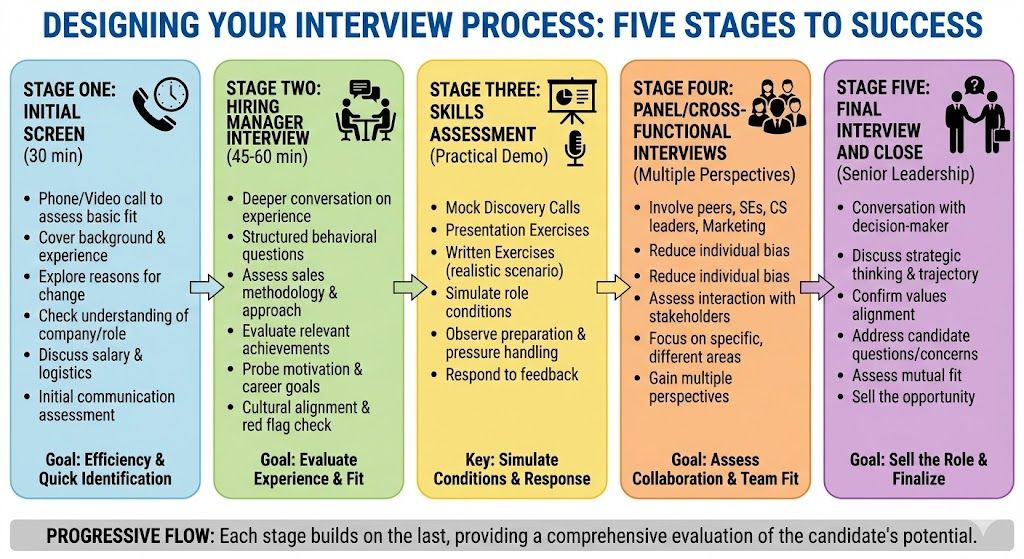
Designing Your Interview Process
A strong sales interview process typically includes four to five stages, each serving a distinct purpose.
Stage One: Initial Screen
A 30-minute phone or video call to assess basic fit before investing more time. Cover their background and experience, reasons for exploring new opportunities, understanding of your company and role, salary expectations and logistics, and initial assessment of communication skills. The goal is efficiency. Quickly identify candidates worth bringing into the full process and respectfully exit those who aren’t a fit.
Stage Two: Hiring Manager Interview
A deeper conversation, typically 45-60 minutes, where the hiring manager evaluates experience, skills, and potential fit. Use structured behavioral questions that probe for specific examples from past experience. This interview should assess sales methodology and approach, relevant experience and achievements, motivation and career goals, cultural alignment, and initial red flag identification.
Stage Three: Skills Assessment
This is where you move beyond conversation to actual demonstration. Options include mock discovery calls where candidates conduct a simulated discovery conversation with someone playing a prospect, presentation exercises where candidates prepare and deliver a presentation on your product or a case study, and written exercises where candidates respond to a realistic scenario in writing. The key is simulating conditions they’ll face in the actual role. Watch how they prepare, how they handle pressure, and how they respond to feedback.
Stage Four: Panel or Cross-Functional Interviews
Involve others who would work closely with the hire. This might include peer sellers, sales engineers, customer success leaders, or marketing partners. Multiple perspectives reduce individual bias and assess how candidates interact with different stakeholders. Keep these focused on specific areas rather than repeating the same questions.
Stage Five: Final Interview and Close
A conversation with senior leadership or the final decision-maker. This often covers strategic thinking and career trajectory, values alignment, candidate questions and concerns, and mutual fit assessment. This is also where you sell the opportunity to candidates you want to hire. Top candidates have options, and this conversation should leave them excited about joining.
Crafting Effective Interview Questions
The questions you ask determine the quality of information you gather. Three types of questions work best for sales interviews:
Behavioral Questions
These ask candidates to describe how they handled specific situations in the past. The premise is that past behavior predicts future behavior.
Examples:
- Tell me about a deal you lost that you thought you were going to win. What happened, and what did you learn?
- Describe a time you had to navigate a complex buying committee with multiple stakeholders. How did you approach it?
- Give me an example of how you’ve handled a situation where you were significantly behind on quota mid-quarter.
- Tell me about a time you disagreed with your manager about how to approach a deal. How did you handle it?
Listen for specificity, self-awareness, and evidence of learning. Vague answers often indicate the candidate is fabricating or exaggerating.
Situational Questions
These present hypothetical scenarios and ask candidates how they would respond. They reveal thinking process and judgment.
Examples:
- Imagine you’re in a discovery call and the prospect says they’re happy with their current solution. How would you respond?
- A deal you’ve been working on for three months just went dark. The champion stopped responding. Walk me through your approach.
- You learn that a competitor is offering a significant discount to win a deal you’re pursuing. What do you do?
Look for structured thinking, creativity, and alignment with your sales methodology.
Motivational Questions
These probe what drives the candidate and whether those drivers align with what your role offers.
Examples:
- What aspects of sales do you find most energizing? What aspects drain you?
- Describe your ideal work environment and management style.
- Where do you see yourself in three years, and how does this role fit into that trajectory?
Honest answers reveal whether there’s genuine alignment between what the candidate wants and what you can provide.
Evaluating Candidates Consistently
Create scorecards that define evaluation criteria before interviews begin. For each competency you’re assessing, define what a strong answer looks like, what an average answer looks like, and what a weak answer looks like.
Typical competencies for software sales roles include discovery and qualification ability, objection handling, business acumen, communication skills, coachability, drive and motivation, technical aptitude, and cultural fit.
Have interviewers complete their scorecards independently before discussing candidates as a group. This prevents anchoring bias where early opinions influence later evaluations. Use a consistent rating scale (1-5 works well) and require specific notes supporting each rating.
Incorporating Role Plays and Simulations
Role plays are among the most predictive elements of sales interviews because they show rather than tell. Common formats include:
Discovery role play. Give candidates a brief about a prospect and have them conduct a 15-20 minute discovery call. Evaluate their questioning technique, listening skills, and ability to uncover pain.
Objection handling. Present common objections and evaluate how candidates respond. Look for composure, logic, and empathy rather than scripted rebuttals.
Demo or presentation. Have candidates present your product or a case study to a panel. Assess preparation, clarity, ability to connect features to value, and handling of questions.
Closing scenario. Present a late-stage deal with complications and have candidates talk through how they would drive it to close.
Provide feedback after role plays and observe how candidates respond. Coachability, meaning the willingness and ability to incorporate feedback, is one of the strongest predictors of sales success.
Reference Checks That Actually Work
Most reference checks are formalities that yield little useful information. Make yours count:
Go beyond provided references. Ask candidates for specific names of managers and colleagues, then reach out directly. Provided references are pre-screened to give positive feedback.
Ask specific questions. General questions get general answers. Instead ask: How did this person rank on the team? What deals did they lose and why? What would you do differently if you managed them again? Would you enthusiastically hire them back?
Listen for hesitation. References rarely say negative things directly. But hesitation, qualified praise, or damning with faint praise all signal concerns worth probing.
Verify claims. If candidates claimed specific achievements in interviews, confirm those achievements with references.
Common Interview Process Mistakes
Avoid these patterns that undermine hiring quality:
Moving too fast under pressure. When you need to fill a role urgently, it’s tempting to compress the process. This almost always leads to worse outcomes. Maintain standards even when timelines are tight.
Over-weighting interview performance. Remember that candidates are performing during interviews. Balance interview impressions with other data points like assessments, references, and work samples.
Inconsistent processes across interviewers. If different interviewers ask different questions and use different criteria, you can’t meaningfully compare their evaluations. Standardize the process.
Failing to sell the opportunity. Top candidates are evaluating you as much as you’re evaluating them. An interview process that feels like an interrogation rather than a conversation will lose strong candidates.
Ignoring red flags. When something feels off, investigate rather than rationalize. Red flags in interviews rarely resolve themselves after hiring.
Continuous Improvement
Track your hiring outcomes and use them to improve your process. Monitor which interview elements correlate with on-the-job success, which questions actually differentiate candidates, which interviewers are most accurate in their assessments, and where in the process you’re losing good candidates.
Use this data to refine your approach over time. The best interview processes are built through iteration, not designed once and left static.
For help designing your interview process or sourcing candidates to put through it, consider working with a software recruiting firm that specializes in sales roles. And for broader guidance on building your team, see our article on how to build a sales team from scratch.
The Bottom Line
Your interview process is the gatekeeper for your sales team’s quality. A rigorous, structured approach identifies candidates who can actually do the job rather than those who simply interview well.
Invest the time to build a process with clear stages, consistent questions, objective evaluation criteria, and practical assessments. The upfront effort pays dividends every time you hire someone who performs and avoid someone who would have struggled.
Sales hiring is too important and too expensive to leave to gut feel and good conversation. Structure your process, train your interviewers, and let the data guide your decisions.
Leave a Reply