


Customer success managers keep your existing customers happy, renewing, and expanding their spend. For software companies running subscription or usage-based models, this role directly impacts your most important financial metrics: net revenue retention, churn rate, and expansion revenue.
According to Bain & Company’s 2024 Technology Report, net revenue retention rates decreased for 75% of software companies surveyed, even as nearly 60% increased their customer success spending. That disconnect points to a hiring and deployment problem, not a function that doesn’t matter. The companies getting customer success right are winning. The ones getting it wrong are bleeding revenue.
What Customer Success Managers Actually Do
Customer success sits between sales, support, and product. CSMs own the ongoing relationship with customers after the deal closes, working to ensure customers achieve their goals with your software.
Core responsibilities include:
- Onboarding new customers and driving initial adoption
- Monitoring customer health through usage data and engagement signals
- Conducting regular business reviews and check-ins
- Identifying expansion opportunities and passing them to sales (or closing them directly)
- Managing renewals and preventing churn
- Advocating internally for customer needs with product and engineering teams
- Building relationships with multiple stakeholders within customer accounts
The best CSMs function as trusted advisors. They understand the customer’s business well enough to recommend how your software can solve problems the customer hasn’t even articulated yet.
When to Hire Your First CSM
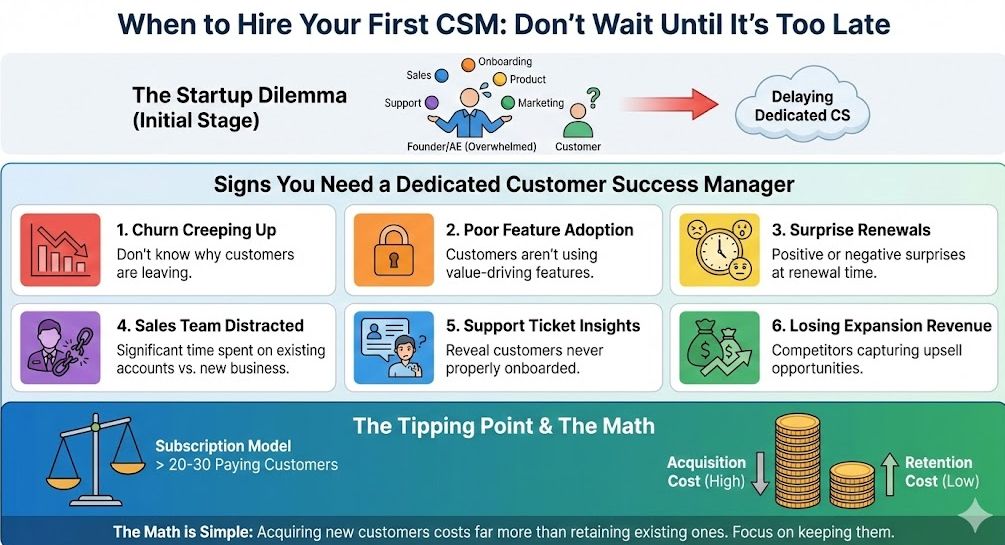
Startups often delay hiring dedicated customer success, relying on founders or account executives to manage post-sale relationships. That works until it doesn’t.
Signs you need dedicated customer success:
- Churn is creeping up and you don’t know why customers are leaving
- Customers aren’t adopting key features that drive value
- Renewals keep surprising you (positively or negatively)
- Your sales team spends significant time on existing accounts instead of new business
- Support tickets reveal customers who never properly onboarded
- You’re losing expansion revenue to competitors
If you’re running a subscription model and have more than 20 or 30 paying customers, you probably need someone focused on keeping them. The math is simple: acquiring new customers costs far more than retaining existing ones.
The Skills That Separate Great CSMs
Customer success requires a blend of relationship skills, business acumen, and technical understanding. The exact mix depends on your product complexity and customer base.
Relationship and communication skills:
- Building rapport quickly with new stakeholders
- Having difficult conversations about underutilization or upcoming renewals
- Presenting business value in quarterly reviews
- Managing expectations when things go wrong
- Navigating complex organizations with multiple decision-makers
Business and analytical skills:
- Understanding SaaS metrics and how CSM activities impact them
- Analyzing usage data to identify at-risk accounts
- Calculating and communicating ROI for customers
- Prioritizing a book of business based on revenue and risk
- Identifying expansion opportunities within accounts
Technical aptitude:
- Learning your product deeply enough to guide customers
- Understanding common integrations and workflows
- Troubleshooting basic issues without escalating to support
- Translating technical concepts for non-technical stakeholders
The technical bar varies significantly. A CSM supporting enterprise security software needs different technical depth than one supporting a marketing automation tool. Match the requirement to your actual customer conversations.
Where to Find CSM Candidates
Customer success is a relatively young function, so candidates come from varied backgrounds. Each source has trade-offs.
Account management or sales backgrounds bring commercial instincts and comfort with revenue conversations. These candidates often transition well to CSM roles that include expansion responsibility. Watch for candidates who are too sales-focused and neglect the “success” part of the job.
Support or implementation backgrounds bring product knowledge and problem-solving skills. These candidates understand what makes customers frustrated and how to resolve issues. They may need coaching on strategic account planning and executive communication.
Industry practitioners who used similar software bring credibility and domain expertise. A former marketing manager can relate to customers of marketing software in ways an outsider can’t. They may need training on customer success methodologies.
Internal promotions from support, implementation, or junior sales roles let you develop talent who already knows your product and customers. This path requires investment in training but often yields strong results.
Working with a software recruiting firm helps when you need to hire quickly or can’t find qualified candidates through your own networks.
Structuring the Interview Process
Your interview process should evaluate both the soft skills that build relationships and the analytical skills that drive results.
Recommended interview stages:
- Phone screen: Assess communication skills and motivation. Why customer success? Why your company?
- Hiring manager interview: Explore past experience managing customer relationships, handling difficult situations, and driving outcomes.
- Role-play exercise: Have candidates conduct a mock quarterly business review or handle a simulated churn risk conversation. This reveals more than any behavioral question.
- Analytical exercise: Give candidates sample customer data and ask them to identify accounts at risk, prioritize their book, or calculate renewal likelihood.
- Cross-functional interviews: Include perspectives from sales, product, and support leadership.
The role-play is essential. You need to see how candidates handle a realistic customer interaction, not just how they describe past experiences.
Compensation Structures for CSMs
CSM compensation typically includes base salary plus variable compensation tied to retention, expansion, or customer health metrics.
Common compensation approaches:
- Base salary ranging from $70,000 to $120,000 depending on experience and market
- Variable compensation at 15-25% of base, tied to renewal rates, net revenue retention, or expansion revenue
- Some companies tie variable to customer health scores or NPS
- Equity grants at earlier-stage companies
The base-to-variable split is usually more conservative than sales compensation structures. A typical CSM might see 80/20 or 75/25 splits, while account executives run 50/50 or 60/40.
Be thoughtful about what you incentivize. If CSMs carry expansion quotas, you’re essentially asking them to be salespeople with retention responsibilities. Some companies separate these functions; others combine them. Neither approach is universally right.
Common Hiring Mistakes
Software companies make predictable errors when building customer success teams. Learning from others’ mistakes saves you time and turnover.
Hiring for personality over substance. Friendly candidates interview well but may lack the analytical rigor or difficult-conversation skills the job requires. Customer success needs both warmth and backbone.
Undervaluing technical aptitude. If your customers are technical, your CSMs need enough technical credibility to earn respect. Hiring purely relationship-oriented candidates for technical products creates friction.
Ignoring the sales component. Many CSM roles include renewal ownership or expansion responsibility. Candidates who can’t have commercial conversations won’t succeed in these roles.
Setting unrealistic book sizes. Overloading CSMs with too many accounts guarantees shallow relationships and reactive firefighting. Understand what coverage your customers actually need.
Treating CSM as an entry-level role. Customer success requires judgment, business acumen, and communication skills that take time to develop. Junior hires can work in scaled or digital-touch models but struggle with strategic enterprise accounts.
These overlap with broader sales hiring mistakes that plague software companies.
Onboarding CSMs Effectively
Your onboarding program should prepare CSMs to own customer relationships, not just understand your product.
Effective CSM onboarding includes:
- Deep product training with hands-on practice
- Shadowing experienced CSMs on customer calls
- Understanding your customer segments and their typical use cases
- Learning your health scoring methodology and early warning indicators
- Reviewing successful and unsuccessful customer journeys
- Gradual account assignment, starting with lower-risk customers
Most CSMs need two to four months before they’re fully effective with a complete book of business. Rushing this timeline leads to customer frustration and CSM burnout.
Building vs. Scaling a CS Team
Your first CSM hire is a generalist who handles everything. As you grow, you’ll face decisions about specialization and team structure.
Questions to consider as you scale:
- Should CSMs specialize by customer segment (enterprise, mid-market, SMB)?
- Do you need separate roles for onboarding, ongoing success, and renewals?
- What’s the right ratio of CSMs to customers or to ARR?
- Should CSMs own expansion revenue or hand opportunities to sales?
- Do you need a dedicated CS operations function?
The right structure depends on your product complexity, customer volume, and average contract value. High-touch enterprise models might run 1 CSM per 10-15 accounts. Scaled models might run 1 CSM per 50-100 accounts with significant automation support.
Retention Matters More Here
CSM turnover is particularly painful because relationships transfer poorly. When a CSM leaves, customers feel it. Retaining top talent in customer success requires attention to career development, workload management, and recognition.
What keeps CSMs engaged:
- Clear career paths into CS leadership, sales, or product roles
- Manageable book sizes that allow for quality relationships
- Recognition for retention and expansion wins
- Input into product decisions based on customer feedback
- Competitive compensation that reflects their revenue impact
CSMs who feel like second-class citizens compared to sales will leave. Make sure your compensation, recognition, and career development programs value customer success appropriately.
Final Thoughts
Customer success managers protect and grow your existing revenue base. In a software market where customer acquisition costs keep rising, the ROI on great CSMs only increases. Hire people who genuinely care about customer outcomes, give them the tools and authority to drive results, and treat the function as the strategic priority it deserves to be.
Leave a Reply