


Inside sales has become the dominant model for software companies. The ability to sell remotely, cover more ground, and scale efficiently makes it a natural fit for SaaS and subscription businesses. If you’re building or expanding an inside sales function, the decisions you make now will shape your revenue trajectory for years to come.
The core of building an effective inside sales team comes down to three things: hiring the right people, structuring roles clearly, and giving reps the tools and training they need to succeed. Get these right, and you’ll have a scalable engine for growth. Miss on any of them, and you’ll burn through reps and budget without much to show for it.
Here’s how to approach building an inside sales team that actually performs.
Why Inside Sales Works for Software Companies
Inside sales makes particular sense for software businesses for several reasons. The economics are favorable. According to SPOTIO’s research, the average cost of an inside sales call is around $50, compared to $215 to $400 for an outside sales call. That cost efficiency matters when you’re trying to build a repeatable, scalable sales motion.
Inside sales also allows for higher activity levels. Reps can have more conversations per day, work more opportunities simultaneously, and cover larger territories without travel time eating into selling hours. For products with shorter sales cycles and lower ACVs, this velocity advantage is significant.
That said, inside sales does come with tradeoffs. Outside sales reps typically achieve higher quota attainment rates, around 65% compared to 55% for inside reps. They also tend to close larger deals where face-to-face relationships matter. The key is matching your sales model to your product, price point, and buyer expectations.
Defining Your Inside Sales Roles
Before you start hiring, get clear on the roles you need. Most software companies use some combination of these positions:
Sales Development Representatives (SDRs)
SDRs focus on the top of funnel. They prospect, qualify inbound leads, and set meetings for account executives. They don’t typically close deals themselves. This role works best when you have enough lead volume or target account lists to keep SDRs busy, and when your AEs benefit from having meetings pre-set rather than doing their own prospecting.
Account Executives (AEs)
Inside AEs run the full sales cycle from qualified opportunity to close. They conduct demos, manage the evaluation process, negotiate terms, and close deals. In inside sales models, they do all of this remotely through phone, video, and email.
Inbound vs. Outbound Specialization
Some companies split SDRs into inbound and outbound roles. Inbound SDRs qualify leads from marketing. Outbound SDRs proactively prospect into target accounts. The right structure depends on your lead flow and go-to-market strategy.
Hybrid Roles
Earlier-stage companies often start with reps who do everything, from prospecting to closing. This works when deal volume is low and you need flexibility. As you scale, specialization typically improves efficiency.
What to Look for When Hiring
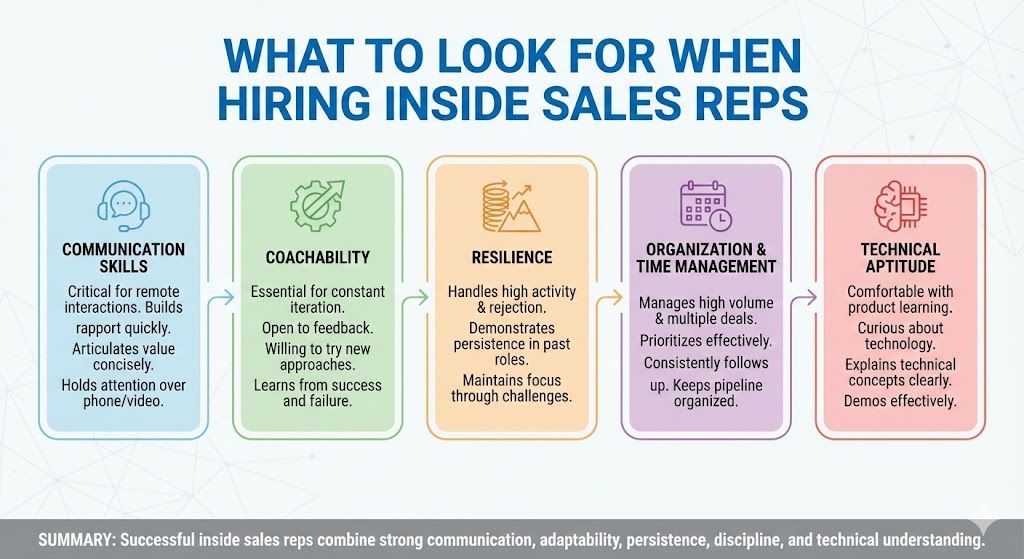
Inside sales requires a specific skill set. Here’s what matters most:
Communication Skills
This seems obvious, but inside reps live and die by their ability to communicate clearly and persuasively without the benefit of being in the room. Look for people who can build rapport quickly, articulate value concisely, and hold attention over the phone or video.
Coachability
Inside sales involves constant iteration. Reps need to be open to feedback, willing to try new approaches, and able to learn from what works and what doesn’t. Ask about how they’ve responded to coaching in the past.
Resilience
Inside sales means high activity, lots of rejection, and days where nothing seems to go right. Look for candidates who have demonstrated persistence in previous roles, whether in sales or elsewhere.
Organization and Time Management
With high volumes of activity and multiple deals in flight, organization is essential. Reps who can’t manage their pipeline, follow up consistently, or prioritize effectively will struggle.
Technical Aptitude
They don’t need to be engineers, but inside reps for software companies should be comfortable learning and demonstrating your product. Look for curiosity about technology and the ability to explain technical concepts clearly.
Interview Tactics That Work
Standard interviews often fail to reveal who will actually perform in an inside sales role. Try these approaches:
Role-play exercises. Have candidates make a mock cold call or conduct a discovery conversation. Watch for how they open, how they handle objections, and whether they can think on their feet.
Activity and metrics questions. Ask about their activity levels in previous roles. How many calls did they make? How many meetings did they set? What was their conversion rate? Strong candidates know their numbers.
Scenario-based questions. Present realistic scenarios and ask how they’d handle them. A prospect goes dark mid-cycle. A competitor comes up in every deal. An objection keeps recurring. Their answers reveal their experience and problem-solving approach.
References focused on performance. When checking references, ask specifically about quota attainment, coachability, and work ethic. Past performance is the best predictor of future results.
Red Flags to Avoid
Watch for these warning signs during the hiring process:
- Vague on metrics. If they can’t tell you their quota attainment, activity levels, or win rates, they probably weren’t tracking them closely.
- Blames external factors. Every rep has dealt with bad territories, poor leads, or product issues. If they only talk about obstacles without discussing how they overcame them, that’s a concern.
- Can’t explain their process. Strong inside reps have a method. They can walk you through how they approach prospecting, discovery, demos, and closing.
- Lack of preparation. If they haven’t researched your company, your product, or your market before the interview, they probably won’t do the prep work with prospects either.
- Short tenures without explanation. Inside sales does have turnover, but a pattern of leaving every six months raises questions about fit or performance.
Structuring for Success
How you structure and support your team matters as much as who you hire:
SDR-to-AE ratios. The typical ratio is around one SDR for every two to three AEs, though this varies based on deal size, sales cycle, and how much prospecting AEs do themselves.
Territories and account assignments. Define clearly who owns what. Geographic territories, named accounts, company size segments, or industry verticals can all work. The key is avoiding overlap and confusion.
Technology stack. Inside sales runs on tools. At minimum, you need a CRM, phone/dialer system, email automation, and video conferencing. Many teams add conversation intelligence, prospecting tools, and sales engagement platforms.
Training and onboarding. Inside sales reps need structured onboarding to learn your product, understand your buyers, and master your sales process. Plan for at least three months before expecting full productivity.
Coaching cadence. Regular one-on-ones, call reviews, and deal coaching help reps improve continuously. Make coaching a consistent priority, not something that happens when there’s time.
Compensation Considerations
Inside sales compensation typically includes base salary plus variable pay tied to quota. A few guidelines:
- Competitive base matters. Inside sales is competitive. If your base is significantly below market, you’ll lose candidates to other opportunities.
- Clear, achievable quotas. Quotas should stretch reps but remain attainable. If most of your team is missing quota, the problem might be the targets, not the people.
- Accelerators for overperformance. Reward reps who exceed quota with accelerated commission rates. This motivates top performers and helps retain your best people.
- SPIFs and contests. Short-term incentives can drive specific behaviors when you need them, whether that’s booking more demos, closing deals before quarter-end, or adopting new processes.
For current benchmarks on what inside sales reps expect, review industry software sales compensation data regularly.
Sourcing Inside Sales Talent
Building a team means finding candidates. Several approaches work:
- Promote from within. SDRs who prove themselves can move to AE roles. This creates a career path and rewards performance.
- Hire from similar companies. Reps with experience selling comparable products to similar buyers will ramp faster.
- Recruit from adjacent roles. Customer success, support, and implementation roles sometimes produce strong inside sales candidates who already know your product or space.
- Work with specialists. A software recruiting firm can help you reach candidates you wouldn’t find on your own, especially for more senior roles.
If you’re building a sales team from scratch, inside sales often provides the most scalable foundation for software companies.
The Bottom Line
Building an inside sales team for your software company is an investment in scalable growth. The model works because it combines efficiency with the ability to have real conversations with buyers, something pure self-serve can’t replicate.
Focus on hiring the right people, giving them clear roles and expectations, and supporting them with the tools and coaching they need. Do that consistently, and your inside sales team will become one of your most valuable assets.
Leave a Reply