

Hiring a VP of Sales is one of the highest-stakes decisions a software company will make. Get it right, and you have a leader who can build the team, systems, and culture that drive sustainable revenue growth. Get it wrong, and you’re looking at months of lost momentum, damaged team morale, and the painful process of starting over.
The challenge is that VP of Sales hiring has a notoriously high failure rate. According to SaaStr’s analysis, 70% of first VP Sales hires at SaaS companies don’t make it to 12 months. That’s a sobering number, especially when you consider the cost of each failed hire in compensation, recruiting, lost revenue, and organizational disruption.
The good news is that most of these failures are preventable. They stem from mismatched expectations, poor fit for company stage, or hiring processes that don’t surface the right information. Here’s how to approach this hire with a better chance of success.
Why VP of Sales Hiring Goes Wrong
Before diving into what to do, it helps to understand why so many of these hires fail:
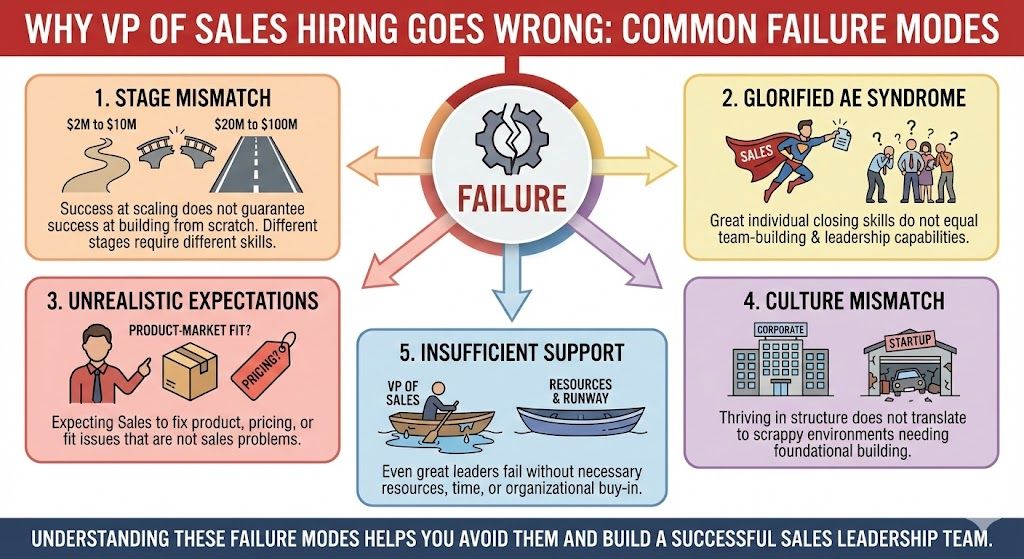
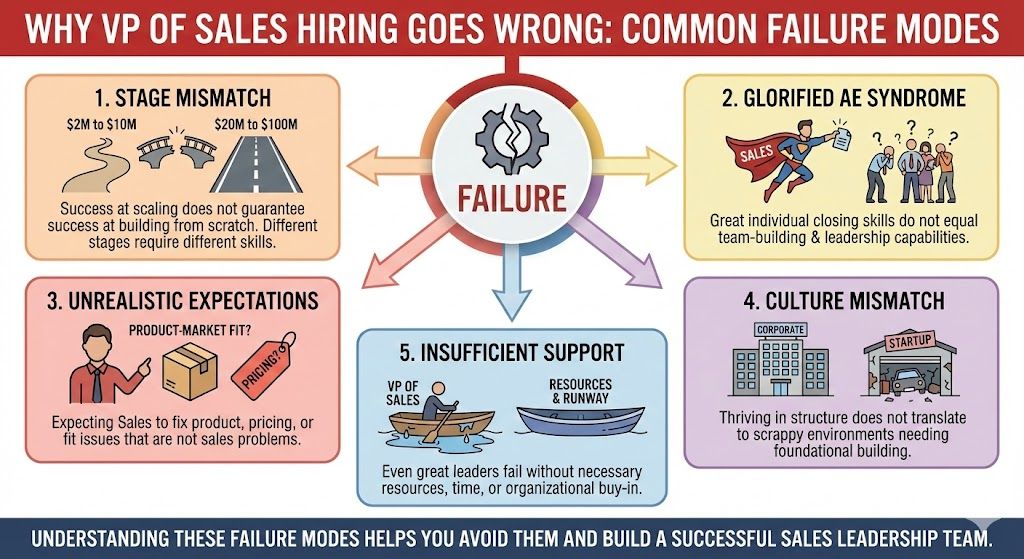
Stage mismatch. A VP who excelled at scaling from $20M to $100M may struggle to build from $2M to $10M. The skills required at different stages are genuinely different, and past success at a later stage doesn’t guarantee success at an earlier one.
Glorified AE syndrome. Some candidates look impressive because they were great individual contributors. But closing deals yourself and building a team that closes deals are different capabilities.
Unrealistic expectations. Founders sometimes expect a VP of Sales to fix problems that aren’t actually sales problems, like product-market fit issues or unrealistic pricing.
Culture mismatch. A VP who thrived in a large, structured environment may struggle in a scrappy startup where they need to build everything from scratch.
Insufficient support. Even great VPs fail when dropped into situations without the resources, runway, or organizational buy-in they need to succeed.
Understanding these failure modes helps you avoid them.
When to Hire a VP of Sales
Timing matters. Hire too early, and your VP won’t have the foundation they need to succeed. Hire too late, and you’ve likely already developed bad habits or missed market opportunities.
Generally, you’re ready for a VP of Sales when:
- You have proven product-market fit with paying customers
- The founder or early team has closed enough deals to understand the sales process
- You have a repeatable sales motion, even if it’s not fully optimized
- You’re ready to invest in building a real sales team, not just adding one more rep
- Revenue is consistent enough that the VP can build on something real
If you’re still figuring out whether your product sells and to whom, you probably need more founder-led selling before bringing in a VP.
What to Look for in a VP of Sales
The right VP of Sales for your company depends on your stage, market, and specific challenges. That said, several capabilities matter universally:
Team building ability. The primary job of a VP of Sales is to recruit, develop, and retain great salespeople. Look for evidence they’ve built teams, not just managed inherited ones.
Process orientation. Strong VPs create systems that scale. They build playbooks, implement metrics, and create processes that make the whole team better.
Coaching mindset. The best VPs spend significant time making their people better through call reviews, deal coaching, and skill development.
Strategic thinking. They should be able to see the big picture, understand market dynamics, and make decisions about where to focus resources.
Execution discipline. Strategy means nothing without execution. Look for VPs who are rigorous about forecasting, pipeline management, and hitting commitments.
Stage-appropriate experience. This is crucial. You want someone who has succeeded at a similar stage to where your company is now, not just at a later stage.
Adaptability. Software sales is constantly evolving. VPs who rely entirely on playbooks from five years ago may struggle with today’s buyers and tools.
Interview Tactics That Reveal the Truth
Standard interviews often fail to surface what you really need to know about a VP of Sales candidate. Try these approaches:
Dig into their team-building track record. Ask them to walk you through teams they’ve built. How many people did they hire? How did they source candidates? What was their retention rate? How many of those people would they hire again?
Explore their sales process thinking. Have them describe the sales process they’ve implemented in the past. What stages did they use? How did they define qualification criteria? What metrics did they track? You’re looking for specificity and clear thinking, not buzzwords.
Test their coaching approach. Ask them to describe how they’ve developed an underperforming rep. What did they identify as the issue? What interventions did they try? What was the outcome? Strong coaches have concrete examples.
Present a realistic scenario. Describe your actual situation and ask how they would approach the first 90 days. Their answer reveals whether they understand your stage and challenges.
Check their data fluency. Ask them to walk through how they would forecast revenue for next quarter. Strong VPs have a systematic approach that goes beyond gut feel.
Reference check deeply. Talk to people who worked for them, not just peers or bosses. Ask specifically about their coaching, their team-building, and how they handled adversity.
Red Flags to Watch For
Some warning signs should give you serious pause:
- All talk, no specifics. If they speak only in generalities about “building great teams” or “driving revenue growth” without concrete examples and numbers, they may be better at selling themselves than delivering results.
- Can’t explain failures. Every VP has had things not work out. If they can’t discuss what went wrong and what they learned, they may lack self-awareness.
- Dismissive of your stage. If they seem to view your current challenges as beneath them or keep referencing what they did at much larger companies, they may not be willing to do the work your stage requires.
- Individual contributor mindset. If their stories are all about deals they personally closed rather than teams they built and developed, they may be a great seller but not a great leader.
- Demands excessive resources upfront. While it’s reasonable to discuss what they need to succeed, candidates who immediately ask for large teams, big budgets, and extensive support may struggle with the constraints of your stage.
- No questions about your business. Strong candidates want to understand your customers, your product, your competition, and your challenges. If they’re not curious, that’s concerning.
Compensation Considerations
VP of Sales compensation typically includes base salary, variable pay tied to team performance, and often equity. A few principles:
- Benchmark against similar companies. Compensation varies significantly by company stage, location, and team size. Use current market data, not assumptions from your last role.
- Align variable pay with what they control. VPs should be compensated on team attainment, not just their personal deals. The mix between base and variable typically ranges from 60/40 to 70/30.
- Be realistic about equity. For early-stage companies, equity is often a significant part of the package. Be prepared to discuss the value and terms clearly.
- Consider the full package. Beyond cash and equity, factors like title, reporting structure, team size, and autonomy all matter to VP candidates.
For current benchmarks, review industry software sales compensation data and talk to other founders at similar stages.
Where to Find VP Candidates
VP of Sales candidates come from several sources:
- Your network. The best hires often come through warm introductions. Ask your investors, advisors, and peers for referrals.
- Promoted from within. Strong directors or senior managers on your team may be ready to step up.
- Competitors and adjacent companies. VPs at similar-stage companies in your space already understand your market.
- Executive recruiters. For critical hires, working with a software recruiting firm that specializes in sales leadership can help you access candidates you wouldn’t reach on your own.
Be patient. This hire is too important to rush. If you’re still building a sales team from scratch, you may want to delay the VP hire until you have more foundation in place.
Setting Your VP Up for Success
Hiring the right person is only half the battle. You also need to set them up to succeed:
- Align on expectations. Be explicit about what success looks like at 90 days, 6 months, and 12 months. Get on the same page about priorities and constraints.
- Give them runway. Building a sales organization takes time. Make sure you and your board are aligned on realistic timelines for results.
- Provide context. Share everything you’ve learned about your customers, your sales process, and what’s worked and what hasn’t.
- Stay involved appropriately. Founders should stay close to sales, especially early on, but avoid undermining the VP’s authority.
- Address problems early. If things aren’t working, have direct conversations quickly. The 70% failure rate partly reflects situations where problems festered too long.
The Bottom Line
Hiring a VP of Sales for your software company is high-risk, high-reward. The right hire can transform your growth trajectory. The wrong hire can set you back a year or more.
Approach this hire with clear-eyed assessment of your stage, rigorous evaluation of candidates, and realistic expectations about what’s possible. Take the time to find someone with the right experience, capabilities, and fit for where your company is today, not just where you hope it will be.
The VP of Sales hire is hard to get right. But understanding why these hires fail, and taking a disciplined approach to the search, dramatically improves your odds.
Leave a Reply