

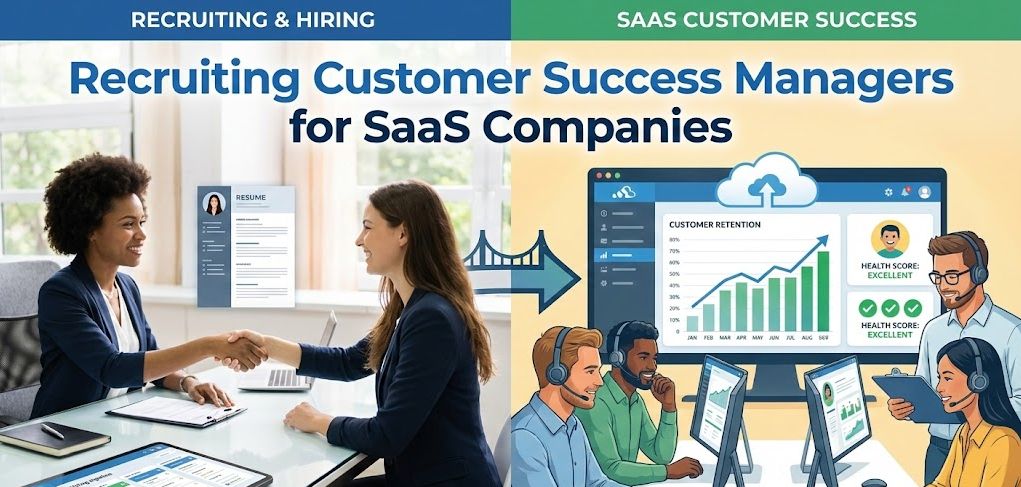
In SaaS, the sale is just the beginning. The real revenue comes from renewals, expansions, and the compounding effect of customers who stay year after year. That’s why customer success has become one of the most critical functions in subscription software businesses.
Your customer success managers are the people responsible for making sure customers actually get value from your product. They drive adoption, identify expansion opportunities, and catch churn risks before they become cancellations. Get this hire right, and you protect and grow your existing revenue. Get it wrong, and you’re fighting an uphill battle against churn that no amount of new sales can overcome.
Here’s how to recruit CSMs who will actually move the needle for your SaaS business.
Why Customer Success Hiring Matters More Than Ever
The economics of SaaS make customer success essential. According to KeyBanc Capital Markets’ SaaS Survey, it costs SaaS companies $1.78 to acquire a dollar in ACV from new customers, compared to just $0.61 to acquire a dollar in ACV from upsells and expansions of existing customers.
That math is stark. You’re essentially losing money on new customer acquisition until you retain and expand those accounts over time. Customer success is the function that makes that happen.
When you hire strong CSMs, you’re not just filling a support role. You’re investing directly in revenue retention and growth.
What Makes a Great SaaS CSM
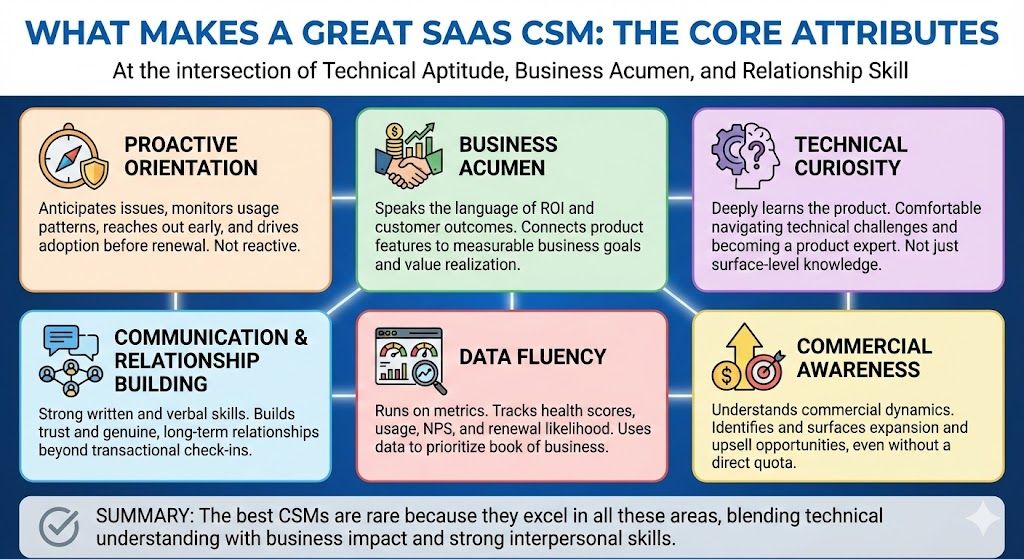
Customer success sits at an interesting intersection. CSMs need enough technical aptitude to understand your product, enough business acumen to speak to customer outcomes, and enough relationship skill to build trust over time. That combination is rarer than you might think.
Here’s what to look for:
Proactive Orientation
The best CSMs don’t wait for problems to surface. They monitor usage patterns, reach out before issues escalate, and drive adoption before renewals come up. Look for candidates who describe their work in proactive terms, not reactive ones.
Business Acumen
CSMs need to understand how customers measure success. That means speaking the language of ROI, business outcomes, and value realization. Candidates who only talk about product features without connecting them to customer goals will struggle.
Technical Curiosity
They don’t need to be engineers, but they should be comfortable learning your product deeply and helping customers navigate technical challenges. Look for evidence they’ve become product experts in previous roles.
Communication and Relationship Building
CSMs spend their days on calls, in emails, and running business reviews. Strong written and verbal communication is essential. So is the ability to build genuine relationships, not just transactional check-ins.
Data Fluency
Modern customer success runs on metrics. CSMs need to track health scores, usage data, NPS, and renewal likelihood. Candidates should be comfortable working with data and using it to prioritize their book of business.
Commercial Awareness
Many CSMs own expansion revenue or work closely with sales on upsells. Even if your CSMs don’t carry quota, they should understand commercial dynamics and be comfortable identifying and surfacing opportunities.
Interview Tactics That Reveal True Capability
Generic interviews won’t surface the capabilities that matter. Use these approaches:
Ask about their book of business. Have them describe the accounts they managed in their last role. How many? What ARR? What was their retention rate? How did they prioritize? Strong candidates know their numbers and can articulate their approach.
Present a churn scenario. Describe a customer showing warning signs and ask how they would approach the situation. What would they want to understand? What interventions might they try? Watch for a structured approach versus reactive scrambling.
Test their ability to run a business review. Role-play a quarterly business review with a fictional customer. Can they frame value delivered, identify opportunities, and navigate tough questions about product gaps or service issues?
Probe their expansion approach. Ask about a time they identified and closed (or supported) an expansion opportunity. How did they spot it? How did they position it? What was the outcome? This reveals commercial instincts.
Evaluate their technical depth. Ask them to explain a complex feature or concept from their current product to you as if you were a customer. This shows both product knowledge and communication ability.
Ask about cross-functional collaboration. CSMs work across sales, product, support, and sometimes marketing. Have them describe how they’ve worked with these teams to solve customer problems or drive outcomes.
Red Flags to Watch For
Some warning signs should give you pause:
- Reactive language. If they describe their work as primarily responding to customer requests or issues, they may not have the proactive orientation CS requires.
- Vague on metrics. Strong CSMs know their retention rates, expansion numbers, and how their book of business performed. Vagueness suggests they weren’t closely tracking outcomes.
- No commercial awareness. Even if they didn’t own quota, CSMs should understand revenue dynamics. Candidates who seem uncomfortable discussing commercial topics may struggle with the business side of the role.
- Feature-focused, not outcome-focused. CSMs who only talk about product capabilities without connecting them to customer results may not truly understand customer success.
- Short tenures at multiple companies. Customer success is about building long-term relationships. A pattern of short stints raises questions about whether they can commit to accounts over time.
- No questions about your customers. Strong candidates want to understand who they’d be working with, what challenges your customers face, and how success is measured at your company.
Where to Find Strong CSM Candidates
Customer success talent comes from several backgrounds:
- Other SaaS companies. CSMs at similar-stage companies understand the subscription model and can ramp quickly.
- Account management. Traditional account managers with a customer-centric orientation often transition well to CS roles.
- Professional services and consulting. Implementation consultants and professional services staff have deep product knowledge and customer-facing experience.
- Sales. Some salespeople prefer the relationship-building side of revenue over hunting new logos. Former AEs who want to stay closer to customers can make excellent CSMs.
- Support and technical support. Support team members who show commercial instincts and want more strategic customer relationships are worth developing.
- Internal promotions. Your own support or implementation team may have candidates ready to step up.
If you’re struggling to find qualified candidates, working with a software recruiting firm that understands SaaS customer success can help you access candidates you wouldn’t reach on your own.
Compensation Considerations
CSM compensation typically includes base salary plus variable pay tied to retention, expansion, or customer health metrics. A few principles:
- Variable should align with what they control. Tying comp to metrics CSMs can actually influence creates the right incentives.
- Consider your expansion model. If CSMs own expansion revenue, variable pay should reflect that. If sales owns expansion, CSM comp should focus more on retention and health.
- Stay competitive. CSM salaries have risen as companies recognize the function’s importance. Benchmark against current software sales compensation data and CS-specific surveys.
- Factor in book size and complexity. CSMs managing enterprise accounts with complex needs should earn more than those handling high-volume SMB books.
Structuring Your CS Team for Success
How you structure the role matters as much as who you hire:
- Define the right CSM-to-account ratio. This varies by segment. Enterprise CSMs might manage 10 to 20 accounts. Mid-market might handle 30 to 50. SMB or tech-touch models might be 100+. Match your ratio to your customer complexity and ACV.
- Clarify ownership. Does CS own renewals? Expansions? Onboarding? Support escalations? Ambiguity creates friction with sales and other teams.
- Invest in tools. CS platforms, health scoring, and usage analytics help CSMs prioritize and scale. Don’t expect them to manage a large book with spreadsheets alone.
- Build career paths. Strong CSMs want to know where the role leads. Whether that’s senior CSM, CS leadership, or a move to sales or product, map out the options.
If you’re building a sales team from scratch, customer success typically comes after you have consistent new business revenue and a base of customers to retain. The exact timing depends on your sales cycle and customer complexity, but most companies hire their first CSM once they have 20 to 50 customers.
The Bottom Line
Recruiting customer success managers for your SaaS company is an investment in your existing revenue base. Strong CSMs protect against churn, drive adoption, and surface expansion opportunities that fuel sustainable growth.
Take the time to evaluate candidates for the specific blend of relationship skills, technical aptitude, and commercial awareness the role requires. The right hires will pay for themselves many times over through the customers they retain and grow.
Leave a Reply