


A director of sales sits at a critical inflection point in your organization. They’re senior enough to shape strategy and own significant revenue targets, but close enough to the front lines to impact deal outcomes and coach managers. Get this hire right, and you accelerate your growth trajectory. Get it wrong, and you’re looking at months of lost momentum, missed targets, and potential turnover below them.
The stakes are high. According to research compiled by Zippia, turnover in an executive role can cost up to 213% of the position’s salary when you factor in separation costs, recruitment expenses, and productivity losses. For a director-level sales hire, that number climbs even higher when you account for the ripple effects on team performance and pipeline.
Here’s how to approach this hire with the rigor it deserves.
Understanding the Director of Sales Role in Software
Before you start interviewing, get clear on what you actually need. The director of sales title means different things at different companies. In some organizations, this person manages a team of individual contributors. In others, they manage managers. Some directors carry a personal quota; others are purely leadership roles.
For most software companies, a director of sales typically:
- Owns a significant portion of overall revenue targets
- Manages a team of sales managers or senior AEs (or both)
- Develops and executes sales strategy within their segment or region
- Partners with marketing, product, and customer success on go-to-market alignment
- Reports to a VP of Sales, CRO, or in smaller companies, directly to the CEO
The scope depends heavily on your company’s size and structure. A director at a 50-person startup looks very different from a director at a 500-person scale-up. Define the role clearly before you start sourcing.
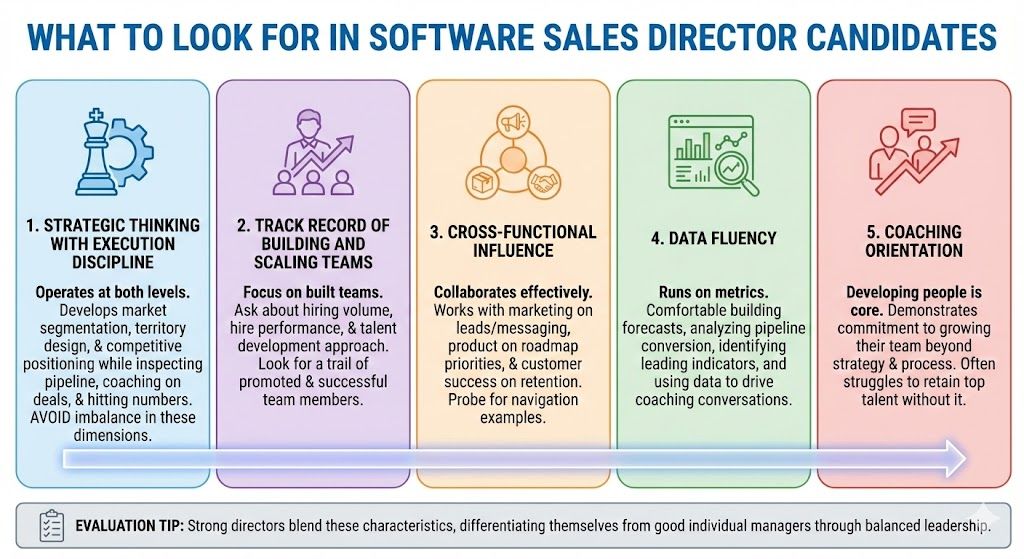
What to Look for in Candidates
Strong director candidates share several characteristics that separate them from good individual managers:
Strategic Thinking with Execution Discipline
Directors need to operate at both levels. They should be able to think about market segmentation, territory design, and competitive positioning while also inspecting pipeline, coaching on deals, and hitting quarterly numbers. Watch out for candidates who are strong on one dimension but weak on the other.
Track Record of Building and Scaling Teams
Ask specifically about teams they’ve built. How many people did they hire? How did those hires perform? What was their approach to developing talent? The best directors leave a trail of people who got promoted and went on to succeed.
Cross-Functional Influence
Software sales doesn’t happen in isolation. Your director needs to work effectively with marketing on lead quality and messaging, with product on roadmap priorities, and with customer success on retention. Probe for examples of how they’ve navigated these relationships.
Data Fluency
Modern software sales runs on metrics. Your director should be comfortable building forecasts, analyzing pipeline conversion rates, identifying leading indicators of performance issues, and using data to drive coaching conversations.
Coaching Orientation
Even at the director level, developing people is a core responsibility. Candidates who only talk about strategy and process without demonstrating a real commitment to growing their team often struggle to retain top talent.
Interview Tactics That Reveal Capability
Generic questions get generic answers. Use these approaches to surface real capability:
Ask for a 90-day plan. Have candidates outline what they would do in their first 90 days. What would they assess? What decisions would they make? What would they wait on? This reveals how they think about prioritization, change management, and building credibility with a new team.
Present a strategic challenge. Describe a real issue your sales organization faces and ask how they would approach it. Maybe it’s a segment that’s underperforming, a competitive threat, or a go-to-market decision. Watch how they structure their thinking and what questions they ask.
Dig into specific hiring decisions. Have them walk you through a hire they made that worked out well and one that didn’t. What did they learn? How did they adjust their approach? This reveals self-awareness and learning orientation.
Test their forecast accuracy. Ask about their track record on forecast accuracy. How did they build their forecasts? How did they hold their team accountable? Directors who can’t speak specifically to this are often weaker operators than they appear.
Role-play a coaching scenario. Describe a situation where a manager on their team is struggling with an underperforming rep. How would they approach the conversation? What would they want to understand? What interventions might they consider?
Probe cross-functional relationships. Ask about a time they disagreed with marketing or product leadership. How did they handle it? What was the outcome? You’re looking for someone who can advocate effectively without creating friction.
Red Flags to Watch For
Some warning signs should make you pause before extending an offer:
- Vague on results. Strong directors know their numbers. If they can’t articulate the specific revenue targets they owned and how they performed against them, dig deeper.
- Blames others for failures. Every leader faces setbacks. How they talk about those challenges reveals their accountability and maturity.
- No examples of developing people. If they can’t point to specific individuals they’ve hired, developed, or promoted, coaching may not be a strength.
- Only talks about strategy. Directors who love the whiteboard but struggle with execution details often underperform when they need to deliver results.
- Poor questions about your business. Candidates who don’t probe deeply into your market, customers, and current challenges may be more interested in the title than the actual work.
- History of short tenures. One short stint could be circumstantial. Multiple short stints suggest a pattern worth understanding.
Where to Find Strong Candidates
Director-level talent is competitive. Here’s where to look:
- Internal promotions. Your best sales managers who show strategic capability and cross-functional influence are worth developing. They already understand your business.
- Competitors and adjacent companies. Directors at companies with similar sales motions understand your challenges and can ramp faster.
- Managers ready to step up. Sometimes the right hire is a strong manager at another company who’s ready for more scope. They may have fresher tactical skills than tenured directors.
- Your network. Board members, investors, and advisors often know director-level talent from their other portfolio companies.
- Specialized recruiters. Working with a software recruiting firm that understands SaaS sales leadership can significantly accelerate your search and surface candidates you wouldn’t find on your own.
Compensation Considerations
Director of sales compensation typically includes base salary, variable pay tied to team performance, and often equity. A few principles:
- Variable should reflect their leverage. Directors influence outcomes across their entire org. Tie compensation to metrics they can actually impact.
- Equity matters at this level. Strong directors have options. Competitive equity packages help close candidates and create long-term alignment.
- Benchmark against your market. Director compensation varies significantly by geography, company stage, and industry segment. Review current software sales compensation benchmarks before building your package.
- Consider the full picture. Benefits, flexibility, and growth opportunity all factor into a candidate’s decision. Don’t assume compensation alone will close the deal.
Setting Your New Director Up for Success
The work doesn’t end when they accept the offer. How you onboard a director-level hire significantly impacts their time to productivity.
- Provide context. Share performance history on every manager and rep in their org. Give them access to historical data on pipeline, conversion rates, and quota attainment.
- Clarify decision rights. What can they change on their own? What requires alignment with you or other executives? Setting these boundaries early prevents friction later.
- Create space for assessment. Give them time to observe before expecting big changes. Thirty to sixty days of listening builds credibility and leads to better decisions.
- Schedule regular check-ins. Weekly one-on-ones during their first 90 days help you stay aligned and give them a space to raise concerns early.
If you’re still in the earlier stages of building your sales team from scratch, a director hire may be premature. Most companies bring on a director once they have multiple sales managers and a proven sales motion. Before that point, a strong VP who can operate at both strategic and tactical levels is often a better fit.
The Bottom Line
Hiring a director of sales for your software company is one of the most consequential decisions you’ll make. The right person accelerates growth, develops your managers, and brings strategic clarity to your go-to-market motion. The wrong person costs you time, money, and momentum you can’t afford to lose.
Take the time to define the role clearly, evaluate candidates rigorously, and onboard them thoughtfully. The investment you make in getting this hire right pays dividends across your entire sales organization.
Leave a Reply