


Preparing for a software sales interview means researching the company and product thoroughly, organizing your sales track record with specific numbers, anticipating the questions you’ll face, and demonstrating your sales process knowledge through how you conduct yourself. The best candidates treat the interview like a sales call. They qualify the opportunity, understand what the hiring manager needs, position themselves as the solution, and follow up professionally.
Most candidates walk into software sales interviews underprepared. They can talk generally about their experience but stumble when asked for specifics. They haven’t researched the product deeply enough to ask intelligent questions. They don’t understand what the interviewer is actually evaluating.
This guide covers how to prepare effectively so you stand out from the competition and give yourself the best chance of landing the offer.
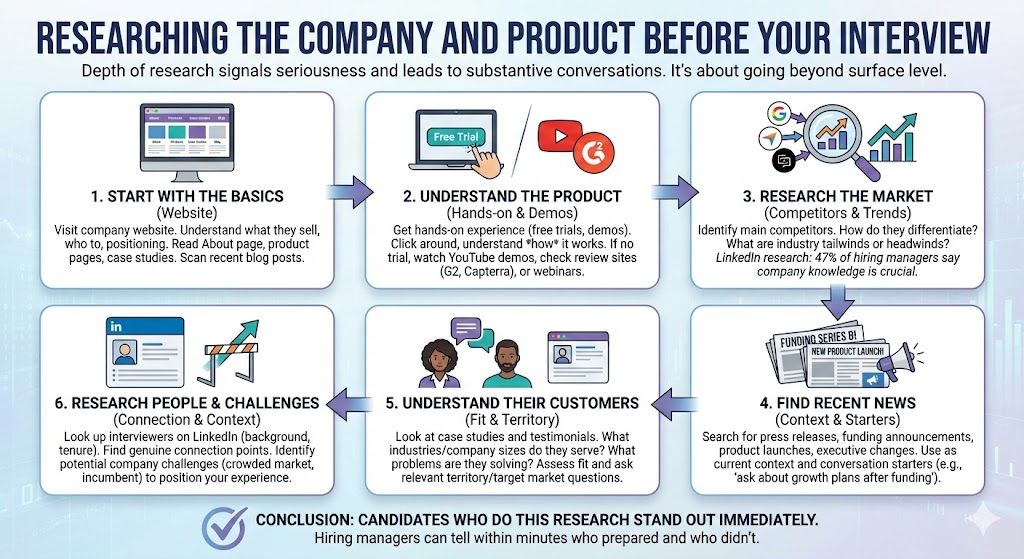
Researching the Company and Product Before Your Interview
The depth of your research signals how seriously you’re taking the opportunity. It also gives you material to have substantive conversations rather than surface-level exchanges.
Start with the basics. Visit the company website. Understand what they sell, who they sell to, and how they position themselves. Read the About page, the product pages, and any case studies they’ve published. If they have a blog, scan recent posts for insight into their priorities and thinking.
Understand the product. If possible, get hands-on experience. Many software companies offer free trials or demos. Sign up. Click around. Understand how the product works, not just what it does. This lets you ask specific questions and shows genuine interest.
If a trial isn’t available, look for product demos on YouTube, review sites like G2 or Capterra, or webinar recordings. The goal is to understand the product well enough to imagine selling it.
Research the market. Who are the main competitors? How does this company differentiate? What’s happening in their industry that creates tailwinds or headwinds? According to research from LinkedIn, 47% of hiring managers say that knowledge of the company is the most important factor in their hiring decisions. This preparation pays off.
Find recent news. Search for recent press releases, funding announcements, product launches, or executive changes. This gives you current context and potential conversation starters. If they just raised a Series B, you can ask about growth plans. If they just launched a new product, you can ask how it’s being received.
Understand their customers. Look at case studies and testimonials. What industries do they serve? What size companies? What problems are customers solving? This helps you assess fit and ask relevant questions about territory and target market.
Research the people. Look up your interviewers on LinkedIn. Understand their backgrounds, how long they’ve been at the company, and their career paths. This isn’t about finding manipulation angles. It’s about having context for the conversation and finding genuine points of connection.
Identify potential challenges. Every company has challenges. Maybe they’re entering a crowded market. Maybe they’re competing against a dominant incumbent. Maybe they’re expanding into new segments. Understanding potential challenges lets you ask thoughtful questions and position your experience as relevant.
The candidates who do this research stand out immediately. Hiring managers can tell within minutes who prepared and who didn’t.
Understanding the Hiring Manager’s Evaluation Criteria
Hiring managers evaluate software sales candidates against specific criteria. Understanding what they’re looking for helps you emphasize the right things.
Quota attainment history. Can you sell? This is the fundamental question. Managers want to see consistent performance against quota. They’ll dig into your numbers, so you need to know them cold. What was your quota each year? What percentage did you achieve? How did you rank against peers?
Relevant experience. Does your background match what they need? They’re assessing deal size alignment, sales cycle similarity, and whether you’ve sold to comparable buyers. Enterprise software sales requires different experience than velocity SaaS sales. Make sure you understand what they’re looking for and can articulate how your experience fits.
Sales process and methodology. Do you have a systematic approach to selling? Managers want to see that you follow a process rather than winging it. Be prepared to discuss how you qualify opportunities, manage pipeline, and move deals through stages.
Product and technical aptitude. Can you learn their product and speak credibly about it? Software sales requires enough technical fluency to hold your own in conversations with technical buyers. They’re assessing whether you can get up to speed quickly.
Cultural fit. Will you work well with the team and thrive in their environment? This is harder to prepare for directly, but being authentic, asking good questions about culture, and showing genuine interest helps.
Coachability. Are you open to feedback and development? This is especially important for candidates earlier in their careers. Managers assess this partly through how you respond to questions and pushback during the interview itself.
Motivation and interest. Do you actually want this job? Managers can tell when candidates are going through the motions versus genuinely excited about the opportunity. Your research and questions reveal your level of interest.
Knowing these criteria helps you structure your preparation. For each area, have specific examples and data points ready to demonstrate your qualifications.
Preparing Your Sales Track Record Presentation
Your track record is your proof. Prepare to present it clearly, specifically, and honestly.
Know your numbers exactly. This seems obvious but many candidates fumble here. For each role, know your quota, your attainment percentage, your ranking versus peers, your average deal size, and your sales cycle length. Don’t approximate. Know the real numbers.
Prepare deal examples. You’ll be asked to walk through specific deals. Select three to five examples that showcase different aspects of your selling ability. Include at least one complex win, one deal you lost and learned from, and one that required creative problem-solving.
For each example, be ready to discuss:
- The prospect’s situation and why they were evaluating solutions
- Who the stakeholders were and how you navigated them
- What objections came up and how you handled them
- How you differentiated against competitors
- What the outcome was and what you learned
Use the STAR framework. Structure your examples around Situation, Task, Action, Result. This keeps your answers focused and ensures you cover the key elements. Practice this structure until it feels natural.
Be honest about challenges. Every sales career has rough patches. Maybe you missed quota one year. Maybe you had a territory that didn’t work out. Don’t hide these, but frame them constructively. What happened? What did you learn? How did you apply those lessons going forward?
Hiring managers expect honesty. They get suspicious when someone claims perfect performance throughout their career. Acknowledging challenges and showing growth is more credible than pretending everything was always great.
Quantify your impact. Whenever possible, use numbers. “I exceeded quota” is weaker than “I hit 127% of a $1.2M quota and ranked second on a team of twelve.” Specifics are more credible and more memorable.
Prepare a brief career narrative. You’ll likely be asked to walk through your background. Prepare a two to three minute summary that highlights key roles, accomplishments, and the thread connecting your career choices. This shouldn’t be a recitation of your resume. It’s a story that explains who you are as a seller.
Questions to Expect in Software Sales Interviews
Certain questions come up repeatedly in software sales interviews. Prepare thoughtful answers for each category.
Track record questions:
- Walk me through your sales career and major accomplishments.
- What was your quota last year and what did you achieve?
- How did you rank against your peers?
- Tell me about your biggest deal. Walk me through it from start to finish.
- Tell me about a deal you lost. What happened and what did you learn?
Process questions:
- How do you approach prospecting in a new territory?
- Walk me through your discovery process. What questions do you ask?
- How do you qualify opportunities and decide where to focus your time?
- How do you handle a deal that’s stalled?
- Describe your approach to forecasting. How accurate are your forecasts?
Situational questions:
- You’re behind on quota at the end of Q3. What do you do?
- A competitor drops their price significantly mid-deal. How do you respond?
- Your champion leaves the company during an active deal. What’s your next move?
- You’re not getting responses to your outreach. How do you adjust?
Motivation questions:
- Why are you interested in this role?
- Why are you leaving your current position?
- What do you know about our company and product?
- Where do you see yourself in three to five years?
- What motivates you in your work?
Technical and product questions:
- What do you know about our product?
- Who do you think our target customers are?
- Who are our main competitors and how would you differentiate us?
- What questions would you want answered before you could sell this product effectively?
Prepare answers for all of these, but don’t memorize scripts. You want to sound natural, not rehearsed. Know your key points for each question and practice articulating them conversationally.
According to research on interview best practices, consistency in questioning helps interviewers evaluate candidates fairly. Expect structured questions that every candidate receives.
Demonstrating Your Sales Process Knowledge
How you conduct yourself in the interview demonstrates your sales skills as much as what you say about your experience.
Treat it like a sales call. The best software salespeople treat interviews as an opportunity to demonstrate their selling ability. They ask discovery questions. They listen carefully. They position themselves against what the interviewer needs. They handle objections professionally. They close for next steps.
Ask thoughtful questions throughout. Don’t wait until the end to ask questions. Engage in dialogue throughout the conversation. When they describe the role, ask clarifying questions. When they mention a challenge, probe deeper. This shows genuine curiosity and mirrors how you’d conduct a sales conversation.
Good questions to ask:
- What does success look like in this role at 6 and 12 months?
- What’s the current team structure and how would I fit in?
- What percentage of the team hit quota last year?
- What’s the biggest challenge the sales team is facing right now?
- What’s the typical ramp period for new hires?
- How would you describe the culture on the sales team?
- What’s the growth plan for the team over the next year?
- Why is this role open?
Listen more than you talk. This is counterintuitive for many salespeople, but research consistently shows that interviewers rate candidates higher when the interviewer talks more. Ask questions that get them talking. Listen carefully. Respond thoughtfully. This demonstrates the discovery skills you’ll use with prospects.
Take notes. Bring a notebook and take notes during the interview. This shows you’re engaged and helps you remember details for follow-up. It also mirrors what you’d do in a sales meeting.
Handle objections gracefully. If the interviewer pushes back on something in your background or expresses concern, don’t get defensive. Acknowledge the concern, address it directly, and provide additional context. How you handle pushback in an interview predicts how you’ll handle objections from prospects.
Close for next steps. At the end of the interview, ask about the process and timeline. “What are the next steps from here?” or “When would you expect to make a decision?” This is exactly what you’d do at the end of a sales call. Not asking seems passive and undermines your positioning as a strong closer.
Following Up After a Software Sales Interview
Your follow-up is part of the evaluation. Treat it as seriously as the interview itself.
Send a thank-you note within 24 hours. Email each person you interviewed with individually. Don’t send identical messages. Reference something specific from your conversation with each person. Keep it brief but genuine.
A strong thank-you note includes:
- Gratitude for their time
- A specific reference to something you discussed
- Brief reinforcement of why you’re excited about the opportunity
- Confidence that you’d be a strong fit
Reiterate your interest and value. Use the follow-up to reinforce your key selling points. If there was something you wish you’d said in the interview, this is your chance. Keep it concise. One or two sentences reminding them of your relevant experience or addressing a concern that came up.
Address any concerns that surfaced. If the interviewer raised a concern about your background or fit, address it in your follow-up. “You mentioned concerns about my experience with longer sales cycles. I wanted to share that at [Previous Company], I closed several deals that took 9+ months including [specific example].” Don’t let objections linger unaddressed.
Follow up if you don’t hear back. If the timeline they gave you passes without word, it’s appropriate to follow up. Keep it simple. “I wanted to check in on the status of the [Role] position. I remain very interested and would welcome any update you can share.” One follow-up is professional. Multiple follow-ups start to feel pushy.
Stay engaged even if the process stalls. Hiring processes often take longer than expected. Budgets freeze. Priorities shift. Key decision makers go on vacation. If you’re genuinely interested in the opportunity, stay professionally engaged. Share a relevant article. Congratulate them on a company announcement. Stay visible without being annoying.
Be responsive. When they do reach out, respond quickly. This signals interest and professionalism. Being slow to reply suggests you’re not that excited about the opportunity or that you’ll be slow to respond to prospects as well.
The candidates who follow up thoughtfully demonstrate the same skills they’ll use to follow up with prospects. Don’t underestimate how much this influences hiring decisions.
Putting It All Together
Software sales interview preparation comes down to this: know your stuff, understand what they’re looking for, and demonstrate your sales skills through how you engage.
The candidates who win offers prepare more thoroughly than the competition. They walk in knowing the company, the product, the market, and the challenges. They present their track record with specific numbers and compelling examples. They ask thoughtful questions that demonstrate genuine interest. They follow up professionally and persistently.
The interview is your chance to show them exactly what you’ll bring to the role. Every interaction from the first email to the final handshake is an opportunity to demonstrate that you’re the right hire.
If you’re exploring new opportunities in software sales, preparation is what separates candidates who get offers from those who don’t. If you want guidance on how to present your track record effectively or understand what specific companies are looking for, working with recruiters who specialize in software can provide valuable perspective.
Take the time to prepare properly. The effort you put in before the interview shows up in the confidence and competence you display during it.
Leave a Reply