

Enterprise sales is a different game. The deals are larger, the cycles are longer, and the stakes are higher. The rep who crushed it selling $20K deals to small businesses may struggle when facing six-month sales cycles, ten-person buying committees, and procurement departments that treat negotiations like a contact sport.
That’s why hiring enterprise sales reps requires a different approach than hiring for SMB or mid-market roles. You need people with the patience, strategic thinking, and relationship skills to navigate complex organizations and close deals that can make or break your quarter.
According to Optifai’s B2B Sales Benchmark, enterprise software deals (over $100K ACV) typically take 90 to 180 days or longer to close, and the average B2B deal now involves 6.8 stakeholders, up from 5.4 in 2020. Your enterprise reps need to thrive in that environment, not just survive it.
Here’s how to find and hire enterprise sellers who can actually perform.
What Makes Enterprise Sales Different
Before hiring, it helps to understand what makes enterprise selling distinct from other sales motions:
Longer sales cycles. Enterprise deals routinely take six months to a year or more. Reps need the patience and pipeline discipline to manage opportunities over extended timelines without losing momentum or focus.
Larger buying committees. You’re rarely selling to one person. Enterprise purchases typically involve multiple stakeholders across departments, each with different priorities, concerns, and influence on the decision.
Higher complexity. Enterprise buyers have more sophisticated requirements around security, compliance, integration, and customization. Reps need to navigate technical conversations and coordinate with internal resources.
Bigger deal values. The upside is significant, but so is the pressure. Enterprise reps carry large quotas and need to close substantial deals to hit their numbers.
Longer ramp times. It takes time for enterprise reps to build pipeline, develop relationships, and close their first deals. Patience and proper onboarding support are essential.
What to Look for in Enterprise Sales Candidates
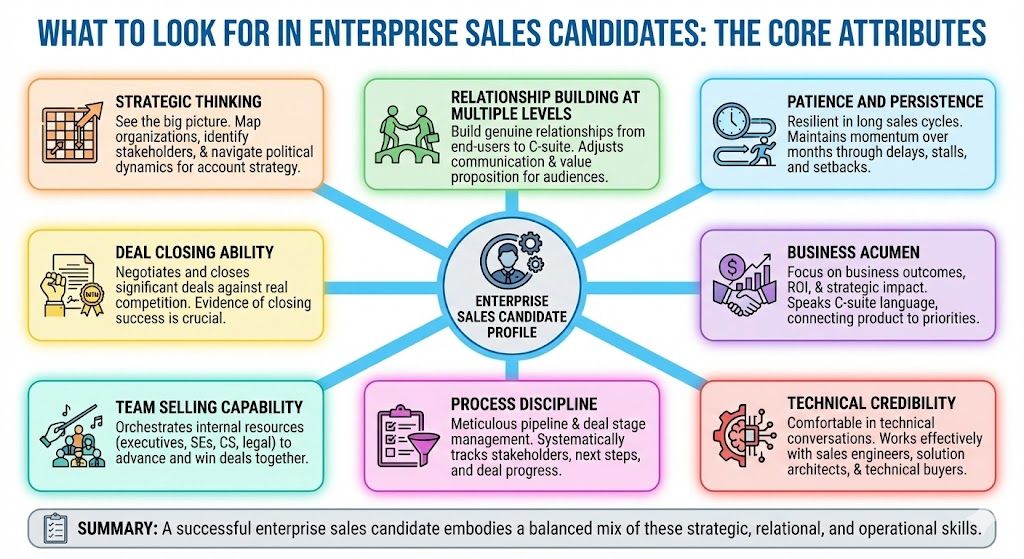
Enterprise selling requires a specific profile. Here’s what matters most:
Strategic thinking. Enterprise reps need to see the big picture. They should be able to map an organization, identify key stakeholders, understand political dynamics, and develop account strategies that navigate complexity.
Relationship building at multiple levels. Great enterprise reps build genuine relationships with everyone from end users to C-suite executives. They adjust their communication style and value proposition for different audiences.
Patience and persistence. Long sales cycles test resilience. Look for candidates who can maintain momentum over months without getting discouraged by the inevitable delays, stalls, and setbacks.
Business acumen. Enterprise buyers care about business outcomes, ROI, and strategic impact. Reps need to speak the language of the C-suite and connect your product to the buyer’s business priorities.
Technical credibility. While they don’t need to be engineers, enterprise reps should be comfortable in technical conversations and able to work effectively with sales engineers, solution architects, and technical buyers.
Process discipline. Managing enterprise deals requires meticulous attention to pipeline, forecasting, and deal stages. Strong enterprise reps have systems for tracking stakeholders, next steps, and deal progress.
Team selling capability. Enterprise deals are rarely won by a single rep. The best enterprise sellers know how to orchestrate internal resources, including executives, sales engineers, customer success, and legal, to advance deals.
Deal closing ability. All the relationship building in the world means nothing if they can’t close. Look for evidence they’ve negotiated and closed significant deals against real competition.
Interview Tactics for Enterprise Sales
Standard sales interviews often fail to reveal enterprise selling capability. Try these approaches:
Deep dive on past deals. Have candidates walk you through their largest closed deal in detail. How did they find the opportunity? Who were the stakeholders? What was the competition? How did they navigate internal politics? What almost killed the deal? How did they close it? The specificity of their answers reveals real experience.
Test account strategy thinking. Give them a target account scenario and ask them to outline an approach. How would they research the company? Who would they try to reach first? How would they map the organization? What would their initial outreach say? Look for strategic thinking, not just activity.
Explore their multi-threading approach. Ask how they typically engage multiple stakeholders in a deal. How do they identify the real decision makers? How do they handle champions who don’t have budget authority? How do they get access to executives? Strong enterprise reps have clear methods.
Probe their technical credibility. Ask them to explain a complex feature or integration from their current product. Can they handle technical conversations with confidence? Do they know when to bring in specialists?
Assess pipeline management. Ask them to describe their current pipeline. What stages do they use? How do they forecast? How do they prioritize opportunities? What’s their close rate? Strong enterprise reps know their numbers cold.
Reference check on deal involvement. When checking references, verify they actually led the deals they claim. Enterprise deals often involve multiple people, and some candidates take credit for team wins. Ask references specifically about the candidate’s role and contribution.
Red Flags to Watch For
Several warning signs suggest a candidate may struggle in enterprise sales:
- SMB mindset. If they talk about velocity, volume, and quick closes without acknowledging the different demands of enterprise, they may not understand what they’re getting into.
- Individual contributor mentality. Enterprise deals require team selling. Candidates who seem reluctant to involve others or who position themselves as lone wolves may struggle.
- Vague on deal specifics. If they can’t provide detailed walk-throughs of past deals, including stakeholders, objections, competition, and how they won, they may not have the experience they claim.
- Impatient timeline expectations. Candidates who ask about average time to first deal or seem anxious about long ramp periods may lack the patience enterprise sales requires.
- Over-reliance on relationships. Yes, relationships matter. But candidates who only talk about relationships without discussing strategy, process, or business value may struggle when they don’t have existing connections.
- Poor forecasting history. Ask about their forecast accuracy. Enterprise reps who consistently miss their calls may lack the deal qualification and pipeline management skills the role requires.
Compensation Considerations
Enterprise sales compensation reflects the longer cycles and larger deal values:
Higher base salaries. Enterprise reps typically command higher bases than SMB or mid-market reps, reflecting the longer ramp times and the experience required.
Variable tied to bookings. Compensation is usually tied to closed bookings or ARR, with significant upside for exceeding quota.
Longer measurement periods. Given longer sales cycles, many companies use quarterly or annual quotas rather than monthly targets. Some use rolling or annualized structures.
Accelerators for large deals. Many comp plans include accelerators that reward reps for closing deals above certain thresholds, reflecting the strategic value of large wins.
Multi-year considerations. For deals with multi-year commitments, clarify how compensation works. Do reps get paid on total contract value or annual value? How are renewals handled?
Review industry software sales compensation data to understand current market rates for enterprise roles.
Where to Find Enterprise Sales Talent
Enterprise reps are in high demand and rarely found through job postings alone:
- Competitors and adjacent companies. Reps selling similar products to similar buyers will ramp fastest. They already understand your market and may have existing relationships.
- Promote from within. Strong mid-market reps with the right attributes can move up to enterprise. This path takes longer but builds loyalty and institutional knowledge.
- Partner and channel sales. People from your partner ecosystem sometimes make strong enterprise hires. They already know your product and may have enterprise relationships.
- Executive recruiting. For senior enterprise roles, working with a software recruiting firm that specializes in sales can help you reach passive candidates at competitor companies.
Setting Enterprise Reps Up for Success
Hiring is only the beginning. Enterprise reps need proper support to succeed:
Extended ramp expectations. Don’t expect enterprise reps to close deals in their first quarter. Build in realistic ramp periods, typically six to nine months or longer, and set interim milestones around pipeline building and activity.
Strong sales engineering support. Enterprise deals require technical depth. Make sure your sales engineering team has capacity to support new enterprise reps effectively.
Executive access. Enterprise deals often require executive involvement. Be prepared to join calls, meet with key stakeholders, and support your reps in strategic accounts.
Clear territory or account assignments. Define which accounts belong to your enterprise team and how they’re assigned. Ambiguity creates conflict and wasted effort.
Proper tooling. Enterprise reps need CRM, prospecting tools, contract management, and collaboration platforms to manage complex deals effectively.
If you’re still building a sales team from scratch, consider whether you’re ready for enterprise sales. The motion requires more resources, longer timelines, and different skills than SMB or mid-market selling. Many companies find success moving upmarket gradually rather than jumping straight to enterprise.
The Bottom Line
Hiring enterprise sales reps for your software company is an investment in pursuing your largest opportunities. The right enterprise sellers can transform your revenue trajectory, opening doors to accounts that drive significant, strategic growth.
Take the time to find candidates with genuine enterprise experience, not just people who want to break into bigger deals. Evaluate their strategic thinking, relationship skills, and ability to navigate complexity. And set them up with the support, patience, and resources they need to succeed in a role where results take time to materialize.
Enterprise sales hiring is hard, but the payoff from getting it right is substantial.
Leave a Reply