

Channel sales can dramatically extend your reach without proportionally increasing your direct sales headcount. The right partners can open doors to markets, customers, and opportunities you’d never access on your own. But that potential only materializes if you have someone skilled at building and managing those partner relationships.
That’s where channel sales managers come in. They’re responsible for recruiting partners, enabling them to sell effectively, and driving revenue through indirect channels. It’s a unique role that blends relationship management, sales strategy, and operational discipline.
The stakes are real. According to Salesforce, more than 90% of their deals over $1 million have partners involved. For software companies pursuing significant revenue through indirect channels, the channel sales manager hire can make or break your partner program.
Here’s how to find and hire channel managers who can actually deliver results.
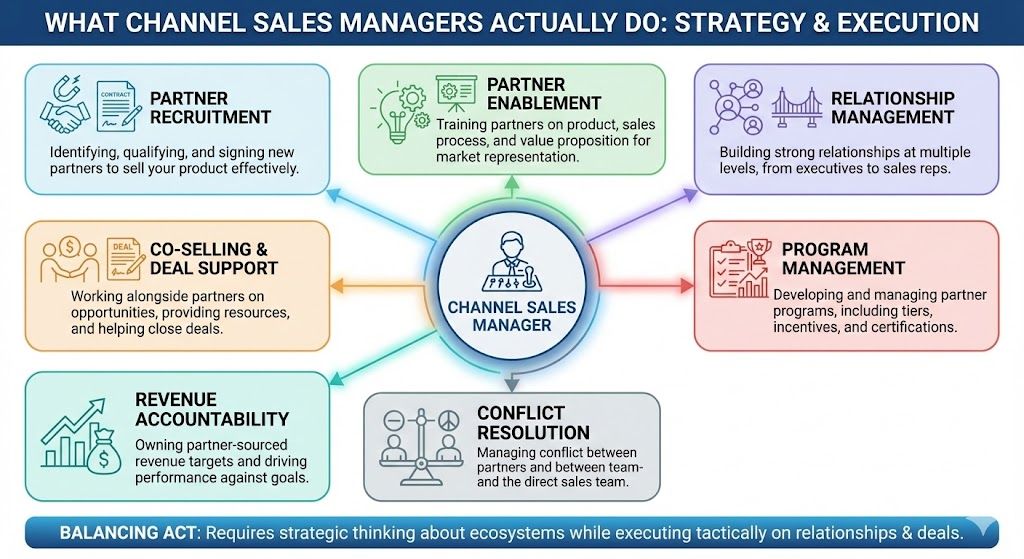
What Channel Sales Managers Actually Do
Before hiring, it helps to understand the scope of the role. Channel sales managers typically handle:
Partner recruitment. Identifying, qualifying, and signing new partners who can effectively sell your product to their customers.
Partner enablement. Training partners on your product, sales process, and value proposition so they can represent you effectively in the market.
Relationship management. Building and maintaining strong relationships with partner organizations at multiple levels, from executives to the sales reps who actually sell your product.
Co-selling and deal support. Working alongside partners on opportunities, providing resources, and helping close deals that benefit both parties.
Program management. Developing and managing partner programs, including tiers, incentives, certifications, and performance requirements.
Revenue accountability. Owning partner-sourced or partner-influenced revenue targets and driving performance against those goals.
Conflict resolution. Managing channel conflict between partners, and between partners and your direct sales team.
The role requires someone who can think strategically about partner ecosystems while also executing tactically on individual relationships and deals.
What to Look for in Channel Sales Candidates
Channel sales requires a distinct profile. Here’s what matters most:
Relationship building ability. Channel success depends on trust and mutual benefit. Look for candidates who can build genuine relationships, not just transactional arrangements.
Sales acumen. Channel managers need to understand the sales process deeply, even though they’re not always directly closing deals. They need to coach partners on how to sell your product effectively.
Business development mindset. Recruiting new partners is essentially business development. Look for candidates who are comfortable with outreach, prospecting, and pitching partnerships.
Training and enablement skills. Partners won’t sell what they don’t understand. Strong channel managers can teach, create training materials, and make complex products accessible.
Strategic thinking. The best channel managers think beyond individual partners to build a coherent ecosystem strategy. They understand which partner types drive the most value and focus accordingly.
Program management capability. Running a partner program involves logistics, incentives, tiers, certifications, and ongoing management. Look for organizational skills and attention to detail.
Conflict navigation. Channel conflict is inevitable. Whether between partners competing for the same deal or between partners and direct sales, channel managers need to mediate diplomatically.
Technical credibility. For software companies, channel managers need enough technical depth to have credibility with technical partners and to understand integration requirements.
Interview Tactics That Reveal True Capability
Standard sales interviews won’t surface what you need to know about channel candidates. Try these approaches:
Explore their partner recruitment track record. Ask them to describe how they’ve identified and signed new partners in previous roles. What made a partner attractive? How did they approach them? What was their close rate? How long did partnerships take to become productive?
Test their enablement approach. Have them describe how they’ve onboarded and trained partners. What materials did they create? How did they structure training? How did they measure whether partners were ready to sell? Strong channel managers have systematic approaches to enablement.
Present a co-selling scenario. Describe a deal involving a partner and ask how they would approach it. How would they coordinate with the partner? When would they get involved? How would they handle credit and compensation? Watch for collaborative thinking and deal awareness.
Probe their conflict resolution experience. Ask about times they’ve had to manage channel conflict. How did they handle a partner who felt undercut by direct sales? How did they deal with partners competing for the same customer? Look for diplomatic problem-solving.
Assess their ecosystem thinking. Ask them to describe the ideal partner ecosystem for a company like yours. What types of partners would they prioritize? How would they structure tiers? What incentives would drive the right behavior? Strategic thinkers have clear frameworks.
Reference check on partnership outcomes. When checking references, ask specifically about partner relationships. Did partners enjoy working with this person? Did partnerships become productive? Would partners work with them again?
Red Flags to Watch For
Several warning signs suggest a candidate may struggle in channel sales:
- Direct sales mindset. If they talk primarily about closing deals themselves rather than enabling others to close, they may not have the right orientation for channel.
- Transactional relationship approach. Partners can sense when they’re being used. Candidates who seem focused only on what they can extract from partnerships, rather than mutual value, will struggle to build lasting relationships.
- Vague on partner metrics. Strong channel managers know their numbers: partner recruitment rates, partner revenue contribution, deal registration conversion, etc. Vagueness suggests they weren’t closely managing performance.
- No enablement examples. If they can’t describe specific training programs, materials, or approaches they’ve created, they may not have the enablement capability the role requires.
- Avoids conflict discussion. Channel conflict is real. Candidates who claim they’ve never dealt with it either lack experience or aren’t being candid.
- Single partner type experience. If they’ve only worked with one type of partner (resellers only, or integrators only), they may struggle to build a diverse ecosystem.
Compensation Considerations
Channel sales manager compensation typically includes base salary plus variable pay tied to partner-sourced or partner-influenced revenue. A few principles:
Base and variable mix. Channel roles often have a higher base-to-variable ratio than direct sales because revenue through partners takes longer to develop and is less directly controllable.
Clear attribution model. Define upfront how partner-sourced vs. partner-influenced revenue will be tracked and credited. Ambiguity creates conflict and frustration.
Recruitment and activation incentives. Some companies add bonuses for signing new partners or getting partners to first revenue, reflecting the importance of building the ecosystem.
Long-term orientation. Partner relationships compound over time. Consider compensation structures that reward sustained partner performance, not just initial deals.
Review industry software sales compensation data to understand current market rates for channel roles at your stage and scale.
Where to Find Channel Sales Talent
Channel managers come from several backgrounds:
- Other software companies with partner programs. Candidates who’ve built or managed partner programs at similar companies understand the motion and can ramp quickly.
- Partners themselves. People from your partner ecosystem (resellers, integrators, consultants) understand the partner perspective and may have relationships you can leverage.
- Direct sales with partner experience. Strong direct salespeople who’ve worked closely with partners can transition to channel roles, though they need to adjust their orientation.
- Business development. BD professionals often have the relationship and deal-making skills channel requires, even if they haven’t specifically managed partner programs.
- Partner marketing. Marketing professionals focused on partner enablement and co-marketing sometimes move into channel sales roles.
For senior channel roles or when you need specific ecosystem expertise, working with a software recruiting firm can help you access candidates with relevant partner network relationships.
Setting Channel Managers Up for Success
Hiring is only the beginning. Channel managers need proper support to succeed:
Clear channel strategy. Before hiring, define what you want from your partner program. What types of partners? What markets? What revenue contribution? Without strategic direction, channel managers struggle to prioritize.
Executive sponsorship. Partner programs require investment and patience. Make sure leadership is committed to the long-term development of the channel, not expecting immediate returns.
Direct sales alignment. Nothing kills channel faster than conflict with direct sales. Establish clear rules of engagement, territory definitions, and deal registration processes before channel managers start recruiting partners.
Enablement resources. Partners need training, materials, and support. Give your channel manager budget and resources to create proper enablement programs.
Technology stack. Partner relationship management (PRM) systems, deal registration tools, and co-marketing platforms make channel management more efficient and scalable.
If you’re building a sales team from scratch, channel typically comes after you’ve established direct sales success. Partners need to see that your product sells before they’ll invest in learning and promoting it.
The Bottom Line
Recruiting channel sales managers for your software company is an investment in scalable growth through partnerships. The right channel manager can build an ecosystem that extends your reach, adds credibility, and drives revenue you’d never capture on your own.
Take the time to find candidates with genuine channel experience, not just direct salespeople looking for something different. Evaluate their ability to build relationships, enable partners, and think strategically about ecosystems. And set them up with the strategy, resources, and organizational alignment they need to succeed.
Channel programs take time to build, but the compounding returns from a well-managed partner ecosystem can transform your growth trajectory.
Leave a Reply