


A great sales engineer can be the difference between winning and losing a complex deal. They’re the ones who translate your product’s technical capabilities into business outcomes, handle the tough questions from IT teams, and build the credibility that gets buying committees to say yes.
But finding the right person for this role is tricky. You need someone who can go deep on technical details while also reading a room and adapting their message. That combination is rare, and getting the hire wrong means lost deals, frustrated AEs, and wasted ramp time.
Here’s how to identify and evaluate sales engineers who will actually move the needle for your software company.
Why Sales Engineers Matter More Than Ever
Software buying has become increasingly complex. Gartner research found that 77% of B2B buyers described their last purchase as “very complex or difficult”, with typical buying groups involving six to ten stakeholders. Each of those stakeholders has questions, concerns, and criteria that need addressing.
Your sales engineers are often the ones fielding those technical questions. They run the demos that make or break deals. They’re the credibility layer that gives prospects confidence your product will actually work in their environment.
When you hire the right SE, your AEs close more deals. When you hire the wrong one, opportunities stall and your technical reputation suffers.
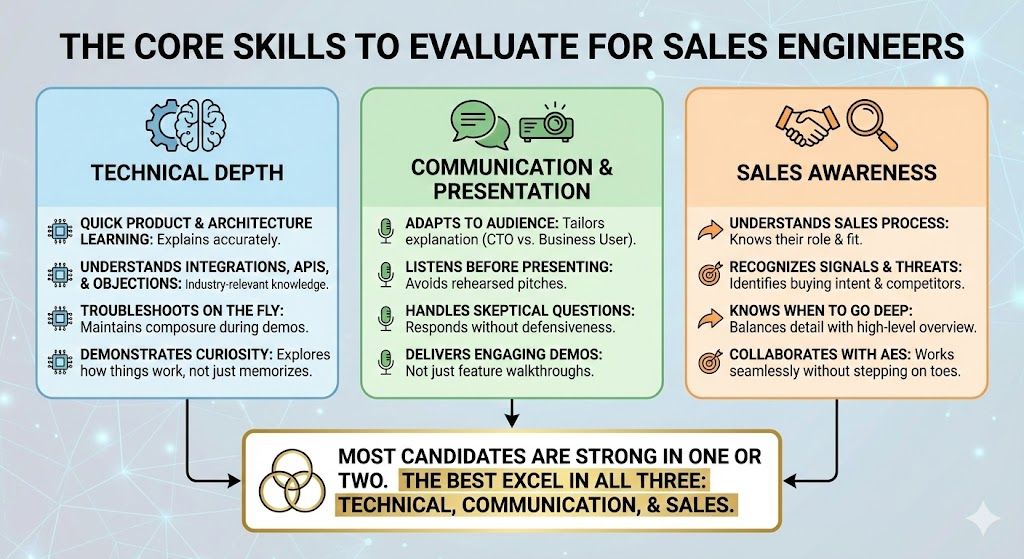
The Core Skills to Evaluate
Sales engineers need to excel in three distinct areas: technical knowledge, communication ability, and sales instincts. Most candidates are strong in one or two. The best are strong in all three.
Technical Depth
- Can they learn your product architecture quickly and explain it accurately?
- Do they understand integration patterns, APIs, and common technical objections in your space?
- Can they troubleshoot on the fly during a demo without losing composure?
- Are they curious about how things work, or do they just memorize talking points?
Communication and Presentation
- Can they adjust their explanation based on who they’re talking to (CTO vs. business user)?
- Do they listen before they present, or do they launch into a rehearsed pitch?
- Can they handle hostile or skeptical questions without getting defensive?
- Are their demos engaging, or do they feel like a feature walkthrough?
Sales Awareness
- Do they understand the sales process and where they fit in it?
- Can they recognize buying signals and competitive threats?
- Do they know when to go deep and when to keep things high-level?
- Can they work collaboratively with AEs without stepping on toes?
Interview Tactics That Reveal the Real Candidate
Generic interview questions won’t tell you much. Instead, put candidates in situations that mirror the actual job.
Give them a mock demo scenario. Provide basic information about a fictional prospect and ask them to deliver a 15-minute demo of a product they know well (ideally their current or previous company’s product). Watch for:
- How they open: Do they ask about the prospect’s priorities, or jump straight into features?
- How they handle interruptions: Can they field questions mid-demo without losing their thread?
- How they close: Do they summarize value and suggest next steps?
Run a technical deep-dive. Have one of your engineers ask increasingly detailed technical questions. You’re not looking for perfect answers. You’re looking for how they handle the edges of their knowledge:
- Do they admit when they don’t know something?
- Can they explain how they’d find the answer?
- Do they stay calm under pressure?
Test their discovery skills. Role-play as a prospect and have them run discovery. Strong SEs ask questions before they present. They dig into the business problem, the current state, and the evaluation criteria. Weak SEs start talking about features immediately.
Assess their collaboration style. Ask about times they disagreed with an AE about deal strategy. How did they handle it? The best SEs know how to push back constructively while supporting the overall sales motion.
Red Flags That Should Give You Pause
Watch out for these warning signs during the interview process:
- Demo-focused but not discovery-focused: SEs who love presenting but hate asking questions often miss what actually matters to the prospect.
- Can’t simplify complex concepts: If they can’t explain something to you in plain terms, they’ll struggle with non-technical stakeholders.
- Defensive about gaps in knowledge: The best SEs are comfortable saying “I don’t know, but here’s how I’d find out.”
- No curiosity about your product: If they haven’t researched your company and don’t have questions about your technology, they’re probably not that interested.
- History of conflict with sales teams: Probe for patterns. One bad experience is normal. Multiple conflicts suggest they struggle with the collaborative nature of the role.
- Overly scripted responses: Sales engineering requires adaptability. Candidates who can only operate from a script will struggle in live customer situations.
Where to Find Strong Candidates
Sales engineers with software experience are in high demand. Here’s where to look:
- Competing companies: SEs at competitors already understand your market and buyer personas.
- Customer success or professional services: Implementation consultants and CSMs often have the technical chops and customer-facing experience that transfers well.
- Technical support escalation teams: Senior support engineers who enjoy customer interaction sometimes make excellent SEs.
- Former developers with strong communication skills: Rare, but when you find them, they bring deep technical credibility.
- Referrals from your current SEs: Top performers know other top performers in the presales community.
If you’re struggling to find qualified candidates, working with a software recruiting firm that understands presales roles can accelerate your search significantly.
Structuring Compensation
Sales engineer compensation typically includes a base salary plus variable pay tied to team or individual performance. A few things to keep in mind:
- Base-heavy is the norm: Most SE comp plans run 70-80% base, 20-30% variable. This reflects the collaborative nature of the role.
- Tie variable to outcomes they influence: Pipeline generated, technical wins, or deal support metrics work better than pure revenue quota.
- Consider your AE ratios: If one SE supports multiple AEs, make sure comp reflects the broader impact.
- Stay competitive: SEs know their market value. Check current software sales compensation benchmarks before making offers.
Setting Your New SE Up for Success
The work doesn’t end once they accept the offer. Onboarding a sales engineer well makes a significant difference in their ramp time and effectiveness.
- Pair them with a strong AE early: Let them shadow real customer calls before they’re expected to lead.
- Give them product immersion time: SEs need deeper product knowledge than AEs. Build this into their first 30 days.
- Connect them with engineering and product teams: The best SEs build internal relationships that help them answer tough customer questions.
- Set clear expectations for demo readiness: Define what “ready to demo solo” looks like and give them a timeline.
If you’re building a sales team from scratch, timing your SE hire matters. Most companies hire their first SE after they have two or three AEs generating consistent pipeline. Before that, founders or senior AEs typically handle presales.
The Bottom Line
Hiring a sales engineer requires evaluating a unique blend of technical depth, communication skill, and sales awareness. The best candidates can go deep on architecture questions, adjust their message for different audiences, and work seamlessly with your sales team to close complex deals.
Take the time to structure your interviews around real scenarios rather than generic questions. Watch how candidates handle ambiguity, technical pressure, and the collaborative dynamics of the role. When you find the right person, you’re adding a significant competitive advantage to every deal they touch.
Leave a Reply