


Your SDR team is the front line of your sales organization. They’re the ones filling your pipeline, booking meetings for your Account Executives, and often making the first impression on prospective customers. Get this hire right, and you’re setting up your revenue engine for success. Get it wrong, and you’re burning time, money, and momentum.
Here’s the reality: hiring SDRs for software companies isn’t the same as hiring them for other industries. The technical complexity of your product, the sophistication of your buyers, and the pace of the SaaS market all demand a specific kind of candidate. Let’s break down what actually works.
Why SDR Hiring Matters More Than You Think
According to The Bridge Group’s SDR Metrics & Compensation Report, the average SDR tenure is just 1.5 years, with a ramp time of approximately 3.2 months. That means you’re looking at roughly 14 to 15 months of full productivity per hire.
Those numbers should make you pause. Every SDR hire is a significant investment, and the window for ROI is narrow. This makes your hiring process one of the highest-leverage activities in your sales organization.
What to Look for in a Software SDR
Forget the generic “hungry and coachable” advice. While those traits matter, software SDRs need specific capabilities:
- Technical curiosity: They don’t need to be engineers, but they should be genuinely interested in how software works and how it solves business problems.
- Research skills: The best SDRs dig into prospects before reaching out. They understand org structures, identify pain points, and personalize their approach.
- Written communication: Cold emails are a core part of the job. Look for candidates who can write clearly and persuasively without sounding like a template.
- Resilience without robotics: Rejection is constant in this role. You want someone who can handle it without becoming mechanical or disengaged.
- Pattern recognition: Strong SDRs start to see what works and what doesn’t. They adjust their approach based on what’s landing with prospects.
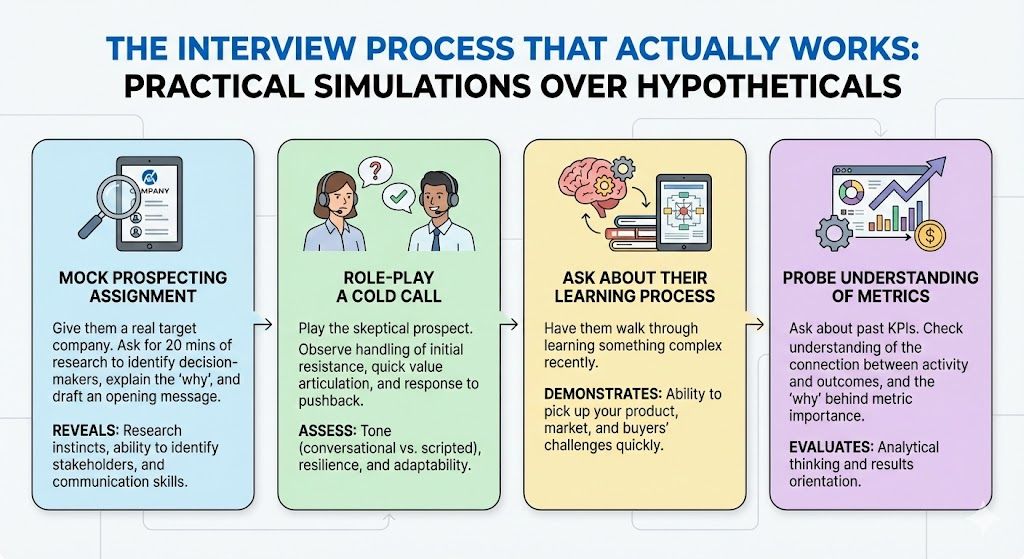
The Interview Process That Actually Works
Skip the hypothetical questions. Instead, focus on exercises that simulate the actual work:
- Give them a mock prospecting assignment
Provide the name of a real company in your target market. Ask them to spend 20 minutes researching and then explain who they’d reach out to, why, and what their opening message would say. This reveals their research instincts, their ability to identify decision-makers, and their communication skills.
- Role-play a cold call
You play the skeptical prospect. See how they handle initial resistance, whether they can articulate value quickly, and how they respond when pushed. Pay attention to their tone. Are they conversational or scripted?
- Ask about their learning process
Have them walk you through how they learned something complex recently. This shows you whether they can pick up your product, your market, and your buyers’ challenges.
- Probe their understanding of metrics
Ask what KPIs they’ve been measured on before. Do they understand the connection between activity and outcomes? Can they articulate why certain metrics matter?
Where to Find Strong SDR Candidates
The best SDRs aren’t always actively job hunting. Consider these sourcing strategies:
- Recent college graduates with relevant internships: Look for candidates who interned in sales, marketing, or customer-facing roles at tech companies.
- Career changers from adjacent fields: Former teachers, recruiters, and customer success reps often have the communication skills and resilience this role demands.
- Internal promotions: Your customer support or implementation team might have people hungry for a sales path.
- Referrals from your current team: Top performers tend to know other top performers.
- Specialized recruiters: Working with a software recruiting firm that understands the SaaS landscape can accelerate your search significantly.
Red Flags to Watch For
Some warning signs should make you think twice:
- Vague answers about past performance: If they can’t tell you their numbers, there’s usually a reason.
- No questions about your product or market: Genuine curiosity is essential. If they’re not asking, they’re not engaged.
- Overemphasis on automation tools: Tools matter, but the best SDRs understand that personalization drives results.
- Short tenure at multiple companies: One short stint is fine. A pattern suggests they either struggle to perform or get bored easily.
- Inability to handle rejection in the interview: If they get defensive or flustered during a role-play, they’ll struggle on the phones.
Structuring Compensation to Attract Top Talent
SDR compensation in software typically includes a base salary plus variable pay tied to meetings booked, qualified opportunities, or pipeline generated. A few principles to keep in mind:
- Keep the variable component achievable: If only 20% of your SDRs hit their targets, your comp plan needs adjustment.
- Tie incentives to quality, not just quantity: Meetings that no-show or leads that don’t convert shouldn’t pay the same as ones that do.
- Be transparent about OTE: Candidates talk. If your “on-target earnings” are only achievable by your single best performer, word gets around.
- Factor in your market: Compensation expectations vary significantly by geography and company stage. Review your software sales OTE benchmarks to stay competitive.
Onboarding for Faster Ramp
Your hiring process doesn’t end with an accepted offer. How you onboard determines how quickly your new SDR becomes productive.
- Product training should be ongoing, not one-and-done: Give them foundational knowledge in week one, then build on it over the first 90 days.
- Shadow calls and live coaching accelerate learning: Pair new SDRs with your top performers.
- Set realistic expectations for the first 30, 60, and 90 days: New hires should know exactly what success looks like at each milestone.
- Create feedback loops: Regular one-on-ones focused on skill development, not just pipeline reviews.
Building Your SDR Team for Long-Term Success
Hiring one great SDR is a win. Building a team that consistently performs requires more intentional planning:
- Document what works: When an SDR finds a message or approach that resonates, capture it and share it.
- Create career paths: The best SDRs want to know where this role leads. Whether that’s AE, sales management, or another function, map it out.
- Invest in management: One manager overseeing too many SDRs means nobody gets the coaching they need.
- Measure what matters: Track leading indicators like activity and conversations, but also lagging indicators like meeting quality and conversion rates.
If you’re building a sales team from scratch, getting your SDR foundation right is one of the most important early decisions you’ll make.
The Bottom Line
Hiring SDRs for a software company requires more than posting a job and hoping for the best. You need a clear profile of what success looks like, an interview process that reveals actual capability, and an onboarding program that sets new hires up to win.
The companies that consistently hire great SDRs treat it as a core competency, not an afterthought. Given how directly this role impacts your pipeline, that investment pays off.
Leave a Reply