


Software sales professionals can leverage AI to research prospects faster, personalize outreach at scale, prepare for meetings more thoroughly, and handle administrative tasks that used to consume hours each week. The salespeople who learn to use these tools effectively will outperform those who don’t. But AI won’t replace skilled software salespeople anytime soon. Complex enterprise deals still require human judgment, relationship building, and the ability to navigate organizational politics that no algorithm can replicate.
The question isn’t whether AI will affect your career in software sales. It already is. The question is whether you’ll use it to become more effective or watch others pull ahead while you stick with old methods.
This guide covers how AI is changing software sales, which tools you should know, practical applications for prospecting and deal management, and the skills that will matter most as the technology evolves.
How AI Is Changing the Software Sales Landscape
AI has moved from buzzword to daily reality in software sales. Understanding how it’s changing the landscape helps you adapt strategically rather than reactively.
Buyer expectations have shifted. Your prospects are using AI too. They’re researching solutions with ChatGPT before they ever talk to a salesperson. They’re asking AI tools to compare vendors, summarize capabilities, and identify questions to ask during demos. According to research from Gartner, 75% of B2B buyers prefer a rep-free sales experience when possible. This doesn’t mean salespeople are obsolete. It means the bar for adding value in conversations is higher than ever.
Personalization has scaled. The days of sending the same email to 500 prospects are ending. AI enables personalization that was previously impossible without massive time investment. Salespeople who still rely on generic templates are increasingly ignored while those using AI to personalize outreach see better response rates.
Research happens in minutes, not hours. Understanding a prospect’s business, recent news, competitive landscape, and potential pain points used to take significant preparation time. AI tools compress this research dramatically. Salespeople can now walk into meetings with deeper context than was practical before.
Administrative burden is decreasing. Note taking, CRM updates, follow-up drafting, meeting scheduling. These tasks consumed a substantial portion of selling time. AI handles much of this now, freeing salespeople to spend more time actually selling.
New competitive dynamics are emerging. Companies that adopt AI-enhanced sales processes are moving faster than those that don’t. Their reps are more prepared, more responsive, and more efficient. If you’re competing against AI-enabled salespeople and you’re not using these tools yourself, you’re operating at a disadvantage.
None of this means AI replaces the core skills that make software salespeople successful. But it does mean the baseline expectations for preparation, responsiveness, and personalization are rising.
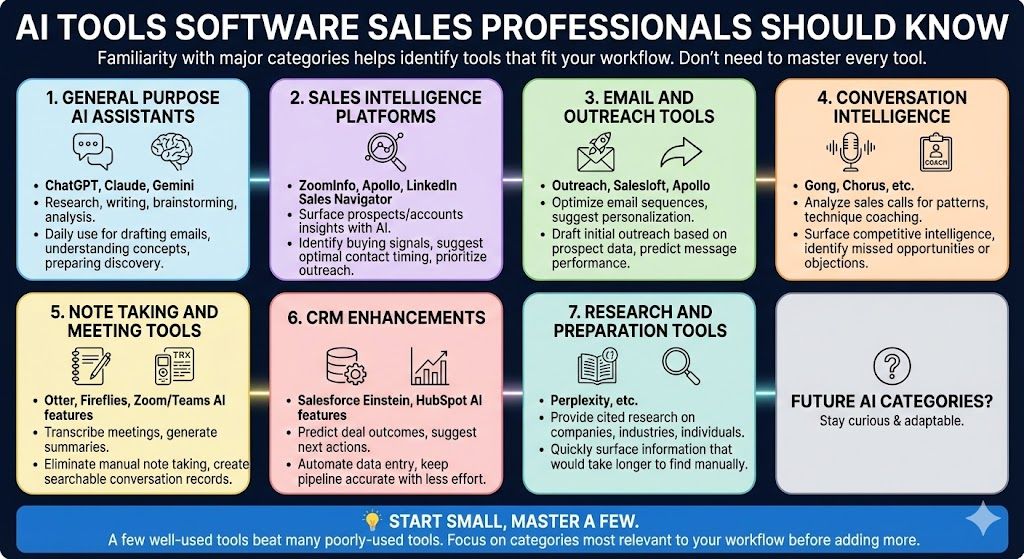
AI Tools Software Sales Professionals Should Know
You don’t need to master every AI tool on the market. But familiarity with the major categories helps you identify which tools fit your workflow.
General purpose AI assistants. ChatGPT, Claude, and Gemini are the foundational tools. They help with research, writing, brainstorming, and analysis. Most software salespeople should be using at least one of these daily. They’re useful for everything from drafting emails to understanding technical concepts to preparing discovery questions.
Sales intelligence platforms. Tools like ZoomInfo, Apollo, and LinkedIn Sales Navigator now incorporate AI to surface insights about prospects and accounts. They identify buying signals, suggest optimal contact timing, and help prioritize outreach.
Email and outreach tools. Platforms like Outreach, Salesloft, and Apollo use AI to optimize email sequences, suggest personalization, and predict which messages will perform best. Some can draft initial outreach based on prospect data.
Conversation intelligence. Gong, Chorus, and similar tools analyze sales calls to identify patterns, coach on technique, and surface competitive intelligence. They can tell you when you’re talking too much, missing discovery opportunities, or failing to address key objections.
Note taking and meeting tools. Otter, Fireflies, and built-in AI features in Zoom and Teams transcribe meetings and generate summaries. This eliminates the distraction of manual note taking and creates searchable records of every conversation.
CRM enhancements. Salesforce Einstein, HubSpot’s AI features, and similar tools predict deal outcomes, suggest next actions, and automate data entry. They help keep your pipeline accurate with less manual effort.
Research and preparation tools. Tools like Perplexity provide cited research on companies, industries, and individuals. They can quickly surface information that would take much longer to find through traditional search.
Start with one or two tools in categories most relevant to your workflow. Master those before adding more. A few tools used well beats many tools used poorly.
Using AI for Prospecting and Research
Prospecting and account research are where AI delivers some of the most immediate time savings. Here’s how to apply it practically.
Company research in minutes. Before AI, researching a target account meant scanning their website, reading recent press releases, checking LinkedIn, and searching for news articles. This could take 30 minutes or more per account.
Now you can prompt an AI assistant with something like: “Give me a summary of [Company Name], including their main products, recent news, key executives, and potential challenges they might be facing.” You’ll get a solid overview in seconds that you can verify and expand on.
Understanding industry context. Let’s say you’re selling to manufacturing companies but don’t have deep industry expertise. AI can help you get up to speed quickly. Ask about industry trends, common challenges, regulatory factors, and competitive dynamics. Use this context to ask better discovery questions and position your solution more effectively.
Identifying pain points. Based on company and industry research, AI can help you hypothesize potential pain points before you ever speak with a prospect. “Based on what you know about mid-size manufacturing companies, what are the most common challenges with supply chain visibility?” This gives you a starting point for discovery conversations.
Personalizing outreach at scale. Generic outreach gets ignored. But truly personalized outreach to hundreds of prospects isn’t practical manually. AI helps bridge this gap.
Imagine you’re reaching out to a prospect. You can feed AI their LinkedIn profile, recent company news, and job description, then ask it to draft an email that references something specific and relevant. The output needs editing, but it’s a much better starting point than a generic template.
Qualifying prospects before conversations. AI can help you assess whether a prospect fits your ideal customer profile before you invest time in outreach. Feed it the information you have and ask it to evaluate fit against your criteria. This helps you prioritize higher-probability opportunities.
Preparing discovery questions. Based on your research, AI can suggest discovery questions tailored to the specific prospect and their likely situation. This is especially useful when you’re selling into unfamiliar industries or dealing with complex use cases.
The key is using AI to augment your judgment, not replace it. AI gives you a starting point. Your experience and intuition refine it into something truly effective.
AI-Assisted Deal Preparation and Proposals
Beyond prospecting, AI adds significant value in how you prepare for meetings and develop proposals.
Pre-meeting preparation. Before an important meeting, you can use AI to compile everything you know about the account, the stakeholders, and where the deal stands. Ask it to identify potential objections based on the prospect’s situation and suggest how to address them. Ask it to role-play as a skeptical CFO so you can practice handling tough questions.
Creating account plans. For strategic accounts, AI can help you build comprehensive account plans. Provide it with information about the company, the stakeholders you’ve identified, the competitive landscape, and your solution’s strengths. Ask it to outline a strategy for winning the account, including potential champions, likely objectors, and key milestones.
Competitive positioning. When you know a competitor is in a deal, AI can help you prepare. Ask it to outline the competitor’s strengths and weaknesses, suggest questions that highlight their gaps, and develop talk tracks for common objections. Combine this with your own competitive knowledge for a more complete picture.
Proposal and presentation drafting. AI can create first drafts of proposals, executive summaries, and presentations based on the information you provide. It won’t produce finished work, but it handles the blank page problem and gives you something to refine rather than starting from scratch.
Business case development. Building ROI models and business cases for prospects is time-consuming. AI can help structure these documents, suggest relevant metrics, and even draft initial calculations based on industry benchmarks. You’ll need to validate the numbers, but the framework comes together much faster.
Follow-up communication. After meetings, AI can draft follow-up emails that summarize key points, confirm next steps, and reinforce your value proposition. Based on meeting notes or transcripts, it can capture details you might otherwise forget.
Contract and negotiation prep. While you shouldn’t rely on AI for legal advice, it can help you prepare for negotiations. Ask it to identify potential sticking points in standard contract terms, suggest concessions you might offer, or outline a negotiation strategy based on the prospect’s priorities.
One important note: be careful about sharing confidential information with AI tools. Understand your company’s policies and the privacy implications of the tools you use. Some information shouldn’t be entered into external AI systems.
Protecting Your Value in an AI-Driven Sales Environment
If AI can do research, write emails, and prepare proposals, what’s left for salespeople? Quite a lot, actually. But you need to be intentional about where you focus.
Double down on relationships. AI can’t build trust. It can’t take a prospect to dinner. It can’t read body language in a meeting or sense when something is off in a deal. Human connection remains essential in complex B2B sales. The salespeople who invest most heavily in relationships will differentiate themselves as AI handles more transactional tasks.
Develop deeper business acumen. AI can summarize what a company does. It can’t truly understand how their business works, where the political tensions lie, or what would make a specific executive look good to their board. Enterprise software sales rewards people who genuinely understand business problems, not just those who can research surface-level information.
Get better at asking questions. AI can suggest discovery questions. But the real skill is knowing which question to ask next based on what the prospect just said. Great salespeople listen actively and dig deeper. They notice what isn’t being said. This remains deeply human.
Navigate complex organizations. Enterprise deals involve multiple stakeholders with competing interests. Mapping these relationships, identifying champions, handling objectors, and building consensus requires human judgment that AI can’t replicate. If you want to protect your career in software sales, get very good at navigating complexity.
Bring strategic insight. Anyone can summarize a prospect’s business. Fewer salespeople can connect the dots between what a prospect is trying to accomplish and how your solution uniquely enables that. Strategic thinking and consultative selling become more valuable as basic research becomes commoditized.
Stay current on AI itself. Your prospects are figuring out how to use AI in their own businesses. If you understand the technology, you can have more relevant conversations. If you’re selling software that involves AI or data, this becomes essential.
The salespeople at risk are those who relied on effort quantity over quality. Sending more emails, making more calls, working longer hours. AI eliminates much of the advantage that pure effort provided. The salespeople who thrive will be those who bring judgment, creativity, and human connection that AI can’t replicate.
Skills That Will Matter More as AI Advances
As AI handles more routine tasks, certain human skills become more valuable. Focus your development here.
Critical thinking. AI produces confident-sounding output that’s sometimes wrong. The ability to evaluate AI suggestions, catch errors, and know when something doesn’t make sense separates effective AI users from those who blindly trust the output. Question what AI tells you. Verify important facts. Apply your own judgment.
Communication and storytelling. AI can draft messages, but the most persuasive communication still comes from humans who understand their audience deeply. Storytelling, emotional intelligence, and the ability to inspire remain human strengths. Getting promoted in your career increasingly depends on these skills.
Creativity and problem-solving. When deals get stuck or prospects have unusual requirements, creative solutions move things forward. AI can suggest conventional approaches. Humans identify the unconventional moves that win difficult deals.
Adaptability. AI tools and capabilities evolve constantly. The specific tools you use today will change. The ability to learn new tools quickly, adapt your workflows, and stay current matters more than mastering any specific technology.
Emotional intelligence. Understanding what prospects and colleagues are feeling, reading rooms, navigating difficult conversations. These skills don’t automate away. In fact, they become more valuable as other tasks get automated.
Technical fluency. Understanding how AI tools work helps you use them more effectively and have more relevant conversations with prospects. You don’t need to be an engineer, but curiosity about technology pays dividends.
Time and attention management. With AI handling many routine tasks, how you spend your freed-up time determines whether you actually become more productive. Discipline about focusing on high-value activities becomes essential.
The pattern here is clear. Routine, repeatable tasks get automated. Judgment, creativity, and human connection become premium skills. Invest accordingly.
Getting Started With AI in Your Sales Workflow
If you’re not already using AI in your sales work, here’s how to start without getting overwhelmed.
Start with one tool. Pick either ChatGPT, Claude, or Gemini. These general-purpose assistants handle most common use cases. Use it daily for a month before adding other tools. Get comfortable with prompting and understand what it does well and where it falls short.
Begin with low-risk applications. Use AI to help with research, brainstorm ideas, or draft internal communications before using it for client-facing work. Build confidence with lower-stakes applications first.
Develop your prompting skills. The quality of AI output depends heavily on how you ask. Be specific about what you want. Provide context. Ask for multiple options. Tell it to take on a specific perspective. The more you practice, the better results you’ll get.
Create templates for common tasks. Once you find prompts that work well, save them. Build a library of templates for prospect research, email drafting, meeting preparation, and other recurring tasks. This accelerates your workflow and ensures consistency.
Verify important output. Don’t trust AI blindly, especially for facts about specific companies or individuals. AI can hallucinate, confidently stating things that aren’t true. Always verify information that matters before using it in prospect conversations.
Share what works with your team. If you discover effective AI applications, share them. Sales teams that learn together improve faster. This also raises your profile as someone who helps others succeed.
Stay curious. New tools and capabilities emerge constantly. Set aside time to explore what’s new. Follow thought leaders who cover AI in sales. Experiment with new approaches. The salespeople who stay curious will stay ahead.
AI in software sales is still early. The playbooks are being written in real time. The salespeople who engage now, learn what works, and develop AI-enhanced workflows will have a significant advantage over those who wait.
Your next career opportunity will likely ask about your AI proficiency. Start building those skills today.
Leave a Reply