


Your sales resume has one job: get you an interview. That’s it. It doesn’t need to tell your entire career story or showcase every deal you’ve closed. It needs to convince a recruiter or hiring manager, often in under 30 seconds, that you’re worth a phone call. The resumes that accomplish this share specific characteristics: they lead with results, they’re tailored to the role, and they prove impact with numbers rather than vague claims about being a “motivated self-starter.”
The data backs this up. Research from TalentWorks found that resumes with quantified achievements increase interview rates by 40% compared to those without metrics. For sales professionals, this should be obvious. You spend your days talking about ROI, pipeline value, and quota attainment. Your resume should speak the same language.
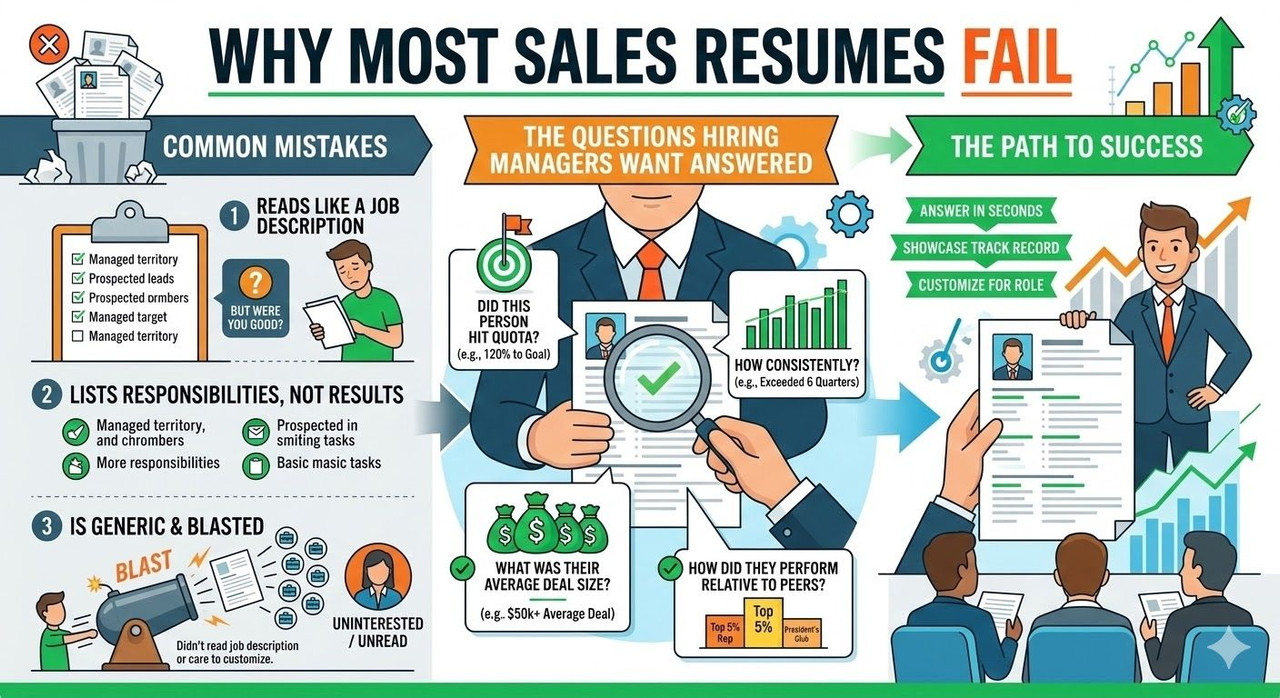
Why Most Sales Resumes Fail
The typical sales resume reads like a job description, not a track record of success. It lists responsibilities instead of results. It says things like “managed a territory” or “responsible for prospecting” without any indication of whether the person was actually good at those things.
Hiring managers reviewing sales resumes want answers to specific questions:
- Did this person hit quota?
- How consistently?
- What was their average deal size?
- How did they perform relative to peers?
If your resume doesn’t answer these questions within the first few seconds of scanning, you’ve already lost.
The other common mistake is writing one generic resume and blasting it to every job posting. Recruiters can tell. When your resume doesn’t reflect the specific requirements of the role, it signals that you either didn’t read the job description or didn’t care enough to customize your application.
The Structure That Works
A strong sales resume follows a predictable format that hiring managers can scan quickly. Here’s the framework:
Contact information and LinkedIn URL. Make sure your LinkedIn profile matches your resume and is complete. Many recruiters check LinkedIn before deciding whether to call you.
Professional summary (3-4 lines max). This isn’t an objective statement about what you want. It’s a quick snapshot of who you are professionally and what you’ve accomplished. Include your years of experience, the types of sales you’ve done, and one or two headline metrics.
Work experience with quantified achievements. This is the core of your resume. Each role should include your title, company name, dates, and 3-5 bullet points highlighting specific accomplishments with numbers attached.
Skills section. List relevant tools, methodologies, and technical skills. For software sales, this might include CRM platforms, sales engagement tools, and familiarity with specific tech stacks.
Education. Unless you’re early in your career, this belongs at the bottom and can be brief.
Quantifying Your Sales Achievements
Numbers transform weak resume bullets into compelling evidence. Here’s how to think about quantifying your experience:
Quota attainment. This is the most important metric for any sales role. Include your attainment percentage and specify the timeframe. “Achieved 118% of quota in 2024” tells a clear story. If you’ve consistently hit quota over multiple years, say so.
Rankings and awards. “Ranked #2 of 45 AEs in North America” or “President’s Club 2023, 2024” provides instant context about how you performed relative to peers.
Pipeline and revenue. Include the dollar amounts you’ve influenced. “Generated $2.4M in pipeline through outbound prospecting” or “Closed $1.8M in new business ARR” gives concrete scale to your contributions.
Activity metrics (for SDRs). If you’re earlier in your career, include relevant activity and conversion numbers. “Booked 47 qualified meetings per month, 22% above team average” shows both output and relative performance.
Deal metrics. Average deal size, sales cycle length, and win rates all help paint a picture. “Maintained 34% win rate on deals over $50K” demonstrates consistent performance on meaningful opportunities.
If you don’t know your exact numbers, estimate conservatively and be prepared to discuss your methodology in interviews. Rough numbers are better than no numbers.
Tailoring Your Resume to Each Role
The companies getting the best candidates are flooded with applications. To stand out, your resume needs to feel like it was written specifically for the job you’re applying to.
Start by reading the job description carefully. Identify the key requirements, the tools they mention, the type of sales motion (inbound vs. outbound, SMB vs. enterprise), and any specific experience they’re seeking.
Then adjust your resume accordingly:
- Mirror their language. If they say “enterprise sales,” don’t call it “large account sales.”
- Lead with the most relevant experience. If they want someone who’s sold into healthcare, move your healthcare wins to the top of each role’s bullet points.
- Match the scope. If they’re hiring for a role selling $500K deals, emphasize your experience with complex, high-value sales cycles.
This doesn’t mean lying or inventing experience. It means presenting your genuine background in a way that aligns with what they’re looking for.
Common Mistakes to Avoid
Focusing on responsibilities instead of results. “Managed a book of 150 accounts” tells me nothing about whether you did it well. “Grew account base from 150 to 210 accounts while increasing average deal size by 23%” tells a story of success.
Using vague language. Words like “helped,” “assisted,” and “contributed to” make you sound like a supporting player rather than a driver of results. Use strong action verbs: generated, closed, exceeded, launched, built.
Including irrelevant information. Your resume doesn’t need to list every job you’ve ever had. Focus on the last 10-15 years and the roles most relevant to the position you’re targeting.
Making it too long. For most sales professionals with under 15 years of experience, one page is sufficient. Two pages maximum for senior roles with extensive relevant experience.
Burying your best achievements. Recruiters scan resumes top to bottom, left to right. Put your strongest metrics near the top of each section where they’ll be seen immediately.
Typos and formatting errors. Sales is a detail-oriented profession. Sloppy resumes suggest sloppy work habits. Proofread carefully and have someone else review it before sending.
What to Include in Your Summary
Your professional summary is prime real estate. Use it wisely. Here’s a formula that works:
[Years of experience] + [Type of sales] + [Industry focus] + [Key achievement or differentiator]
For example: “Enterprise software sales professional with 6 years of experience selling SaaS solutions to Fortune 500 companies. Consistent top performer, achieving 110%+ of quota in 5 of the last 6 years. Experienced in complex, multi-stakeholder sales cycles with deal sizes ranging from $250K to $1.2M.”
This summary tells the reader exactly who you are and whether you might be a fit, all in three sentences.
Making Your Resume ATS-Friendly
Many companies use Applicant Tracking Systems to filter resumes before a human ever sees them. To get through these systems:
- Use standard section headings (Work Experience, Education, Skills)
- Include keywords from the job description naturally throughout your resume
- Avoid tables, graphics, and unusual formatting that ATS systems struggle to parse
- Submit in the format requested (usually PDF or Word)
- Don’t try to game the system by hiding keywords in white text; modern ATS can detect this
Final Review Checklist
Before submitting your resume, confirm:
- Every bullet point includes a quantified result or specific achievement
- The resume is tailored to the specific role and company
- Your most impressive metrics appear in the top third of the document
- There are no typos, grammatical errors, or formatting inconsistencies
- The document is easy to scan in under 30 seconds
- Your contact information and LinkedIn URL are current and correct
Your resume is a sales document, and you’re the product. Apply the same rigor you’d use when crafting a proposal for a prospect. Lead with value, prove your claims with data, and make it easy for the buyer to say yes.
Leave a Reply