


The promotion from SDR to Account Executive is the most common career move in software sales, but it’s far from guaranteed. Most SDRs spend 12 to 24 months in their role before earning an AE seat, and the ones who get there fastest share specific habits and mindsets that set them apart. If you want to close deals instead of just booking meetings, you need to start preparing now, not when the promotion conversation begins.
Here’s the uncomfortable truth about this transition: research from The Bridge Group found that 26% of SDRs who get promoted to AE ultimately fail in the role. Even more striking, the failure rate jumps to 55% for SDRs with less than 12 months of experience. But for those who spent 16 months or more as an SDR before promotion, the failure rate dropped to just 6%. The data is clear: rushing the transition hurts your long-term success.
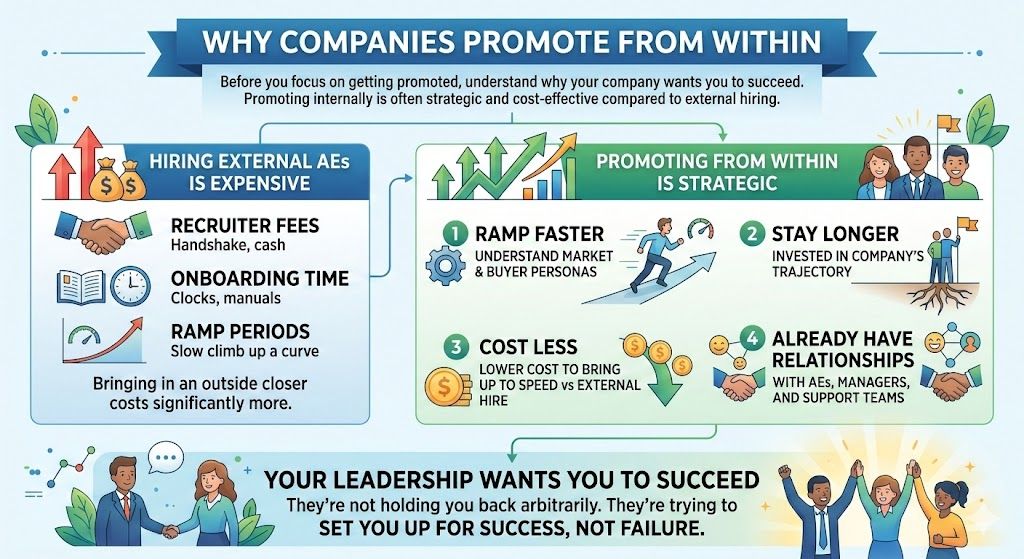
Why Companies Promote From Within
Before you focus on getting promoted, understand why your company wants you to succeed. Hiring external AEs is expensive. Between recruiter fees, onboarding time, and ramp periods, bringing in an outside closer costs significantly more than promoting someone who already knows the product, the customers, and the culture.
When you get promoted internally, you typically:
- Ramp faster because you understand the market and buyer personas
- Stay longer because you’re invested in the company’s trajectory
- Cost less to bring up to speed than an external hire
- Already have relationships with the AEs, managers, and support teams you’ll work with
This means your manager and leadership genuinely want you to earn that promotion. They’re not holding you back arbitrarily. They’re trying to set you up for success, not failure.
The Skills Gap Most SDRs Underestimate
Many SDRs look at Account Executives and think the job looks easier. No more cold calling. No more grinding through 80 dials a day. Just take meetings and close deals.
This perception is dangerously wrong.
As an SDR, you can brute force your results. More activity generally equals more output. The AE role doesn’t work that way. You’re managing multiple stakeholders across different deals, each at various stages, with unique objections and timelines. One wrong move in a negotiation can cost you a six-figure deal you’ve worked on for months.
The rejection also hits differently. When a prospect ghosts you as an SDR, you move on to the next one. When you lose a deal you’ve spent three months nurturing, it stings. You start questioning your abilities in ways you never did while booking meetings.
Skills you need to develop before promotion:
- Discovery and qualification depth: You’re not just confirming BANT criteria anymore. You need to uncover pain, understand buying processes, and identify all the stakeholders involved.
- Multithreading: Great AEs build relationships with multiple contacts at each account. If your champion leaves, you still have a path forward.
- Pipeline management: Forecasting accurately, knowing which deals will close and which are at risk, and managing your time across opportunities at different stages.
- Negotiation: Handling pricing objections, navigating procurement, and knowing when to hold firm versus when to flex.
- Presentation skills: Running demos that connect product capabilities to specific business outcomes, not just feature tours.
What Hiring Managers Actually Look For
When your sales leadership evaluates you for promotion, they’re trying to minimize risk. They’re asking themselves: “If I give this person an AE seat, will they hit quota or will I be backfilling their role in six months?”
Here’s what builds their confidence:
Consistent quota attainment. Not one great month followed by two mediocre ones. They want to see sustained performance over multiple quarters. If you haven’t strung together at least 12 months of hitting your numbers, you probably aren’t ready.
Quality of opportunities. Are the meetings you book actually converting to pipeline and revenue? AE feedback matters here. If the closers on your team respect your work and fight to get your meetings, that signals you understand what makes a real opportunity.
Ownership mentality. Do you just pass off meetings, or do you follow up to see what happened? Do you ask AEs what made certain deals close and others stall? This curiosity shows you’re already thinking like a closer.
Self-directed learning. The SDRs who get promoted fastest don’t wait for the company to train them. They’re listening to recorded calls, reading sales books, asking AEs to let them shadow negotiations. They’re building skills before they need them.
How to Accelerate Your Timeline
You can’t skip steps, but you can move through them faster with the right approach.
Get exposure to the full sales cycle. Ask to shadow discovery calls, demos, and negotiation meetings. Some companies will let high-performing SDRs assist on smaller deals or run parts of the sales process under supervision. Volunteer for these opportunities.
Build relationships with AEs you respect. Not just your direct partner, but the top performers on the team. Take them to coffee. Ask specific questions about deals they’ve won and lost. Learn how they manage their time, organize their pipeline, and handle objections.
Study the product deeply. Most SDRs know enough to book a meeting. AEs need to understand how the product solves problems at a much deeper level. Spend time with solutions consultants or sales engineers. Learn the technical details that matter to buyers.
Create your own training plan. Map out the skills you need to develop over the next six months. Read books on negotiation and closing. Listen to podcasts about enterprise selling. Practice demos on your own time. When you walk into your promotion interview, you should be able to show exactly how you’ve prepared.
Ask for explicit criteria. Sit down with your manager and ask what specific metrics and behaviors qualify you for AE consideration. Get it in writing if possible. Then track your progress against those benchmarks and review it in your one-on-ones.
Mistakes That Derail Promotions
Some SDRs sabotage their own chances without realizing it.
Publicly complaining about the timeline. Expressing frustration about not being promoted yet signals immaturity. Leadership notices, and it counts against you.
Letting performance slip while focused on promotion. If your quota attainment drops because you’re spending all your time shadowing AEs, you’ve proven you can’t handle the multitasking required to close deals.
Jumping ship too early. Leaving for an AE role at another company might seem like a shortcut, but you’ll arrive without product knowledge, without relationships, and without the support system you’ve built. The failure rate for external AE hires is often higher than internal promotions.
Assuming the promotion means easier work. Walk in expecting to work less and you’ll fail. The AEs who succeed treat the role as more demanding than their SDR days, not less.
Playing the Long Game
Your career in sales will span decades. Whether you get promoted in 12 months or 18 months matters far less than whether you succeed once you get there.
The SDRs who build lasting AE careers treat the transition as a skill development period, not just a waiting period. They arrive in their closing role with genuine confidence because they’ve done the work. They don’t just want the title and the higher OTE. They want to be genuinely ready to perform.
If you’re six months into your SDR role and itching for promotion, redirect that energy into preparation. Learn the sales cycle. Study the product. Build relationships. Track your performance metrics and celebrate consistency over occasional spikes.
The promotion will come. Make sure you’re ready when it does.
Leave a Reply