


Most candidates don’t negotiate job offers, and they leave significant money on the table because of it. In sales, where compensation directly reflects the value you bring, failing to negotiate is especially costly. The good news: negotiation works. A Fidelity Investments survey found that 85% of Americans who countered on salary, benefits, or other compensation received at least some of what they asked for. Companies expect you to negotiate. The question isn’t whether you should, but how to do it well.
Understand the Full Package Before You Negotiate
Sales compensation isn’t just base salary. Before you can negotiate effectively, you need to understand all the components of your offer. A strong offer letter should include:
- Base salary: Your guaranteed annual pay
- On-target earnings (OTE): Total compensation if you hit 100% of quota
- Commission structure: How variable pay is calculated and when it’s paid
- Quota: The target you’re expected to hit
- Ramp period: How quota and commission work during your first months
- Accelerators: Higher commission rates for exceeding quota
- Benefits: Health insurance, 401(k) match, equity, PTO
When evaluating offers, look beyond base salary. A $90K base with a $180K OTE and realistic quotas might be better than a $100K base with a $200K OTE tied to unattainable targets. Ask questions about quota attainment across the team. If most reps hit 80-120% of quota, the OTE is realistic. If average attainment is 60%, the advertised OTE is misleading.
Understanding how software companies design compensation plans helps you evaluate whether an offer is competitive and identify which elements might have flexibility.
Research Your Market Value
You can’t negotiate effectively without knowing what similar roles pay. Do your homework before any compensation conversation.
Resources for sales compensation research:
- RepVue: Crowdsourced data on quota attainment, compensation, and culture at specific companies
- Glassdoor and Levels.fyi: Salary ranges by company and role
- Payscale and Salary.com: Industry benchmarks by geography and experience level
- LinkedIn: Job postings often include salary ranges, especially in states with pay transparency laws
- Your network: Current and former colleagues in similar roles can share what’s realistic
When researching, account for variables that affect pay: geography, company stage, deal size, and your experience level. An enterprise AE in San Francisco commands different compensation than an SMB AE in Austin. Be honest about where you fall on the spectrum.
Know What’s Negotiable
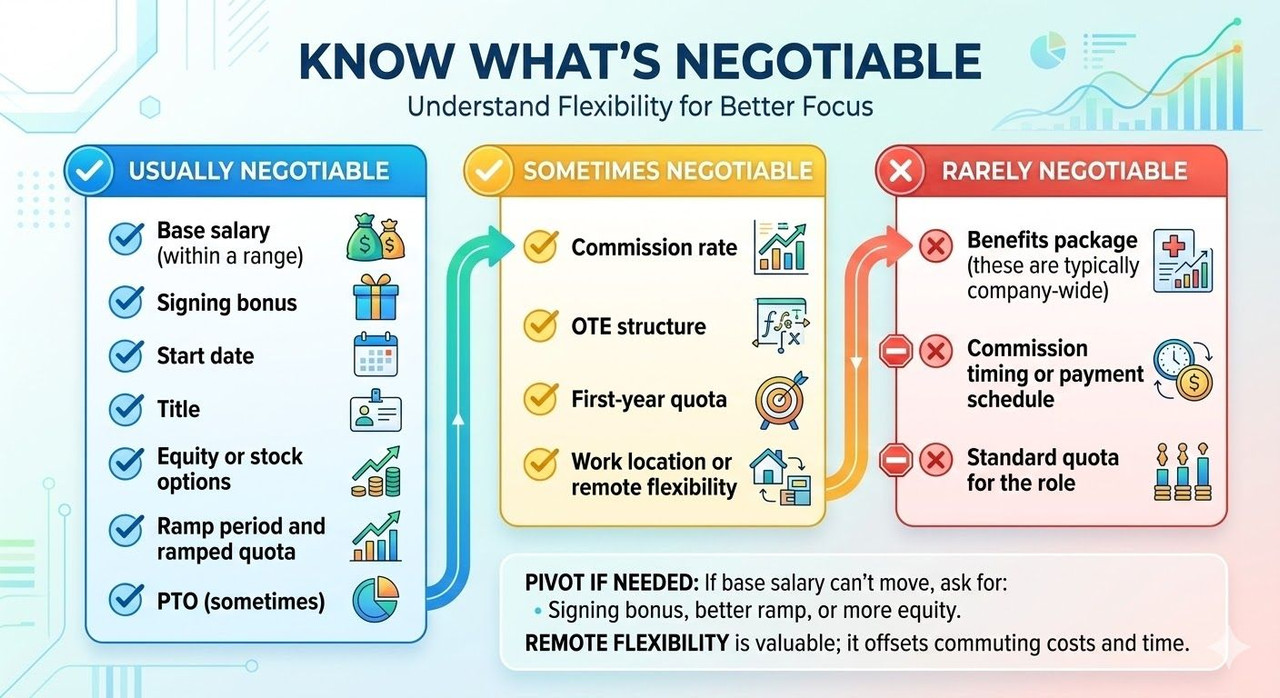
Not everything in an offer has equal flexibility. Understanding what companies can and can’t move on helps you focus your negotiation.
Usually negotiable:
- Base salary (within a range)
- Signing bonus
- Start date
- Title
- Equity or stock options
- Ramp period and ramped quota
- PTO (sometimes)
Sometimes negotiable:
- Commission rate
- OTE structure
- First-year quota
- Work location or remote flexibility
Rarely negotiable:
- Benefits package (these are typically company-wide)
- Commission timing or payment schedule
- Standard quota for the role
If the company can’t budge on base salary, pivot to other areas. A signing bonus, better ramp terms, or additional equity can offset a lower base. Flexibility on remote work might be worth thousands in commuting costs and time.
Timing Your Negotiation
Wait until you have a formal offer before negotiating specifics. During the interview process, if asked about salary expectations, give a range based on your research or ask about the budgeted range for the role. Avoid locking yourself into a specific number too early.
Once you receive an offer:
- Thank them and express enthusiasm for the opportunity
- Ask for time to review the complete offer (24-72 hours is reasonable)
- Review every component carefully
- Prepare your counteroffer with specific asks and justifications
Never negotiate in the moment. Taking time to prepare ensures you approach the conversation strategically rather than reactively.
How to Make Your Ask
When you’re ready to negotiate, be direct, professional, and specific. Vague requests get vague responses.
Frame your ask around your value, not your needs. Instead of “I need a higher salary because my rent is expensive,” say “Based on my track record of exceeding quota and the market rate for this role, I’m looking for a base salary of $X.”
A strong negotiation script:
“I’m really excited about this opportunity and can see myself contributing to the team. I’ve reviewed the offer carefully and would like to discuss a few points. Based on my research and my experience closing enterprise deals at [previous company], I was hoping we could get the base salary to $X. I’m also wondering if there’s flexibility on the signing bonus or ramp period.”
Then stop talking. Let them respond.
Be prepared for pushback. They might say the offer is final, the budget is set, or they need to check with leadership. That’s normal. Stay calm, reiterate your interest, and ask if there’s any flexibility elsewhere in the package.
What to Negotiate as an SDR vs. AE
Your negotiation strategy should match your career stage.
For SDR roles:
Focus on base salary, ramp period, and clear promotion criteria. If you’re breaking into software sales, you may have less leverage, but you can still ask for a slightly higher base or a signing bonus to offset the transition. Ask about the typical timeline for promotion to AE and what metrics qualify you.
For AE roles:
You have more leverage, especially with a strong track record. Negotiate base salary, OTE structure, quota, and ramp terms. If you’re coming in mid-year, negotiate for a prorated quota that reflects your shorter selling time. Ask about accelerators and what top performers actually earn.
For leadership roles:
At the VP or Director level, equity becomes a significant component. Negotiate your option grant, vesting schedule, and any acceleration provisions. Discuss performance bonuses tied to team metrics. Ensure your compensation reflects the scope of responsibility.
Handling Multiple Offers
If you have competing offers, use them strategically but professionally. You don’t need to name the competing company or share exact numbers. Simply saying “I have another offer I’m considering that’s higher in base salary” creates leverage without burning bridges.
Don’t manufacture fake offers. Hiring managers talk to each other, and dishonesty will surface eventually. But if you genuinely have options, it’s fair to use them in your negotiation.
Get Everything in Writing
Once you’ve reached agreement, ask for an updated offer letter reflecting all negotiated terms. Verbal commitments can be forgotten or misremembered. Before you sign, confirm that base salary, OTE, commission structure, start date, title, and any other negotiated items are documented correctly.
This protects both you and the employer. It also ensures there are no surprises on your first day.
Know When to Walk Away
Sometimes negotiations reveal that a company isn’t the right fit. If they’re unwilling to meet you anywhere near market rate, or if the process feels adversarial, that’s valuable information about how they treat employees. A company that lowballs offers might also underpay raises and promotions down the road.
Trust your research, know your worth, and be willing to walk if the numbers don’t work. The right opportunity will compensate you fairly.
Leave a Reply