


Getting a job offer feels great, but accepting the wrong one can set your career back years. In sales, where your success depends on factors like territory, quota, product-market fit, and leadership, choosing poorly has real consequences. A BambooHR study found that 44% of new hires have regrets within the first week, and 70% decide whether a job is right for them within the first month. The best way to avoid becoming part of that statistic is to evaluate offers thoroughly before you accept.
Look Beyond the OTE
Compensation matters, but the advertised OTE only tells part of the story. A $200K OTE means nothing if the quota is unattainable or the territory is burned.
Questions to ask before accepting:
- What percentage of reps hit quota last year?
- What does the top performer earn? The average performer?
- How is quota set, and how often does it change?
- What’s the ramp period and ramped quota structure?
- When and how are commissions paid?
If the company won’t share quota attainment data, that’s a red flag. Strong sales organizations are proud of their numbers. Evasive answers suggest the compensation plan looks better on paper than in practice.
Once you understand the full picture, you can negotiate your compensation package from a position of knowledge rather than hope.
Evaluate the Product and Market
Your ability to hit quota depends heavily on what you’re selling and who you’re selling it to. Even the best salesperson struggles with a weak product or saturated market.
Consider these factors:
- Product-market fit: Does the product solve a real problem? Are customers actively looking for this solution, or does every deal require heavy education?
- Competitive landscape: How crowded is the market? What differentiates this product from alternatives?
- Customer reviews: Check G2, Capterra, or TrustRadius. What do actual customers say? High ratings and genuine testimonials suggest a product that sells itself. Complaints about bugs, support, or missing features mean you’ll be fighting uphill.
- Company trajectory: Is the company growing? Raising funding? Expanding into new markets? Or are they contracting, laying off, or struggling to retain customers?
A company in growth mode typically offers more opportunity. A company in decline creates pressure that falls hardest on the sales team.
Assess the Sales Leadership
Your direct manager shapes your day-to-day experience more than any other factor. A great manager coaches, advocates, and removes obstacles. A poor manager micromanages, blames reps for systemic problems, and creates unnecessary stress.
During the interview process, try to meet your potential manager and ask:
- How do you support reps who are struggling?
- What does your coaching process look like?
- How do you handle situations where quota seems unrealistic?
- What happened to the last person in this role?
Pay attention to how they talk about their team. Do they take responsibility for outcomes, or do they blame individual reps? Do they seem invested in your development, or just in filling a seat?
If possible, ask to speak with current team members without the manager present. Their candor will tell you what the job is really like.
Understand the Territory and Accounts
In many sales roles, your territory determines your ceiling. A rep with strong accounts and greenfield opportunity will outperform a rep with a picked-over book, regardless of individual skill.
Ask about:
- Territory assignment: How are territories divided? By geography, industry, company size, or named accounts?
- Account history: Are you inheriting existing relationships, or starting from scratch? Have these accounts been worked before?
- Pipeline: Will you inherit any pipeline from a departing rep, or are you building from zero?
- Lead flow: How much inbound support exists? What percentage of pipeline are reps expected to self-source?
For SDR roles, ask about lead quality, routing rules, and which AEs you’ll be paired with. Your success depends partly on the closers converting your meetings into revenue.
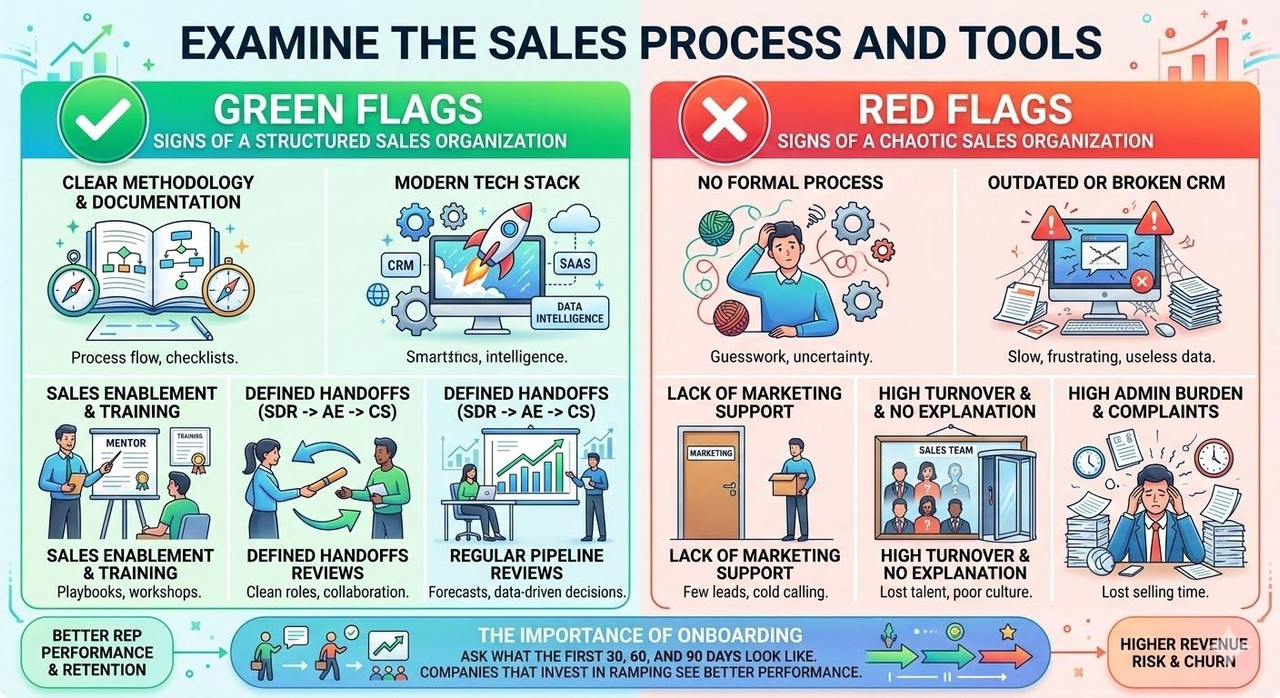
Examine the Sales Process and Tools
A well-structured sales organization gives reps the resources to succeed. A chaotic one expects reps to figure everything out on their own.
Green flags:
- Clear sales methodology and process documentation
- Modern tech stack (CRM, sales engagement tools, conversation intelligence)
- Sales enablement resources and ongoing training
- Defined handoff processes between SDRs, AEs, and customer success
- Regular pipeline reviews and forecasting cadence
Red flags:
- No formal sales process or methodology
- Outdated or poorly maintained CRM
- Lack of marketing support or lead generation
- High turnover with no clear explanation
- Reps complaining about admin burden or lack of tools
The quality of onboarding for new sales hires also matters. Ask what the first 30, 60, and 90 days look like. Companies that invest in ramping new reps tend to have better retention and performance.
Consider Career Growth
A job offer isn’t just about the next 12 months. Think about where this role leads.
For SDRs, ask about the path to Account Executive. What’s the typical timeline? What criteria qualify you for promotion? How many SDRs have been promoted internally in the past year?
For AEs, consider whether this role builds skills and experience that advance your long-term goals. Moving from SMB to mid-market, or from mid-market to enterprise, requires demonstrating success at the current level. Will this role give you that opportunity?
Also consider the company’s growth trajectory. A fast-growing company creates more leadership opportunities. A flat or shrinking organization has fewer paths up.
Trust Your Gut on Culture
Culture is hard to evaluate from the outside, but it shapes your daily experience. Pay attention to signals during the interview process:
- How did people treat you? Were they respectful of your time?
- Did interviewers seem genuinely interested, or were they going through the motions?
- What’s the energy like? Do people seem engaged or burned out?
- How do they talk about competitors, customers, and former employees?
Ask about work-life balance, expectations around hours, and how the company handled challenging periods. A culture that expects 60-hour weeks during “busy season” might actually expect 60-hour weeks year-round.
Compare Offers Systematically
If you have multiple offers, create a simple framework to compare them. Rate each offer on factors that matter to you:
- Base salary and realistic OTE
- Product and market opportunity
- Manager and team quality
- Territory and account potential
- Career growth path
- Culture and work-life balance
- Benefits and perks
Weight these factors based on your priorities. Early in your career, learning and growth might outweigh compensation. Later, stability and earnings potential might matter more.
When to Walk Away
Not every offer deserves a yes. Walk away if:
- The company won’t share quota attainment or earnings data
- Multiple sources confirm high turnover or toxic culture
- The compensation structure seems designed to fail
- Your gut tells you something is off
Turning down an offer is hard, especially after a long job search. But accepting the wrong role costs you time, energy, and momentum. It’s better to keep looking than to join a company you’ll leave in six months.
Take the time to evaluate thoroughly. The right role accelerates your career. The wrong one sets you back.
Leave a Reply