


How you structure your sales team affects everything from quota attainment to employee satisfaction to your ability to scale. The right structure depends on your stage, sales motion, average deal size, and growth targets. There’s no universal answer, but there are proven patterns that work.
According to The Bridge Group’s research, SaaS companies employ an average of 1 SDR for every 2.6 Account Executives. But this ratio varies significantly based on company size, growth rate, and go-to-market strategy. Understanding the principles behind these benchmarks matters more than copying specific numbers.
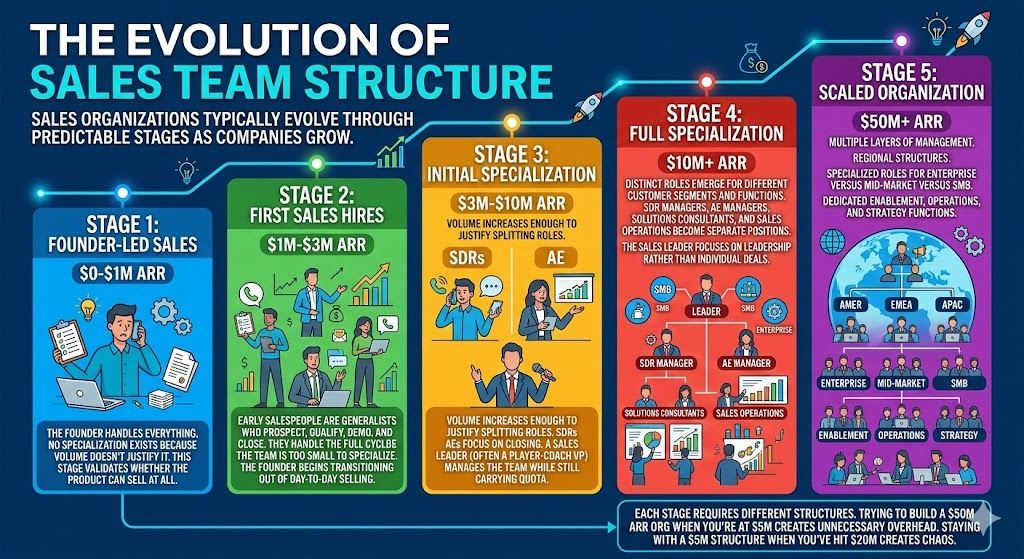
The Evolution of Sales Team Structure
Sales organizations typically evolve through predictable stages as companies grow.
Stage 1: Founder-led sales ($0-$1M ARR) The founder handles everything. No specialization exists because volume doesn’t justify it. This stage validates whether the product can sell at all.
Stage 2: First sales hires ($1M-$3M ARR) Early salespeople are generalists who prospect, qualify, demo, and close. They handle the full cycle because the team is too small to specialize. The founder begins transitioning out of day-to-day selling.
Stage 3: Initial specialization ($3M-$10M ARR) Volume increases enough to justify splitting roles. SDRs handle prospecting and qualification. AEs focus on closing. A sales leader (often a player-coach VP) manages the team while still carrying quota.
Stage 4: Full specialization ($10M+ ARR) Distinct roles emerge for different customer segments and functions. SDR managers, AE managers, solutions consultants, and sales operations become separate positions. The sales leader focuses on leadership rather than individual deals.
Stage 5: Scaled organization ($50M+ ARR) Multiple layers of management. Regional structures. Specialized roles for enterprise versus mid-market versus SMB. Dedicated enablement, operations, and strategy functions.
Each stage requires different structures. Trying to build a $50M ARR org when you’re at $5M creates unnecessary overhead. Staying with a $5M structure when you’ve hit $20M creates chaos.
The Core Roles in Sales Team Structure
Understanding the primary roles helps you design the right structure.
Sales Development Representatives (SDRs):
- Focus on prospecting and qualification
- Generate pipeline for AEs through outbound and/or inbound
- Measured on meetings booked, opportunities created, or pipeline generated
- Typical tenure of 1.5-2 years before promotion to AE or departure
Account Executives (AEs):
- Focus on closing deals
- Run discovery calls, demos, negotiations, and contract execution
- Measured on closed revenue and quota attainment
- May be segmented by deal size, customer segment, or territory
Solutions Consultants/Sales Engineers:
- Provide technical expertise during sales process
- Support AEs with demos, technical discovery, and proof of concepts
- Often shared across multiple AEs rather than 1:1 alignment
Sales Managers:
- Manage individual contributor performance
- Coach, develop, and hold reps accountable
- Handle forecasting and pipeline reviews
- Typical span of control is 6-10 direct reports
Sales Leadership (VP Sales, CRO):
- Set strategy and direction
- Manage managers
- Own the revenue number at organizational level
- Interface with executive team on go-to-market decisions
SDR to AE Ratio
One of the most common structural questions is how many SDRs to hire relative to AEs. The average of 1 SDR per 2.6 AEs is a starting point, but your ratio should be driven by your specific situation.
Factors that decrease the ratio (more SDRs per AE):
- Heavy outbound motion requiring high prospecting volume
- Lower response rates requiring more attempts per opportunity
- Complex products requiring extensive qualification before handoff
- Newer SDRs still ramping to full productivity
Factors that increase the ratio (fewer SDRs per AE):
- Strong inbound lead flow reducing outbound dependency
- Product-led growth where users self-qualify
- Mature SDR team with high productivity
- Shorter sales cycles where AEs have capacity
Calculate based on opportunity flow:
Rather than copying a ratio, work backward from what your AEs need. If each AE requires 15 qualified opportunities per month to hit quota and each fully ramped SDR generates 10 opportunities per month, you need roughly 1.5 SDRs per AE. Adjust as productivity changes.
Manager Span of Control
How many reps should each sales manager oversee? Too few, and you’re paying for unnecessary management overhead. Too many, and managers can’t effectively coach and develop their teams.
Benchmarks from the Alexander Group:
- Inside sales: 8-12 reps per manager
- Field sales (transactional): 8-10 reps per manager
- Field sales (complex/enterprise): 5-8 reps per manager
- SDR teams: 10-12 reps per manager
Factors that support wider spans (more reps per manager):
- Experienced reps who need less hands-on coaching
- Well-defined, repeatable sales processes
- Strong sales operations support for administrative tasks
- Inside sales where observation and coaching are easier
Factors that require narrower spans (fewer reps per manager):
- Newer reps who need extensive development
- Complex sales requiring deal-level coaching
- Field sales with geographic spread
- Player-coach managers who also carry quota
The right span balances manager effectiveness with organizational efficiency. Stretching managers too thin reduces coaching quality. Over-investing in management adds cost without proportional value.
Segmenting Your Sales Organization
As you grow, segmentation becomes necessary. The question is how to segment.
By customer size:
- SMB team handles smaller deals with faster cycles
- Mid-market team handles medium-sized accounts
- Enterprise team handles largest, most complex deals
This works when different deal sizes require fundamentally different selling approaches and skills.
By industry/vertical:
- Dedicated teams for specific industries (healthcare, financial services, manufacturing)
- Reps develop deep domain expertise
This works when industry knowledge significantly impacts win rates.
By geography:
- Regional teams organized by territory
- May be necessary for field sales or international expansion
This works when proximity to customers matters or time zones require local presence.
By product line:
- Separate teams for different products
- Each team develops specialized product knowledge
This works when products are distinct enough that cross-selling isn’t the primary motion.
By function (hunter vs. farmer):
- New business team focuses on acquiring new logos
- Account management team focuses on expansion and retention
This works when new logo acquisition and expansion require different skills and incentives.
Most organizations combine multiple segmentation approaches as they scale. A $50M company might have SMB, mid-market, and enterprise segments, with the enterprise team further divided by industry vertical.
Building Management Layers
As your sales team grows, you need to add management layers thoughtfully.
First sales manager (typically 5-10 reps): When the founder or VP of Sales can no longer effectively manage all reps directly, add a first-line manager. This person handles day-to-day coaching while the VP focuses on strategy and cross-functional work.
Multiple first-line managers (typically 15-30 reps): As rep count grows, add additional front-line managers. Each manages their own team. The VP manages the managers.
Directors (typically 30-50 reps): Add a management layer between the VP and front-line managers. Directors might own segments (SMB Director, Enterprise Director) or functions (SDR Director, AE Director).
Multiple VPs (typically 75+ reps): At scale, you may need VPs for different regions, segments, or functions, all reporting to a CRO or Chief Revenue Officer.
The pattern: roughly 1 manager per 8-10 reps, 1 director per 3-5 managers, 1 VP per 4-5 directors. These ratios vary based on complexity and your organization’s specific needs.
Common Structural Mistakes
Software companies frequently make predictable errors in sales org design.
Specializing too early. Small teams don’t need SDRs, AEs, and solutions consultants as separate roles. Generalists work better until volume justifies specialization.
Copying larger companies. What works at $100M ARR doesn’t work at $10M. Build for where you are, not where you want to be.
Underinvesting in management. Growing the rep count without adding managers results in undertrained, undercoached teams. Performance suffers.
Over-segmenting. Creating too many small teams fragments resources and creates coordination overhead. Combine segments until each is large enough to be efficient.
Ignoring the ops function. As complexity grows, sales operations becomes critical. Without it, managers spend excessive time on administrative work rather than coaching.
Restructuring too frequently. Constant reorganization disrupts relationships and momentum. Make structural changes thoughtfully, not reactively.
When to Restructure
Organizational changes carry real costs. Restructure when you have clear signals, not just because you’re bored with the current structure.
Signs you need to restructure:
- Reps consistently miss quota despite good effort (may indicate wrong segmentation or coverage gaps)
- Manager spans have grown unsustainable (coaching quality has declined)
- Significant growth requires different go-to-market approach
- New products or markets require specialized focus
- Current structure creates conflicts or coverage confusion
Before restructuring, ask:
- Is this a structural problem or an execution problem?
- What specifically will change, and what will stay the same?
- How will you handle the transition without losing momentum?
- What’s the cost of restructuring versus living with current structure?
Restructuring mid-quarter or during critical selling periods maximizes disruption. Plan changes to minimize impact on pipeline and quota attainment.
Designing for Your Situation
There’s no perfect sales structure, only the right structure for your specific situation.
Consider your:
- Stage and ARR
- Deal size and sales cycle
- Inbound versus outbound mix
- Customer segments and their needs
- Geographic footprint
- Growth rate and hiring plan
Start simple. Add complexity only when volume and evidence justify it. Revisit structure quarterly, but change it annually at most.
Your sales structure should enable great selling, not create bureaucracy. Every role should have clear purpose. Every management layer should add value. Every segment should have enough scale to be efficient.
Leave a Reply