


Sales training and coaching are often conflated, but they serve different purposes. Training teaches skills and knowledge. Coaching develops those skills through ongoing practice and feedback. Most software companies need both, but the question is when to invest in dedicated headcount versus relying on managers or external resources.
According to RAIN Group research, a seller is 63% more likely to be a top performer when they have an effective manager, regular coaching, and effective training. The combination of all three elements matters more than any single factor. This has implications for how you think about building your sales enablement function.
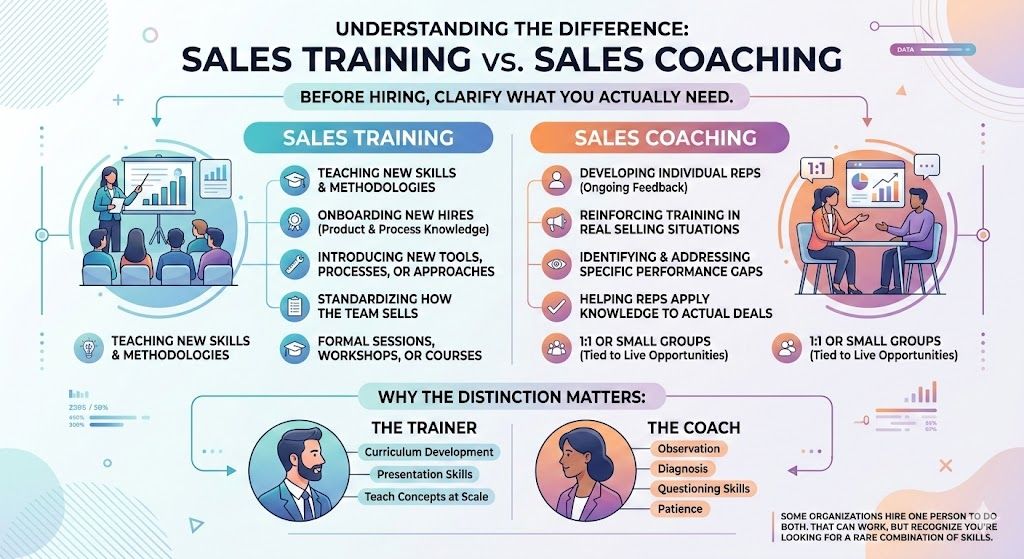
Understanding the Difference: Training vs. Coaching
Before hiring, clarify what you actually need.
Sales training focuses on:
- Teaching new skills and methodologies
- Onboarding new hires with product and process knowledge
- Introducing new tools, processes, or approaches
- Standardizing how the team sells
- Usually delivered in formal sessions, workshops, or courses
Sales coaching focuses on:
- Developing individual reps through ongoing feedback
- Reinforcing training in real selling situations
- Identifying and addressing specific performance gaps
- Helping reps apply knowledge to actual deals
- Usually delivered 1:1 or in small groups, tied to live opportunities
Why the distinction matters:
A brilliant trainer may be ineffective as a coach, and vice versa. Training requires curriculum development, presentation skills, and the ability to teach concepts at scale. Coaching requires observation, diagnosis, questioning skills, and patience to develop individuals over time.
Some organizations hire one person to do both. That can work, but recognize you’re looking for a rare combination of skills.
When to Hire a Dedicated Sales Trainer
Not every company needs a full-time sales trainer. Here’s how to decide.
Signs you need a dedicated trainer:
- You’re hiring more than 10-15 new sales reps per year
- Onboarding is inconsistent and ramp times are too long
- Managers are spending excessive time on training instead of coaching
- You’re rolling out new products, methodologies, or tools regularly
- Performance varies significantly across reps and teams
Signs you can wait:
- Small team with limited new hire volume
- Managers have capacity to train effectively
- You can use external training vendors for major initiatives
- Limited budget for dedicated headcount
The math:
Consider the cost of a sales trainer ($80,000-$150,000 fully loaded) versus the cost of undertrained reps. If poor training extends ramp time by two months for each new hire, and you hire 15 reps per year, that’s 30 months of lost productivity. At even modest quota levels, that lost productivity far exceeds the trainer’s salary.
When to Hire a Dedicated Sales Coach
Coaching is often the responsibility of front-line managers. But some organizations add dedicated coaching roles.
Signs you need a dedicated coach:
- Managers are stretched too thin to coach effectively
- You have consistent skill gaps across the team that managers aren’t addressing
- Reps plateau after initial ramp and stop developing
- Manager coaching quality is inconsistent
- You want to free managers to focus on pipeline and deal support
Signs managers should own coaching:
- Team is small enough that managers have adequate time
- Managers are skilled coaches (not all are)
- You want accountability for development tied to performance management
- Budget constraints prevent adding enablement headcount
The hybrid approach:
Many organizations have managers own primary coaching responsibility while adding enablement resources to support them. Enablement might develop coaching frameworks, train managers on coaching, and step in for specialized skill development.
The Sales Enablement Role
In many software companies, training and coaching roll up under “sales enablement” alongside content, tools, and process optimization.
A sales enablement hire might own:
- New hire onboarding programs
- Ongoing skill development
- Sales methodology reinforcement
- Content and collateral management
- Sales tool administration and training
- Process documentation and optimization
Considerations for your first enablement hire:
- Should they prioritize training, content, or process?
- Do they need to be able to train themselves, or can they coordinate vendors?
- What’s the balance between strategic work and execution?
- Who do they report to (Sales, Marketing, or independent)?
Your first enablement hire should match your biggest gaps. If onboarding is the problem, hire someone who can build and deliver training. If content is the problem, hire someone with content development skills.
What to Look For in Sales Trainer Candidates
Effective sales trainers share certain characteristics.
Essential skills and experience:
- Sales background: They need credibility with reps. Former sellers who excelled and can articulate why make the best trainers. Trainers without sales experience struggle to earn respect.
- Adult learning expertise: Training adults differs from academic teaching. Look for understanding of how adults learn, retain, and apply information.
- Curriculum development: Can they design training programs, not just deliver content others created?
- Facilitation skills: Great trainers engage learners, manage group dynamics, and adapt to the room. This is different from presentation skills.
- Measurement orientation: Can they connect training to outcomes and adjust based on results?
Questions to ask trainer candidates:
- Walk me through how you designed a training program from scratch.
- How do you ensure training translates to behavior change?
- What do you do when reps aren’t engaging with training?
- How do you measure training effectiveness?
- Tell me about a training initiative that didn’t work. What did you learn?
Red flags:
- No selling background or only briefly sold
- Focuses on training delivery without mentioning outcomes
- Can’t explain how they’d measure success
- Relies entirely on vendor content without customization
- Treats training as an event rather than a process
What to Look For in Sales Coach Candidates
Coaching requires a different skill set than training.
Essential skills and experience:
- Strong sales background: Coaches need deep selling experience to diagnose issues and prescribe solutions. They’ve seen what good looks like across many situations.
- Questioning and listening: Coaching isn’t telling reps what to do. It’s asking questions that help them discover answers. Look for people who listen more than they talk.
- Patience: Development takes time. Coaches who expect immediate transformation burn out reps.
- Observation skills: Great coaches notice subtle things in calls, emails, and conversations that others miss.
- Empathy without softness: They need to care about reps while still holding them accountable.
Questions to ask coach candidates:
- Describe how you’ve helped a struggling rep improve.
- What’s your philosophy on coaching?
- How do you balance supporting reps versus holding them accountable?
- How do you handle a rep who resists coaching?
- Walk me through how you’d coach someone on a specific deal.
Red flags:
- Talks more about their own selling success than developing others
- Prescriptive rather than question-based approach
- No patience for slow development
- Can’t articulate a coaching methodology
- Focuses on telling rather than developing
The Player-Coach Trap
Some companies try to hire player-coaches: people who carry quota while also training or coaching others. This rarely works.
Why player-coach roles struggle:
- Quota always takes priority when both compete for time
- Reps see player-coaches as competitors, not developers
- Coaching suffers when the coach is distracted by their own deals
- Burnout is high because neither role gets adequate attention
When player-coach might work:
- Very small teams where full-time specialization isn’t feasible
- The “coach” portion is limited to mentoring peers, not formal responsibility
- Quota is reduced significantly to create time for coaching
If you need coaching, hire a coach. If you need a seller, hire a seller. Trying to get both from one person usually means getting neither done well.
Internal Hire vs. External Hire
Should you promote a top rep into training/coaching, or hire externally?
Advantages of internal promotion:
- They know your product, process, and culture
- They have credibility with the team
- They understand what works in your specific environment
- Lower risk; you know their capabilities
Disadvantages of internal promotion:
- Great sellers aren’t always great teachers or coaches
- They may lack formal training/coaching skills
- You lose a productive seller
- They may struggle with the transition from peer to developer
Advantages of external hire:
- Brings fresh perspective and new ideas
- May have formal training/coaching experience
- Doesn’t carry baggage of peer relationships
- Can challenge existing approaches more easily
Disadvantages of external hire:
- Takes time to learn your business
- May lack credibility initially
- Risk of poor fit
The best approach: Consider internal candidates seriously, but evaluate them against external benchmarks. Being a great seller is necessary but not sufficient for being a great trainer or coach.
Structuring the Role
Once you decide to hire, structure the role for success.
Reporting structure:
- Sales enablement often reports to the VP of Sales or CRO
- Some organizations have enablement report to a Chief Revenue Officer who also owns marketing
- Avoid having trainers report to the people they’re training (creates conflict)
Scope definition:
- Be clear about whether they own training, coaching, content, tools, or all of the above
- Define the balance between building programs and delivering them
- Clarify their role relative to front-line managers
Success metrics:
- Ramp time for new hires
- Time to first deal
- Quota attainment by cohort
- Training satisfaction scores
- Skill assessment improvements
- Manager feedback on rep development
Resources and budget:
- Will they have budget for external vendors and tools?
- What headcount will they have (or will they work solo)?
- What systems and platforms will they use?
Common Mistakes When Hiring Trainers and Coaches
Companies frequently stumble in predictable ways.
Hiring too early. If you have five salespeople and hire infrequently, you don’t need a full-time trainer. Use managers and external resources until volume justifies the hire.
Hiring too late. If training is an afterthought and reps are struggling, you’ve already lost productivity. Hire before the problem becomes critical.
Confusing training with coaching. Hiring a trainer and expecting them to coach (or vice versa) sets everyone up for failure.
Expecting immediate results. Building effective training programs and developing coaching rhythms takes time. Give new enablement hires at least 6-12 months to show impact.
Not supporting the role. Trainers and coaches need executive support, manager buy-in, and budget to succeed. Hiring someone and then starving the function of resources wastes the investment.
Ignoring manager development. Even with dedicated trainers and coaches, front-line managers remain the primary developers of reps. Enablement should equip managers to coach, not replace them.
Leave a Reply