


Hiring your first sales leader is one of the highest-stakes decisions a software company makes. Get the timing right, and you accelerate growth with someone who builds a scalable sales organization. Get it wrong, and you waste months, burn cash, and potentially damage customer relationships.
According to SaaStr founder Jason Lemkin, 70% of first VP of Sales hires don’t make it 12 months. That failure rate isn’t primarily about bad candidates. It’s about founders hiring the wrong person for the wrong stage, or hiring before the company is ready to support a sales leader’s success.
Why Timing Matters So Much
Sales leaders need raw materials to work with. They need a product that solves real problems, customers who’ve already bought, and some evidence that the sales motion can repeat. Without these ingredients, even exceptional sales leaders struggle.
Hire too early, and your sales leader inherits problems they can’t solve. They’re expected to close deals when product-market fit is still uncertain. They’re asked to build processes when there’s no data on what works. They burn out trying to create something from nothing, then leave frustrated.
Hire too late, and you’ve left money on the table. Founders doing their own selling eventually hit a ceiling. Deals pile up. Follow-ups slip. The company grows slower than it should because no one has time to build the sales infrastructure that would accelerate growth.
The window for “right timing” is narrower than most founders expect.
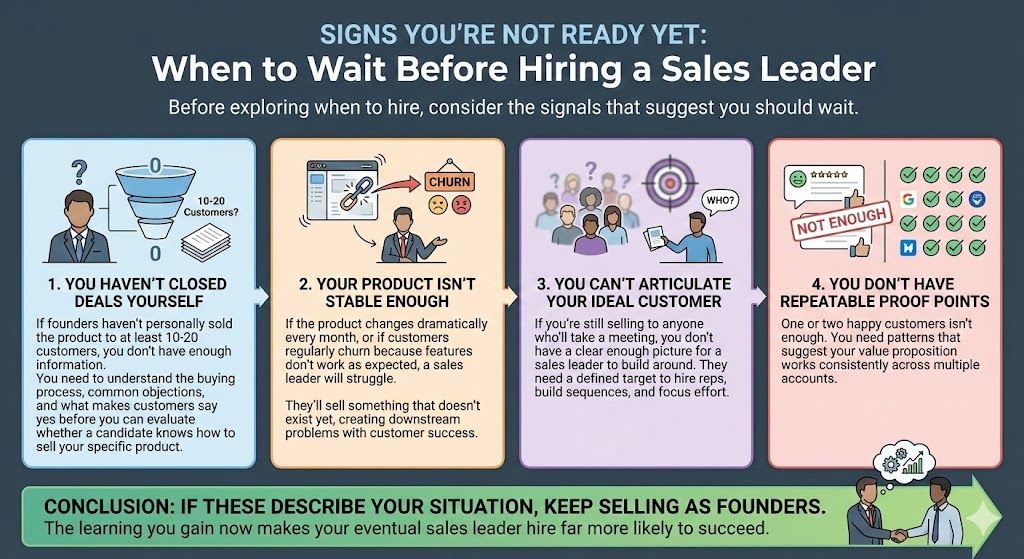
Signs You’re Not Ready Yet
Before exploring when to hire, consider the signals that suggest you should wait.
You haven’t closed deals yourself. If founders haven’t personally sold the product to at least 10-20 customers, you don’t have enough information to hire a sales leader. You need to understand the buying process, common objections, and what makes customers say yes before you can evaluate whether a candidate knows how to sell your specific product.
Your product isn’t stable enough. If the product changes dramatically every month, or if customers regularly churn because features don’t work as expected, a sales leader will struggle. They’ll sell something that doesn’t exist yet, creating downstream problems with customer success.
You can’t articulate your ideal customer. If you’re still selling to anyone who’ll take a meeting, you don’t have a clear enough picture for a sales leader to build around. They need a defined target to hire reps, build sequences, and focus effort.
You don’t have repeatable proof points. One or two happy customers isn’t enough. You need patterns that suggest your value proposition works consistently across multiple accounts.
If these describe your situation, keep selling as founders. The learning you gain now makes your eventual sales leader hire far more likely to succeed.
Signs You’re Ready to Hire
Certain signals indicate the timing is right for bringing in sales leadership.
You’ve closed $500K-$2M in ARR as founders. This range varies by deal size, but the principle holds: you need enough closed revenue to prove the product sells and to have learned what works. Some companies hit this milestone faster than others, but waiting until you have real traction dramatically increases your odds of a successful hire.
You have a rough playbook. You don’t need perfect documentation, but you should be able to explain how deals typically progress, what objections come up, and what differentiates winning deals from losing ones. A sales leader can refine this playbook, but they shouldn’t have to create it from scratch.
You’re turning away opportunities. If qualified prospects are waiting longer than they should for demos, or if deals are dying because no one has time to follow up, you’re leaving revenue on the table. That’s a clear signal for sales help.
You know your numbers. You should understand your average deal size, typical sales cycle length, conversion rates at each stage, and customer acquisition cost. A sales leader needs these baselines to set realistic targets and measure improvement.
You’re ready to let go. Founders who can’t imagine anyone else talking to their customers often sabotage new sales hires. If you’re ready to delegate relationship ownership and trust someone else to represent your company, you’re psychologically ready.
The Progression That Usually Works
Most successful software companies don’t jump straight from founder-led sales to a VP of Sales. There’s typically an intermediate step.
Stage 1: Founder-led sales (Pre-revenue to ~$500K ARR)
Founders close the first customers, learning the sales motion firsthand. This stage is about discovery, not scale.
Stage 2: First sales reps (~$500K to $1-2M ARR)
Hire 1-3 account executives who can execute the playbook founders developed. A founder still manages these reps, provides coaching, and handles escalations. This tests whether the sales motion can work without founders in every conversation.
Stage 3: First sales leader (~$1-2M+ ARR)
Once you have reps producing and a clearer picture of what works, bring in a sales leader to build the organization. They inherit a functioning (if small) team and real data on performance.
This progression works because it de-risks each stage. You don’t ask a sales leader to create a playbook AND hire reps AND close deals AND build infrastructure all at once. You give them something to build on.
What Your First Sales Leader Should Actually Do
Understanding what you need helps you hire the right person at the right time.
A first sales leader should:
- Refine the sales process based on what’s working and fix what isn’t
- Hire and manage additional reps as pipeline allows
- Build the basic infrastructure: CRM hygiene, forecasting, pipeline reviews
- Close deals alongside the team (player-coach mode)
- Provide feedback to product on what customers need
- Work with marketing on lead quality and messaging
A first sales leader should NOT:
- Build the entire sales motion from zero (that’s founder work)
- Operate purely as an executive who manages dashboards
- Focus primarily on enterprise deals when the company sells mid-market
- Expect a fully staffed team and unlimited budget from day one
The right first sales leader is a builder who thrives in ambiguity. They’re not the executive you’ll hire at $50M ARR. They’re the scrappy operator who can take you from $2M to $10M.
Matching the Hire to Your Stage
VP of Sales candidates come from different backgrounds. Match the candidate’s experience to your actual needs.
Avoid candidates who:
- Have only worked at large, established companies with full support infrastructure
- Haven’t personally carried quota in the last 3-5 years
- Can’t describe how they built something from early stages
- Focus primarily on managing rather than doing
Prioritize candidates who:
- Have built sales teams at companies in a similar stage to yours
- Have recent experience selling similar deal sizes to similar buyers
- Can demonstrate hands-on contributions, not just management
- Show genuine enthusiasm for the builder phase, not just the scaling phase
Consider a candidate who helped scale a company from $1M to $10M ARR. They’ve seen the challenges you’re about to face. Compare that to someone who managed a $100M book of business at a mature company. The second candidate has impressive experience, but it may not translate to your context.
Common Mistakes to Avoid
Software companies make predictable errors when hiring their first sales leader.
Hiring too senior too early. Big titles from big companies often struggle in early-stage environments. They’re used to SDRs feeding them leads, marketing teams generating demand, and operations teams handling the CRM. Without that infrastructure, they flounder.
Hiring for the company you want to become. Your first sales leader is for the next 18-24 months, not for when you’re at $100M ARR. Hire for your current stage, not your aspiration.
Rushing the process. Desperation leads to bad hires. Founders who wait too long then panic and hire the first qualified candidate. Taking 3-4 months to find the right person beats hiring quickly and firing in 6 months.
Failing to check references deeply. Call the references your candidate provides. Then call the people they didn’t provide. Ask specific questions about deal sizes, team sizes, and what they personally built versus inherited.
Not defining success clearly. If you can’t articulate what success looks like in the first 6-12 months, you’re not ready to hire. Vague expectations lead to misaligned incentives and frustration on both sides.
These overlap with other common sales hiring mistakes that derail software companies.
Setting Your Sales Leader Up for Success
The work doesn’t end when you make the hire. Your sales leader needs support to succeed.
Provide clear context. Share everything you learned during founder-led sales. Document what worked, what failed, and why. The more context you provide, the faster they can contribute.
Stay involved initially. Don’t disappear after the hire. Join customer calls, participate in deal reviews, and remain accessible. Gradually reduce involvement as trust builds.
Set realistic expectations. A new sales leader won’t transform your numbers in 30 days. Most need 3-6 months to assess the situation, make changes, and see results. Build this into your planning.
Give them authority. If you hire someone to lead sales, let them lead. Second-guessing every decision or overriding their judgment undermines their effectiveness.
Establish feedback loops. Schedule regular check-ins focused on what’s working and what needs adjustment. Early identification of problems prevents larger failures later.
Consider working with a software recruiting firm to access candidates who’ve specifically built sales organizations at similar stages. The pattern-matching matters enormously for this hire.
Alternatives to a Full-Time Sales Leader
If you’re not quite ready for a full-time VP of Sales, consider intermediate options.
Fractional sales leaders provide experienced guidance part-time. They can help build processes, coach reps, and advise on strategy without the full-time cost. This works well when you need expertise but don’t have enough work to justify a full-time executive.
Promoting a top-performing rep to player-coach can bridge the gap. They know your product and customers. The risk: great reps don’t always become great managers.
Founder remaining as sales leader with an operations hire to handle the administrative burden lets you retain customer relationships while offloading CRM work, reporting, and coordination.
These alternatives buy time while you continue growing toward the stage where a full-time sales leader makes sense.
Final Thoughts
The right time to hire your first sales leader is after you’ve proven the sales motion works but before you’ve maxed out your ability to grow without dedicated leadership. That window varies by company, but typically falls somewhere between $1M and $2M in ARR for most software businesses.
When you do hire, prioritize fit over prestige. A builder who thrives in your current stage will outperform a decorated executive who’s never operated without infrastructure. Take your time, check references thoroughly, and set clear expectations from day one.
Leave a Reply