


A sales development team creates the pipeline your account executives need to hit quota. Without consistent pipeline generation, your sales organization starves. With it, you control your growth trajectory.
According to The Bridge Group’s SDR Metrics & Compensation Report, the median pipeline generated per SDR is $3 million annually in B2B SaaS companies, with SDRs responsible for generating 30-45% of new revenue. Those numbers explain why building this function correctly matters so much. Get it right, and you’ve built a growth engine. Get it wrong, and you’ve created an expensive distraction.
When to Build a Sales Development Team
Not every software company needs a dedicated sales development function from day one. But there are clear signals that it’s time to invest.
You should consider building an SDR team when:
- Your AEs spend more time prospecting than selling
- Inbound leads alone can’t support your growth targets
- You need to break into new markets or segments
- Your founders can no longer handle outbound themselves
- Deal sizes justify the cost of dedicated prospecting resources
- You have enough data to define your ideal customer profile
If your average deal size is under $5,000 annually, the math on dedicated SDRs gets challenging. The cost of the SDR plus management overhead needs to generate enough pipeline to justify the investment. For most software companies, that breakeven point sits somewhere around $10,000-15,000 in average contract value.
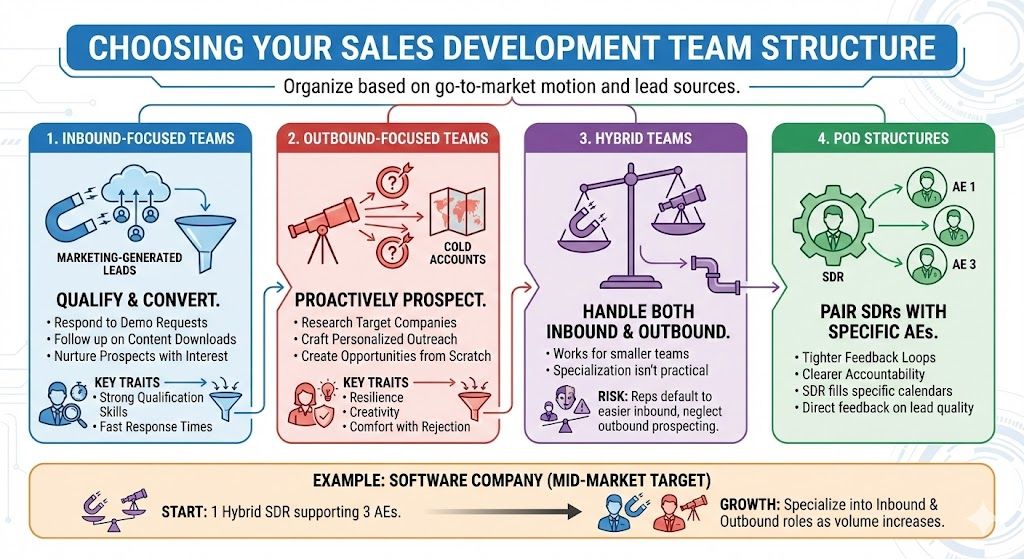
Choosing Your Team Structure
Sales development teams organize in a few common ways. The right structure depends on your go-to-market motion and lead sources.
Inbound-focused teams qualify and convert marketing-generated leads. These SDRs respond to demo requests, follow up on content downloads, and nurture prospects who’ve shown interest. They need strong qualification skills and fast response times.
Outbound-focused teams proactively prospect into cold accounts. These SDRs research target companies, craft personalized outreach, and create opportunities where none existed before. They need resilience, creativity, and comfort with rejection.
Hybrid teams handle both inbound and outbound. This approach works for smaller teams where specialization isn’t practical. The risk: reps default to easier inbound work and neglect outbound prospecting.
Pod structures pair SDRs with specific AEs or groups of AEs. This creates tighter feedback loops and clearer accountability. The SDR knows exactly whose calendar they’re filling and gets direct feedback on lead quality.
Consider a software company targeting mid-market companies. They might start with one hybrid SDR supporting three account executives, then specialize into inbound and outbound roles as volume increases.
Defining Roles and Responsibilities
Clear role definition prevents confusion and finger-pointing. Everyone should know exactly what they own.
SDR responsibilities typically include:
- Researching and identifying target accounts and contacts
- Executing outbound sequences via email, phone, and social
- Qualifying inbound leads against defined criteria
- Booking discovery calls or demos for account executives
- Logging all activity in your CRM
- Providing feedback on messaging and market response
- Meeting activity and output quotas
What SDRs should NOT own:
- Closing deals (that’s the AE’s job)
- Complex technical qualification (that’s for solutions consultants)
- Marketing campaign strategy (that’s marketing’s domain)
- Customer retention (that’s customer success)
The handoff point between SDR and AE deserves special attention. Define exactly what qualifies as a “sales accepted lead” and hold both sides accountable. Vague criteria create conflict.
Hiring Your First SDRs
Your first SDR hires set the tone for the entire function. Hire carefully.
What to look for in early SDR hires:
- Coachability and willingness to follow process
- Resilience and comfort with rejection
- Strong written and verbal communication
- Genuine curiosity about your product and market
- Competitive drive without being difficult to manage
- Organization and attention to detail
For your first hires, consider candidates with slightly more experience who can help you build playbooks and processes. Once you have a working system, you can hire less experienced reps and train them into it.
Avoid the temptation to hire exclusively based on personality. Energetic candidates interview well but may lack the discipline for consistent daily execution. Look for evidence of sustained effort in past roles.
Setting Up Your Tech Stack
SDRs need tools to work efficiently. The right stack multiplies their productivity; the wrong one creates busywork.
Essential tools include:
- CRM: Salesforce, HubSpot, or similar for tracking all activity and opportunities
- Sales engagement platform: Outreach, Salesloft, or Apollo for sequencing and automation
- Data enrichment: ZoomInfo, Clearbit, or similar for contact information
- Dialers: Integrated calling tools for efficient phone outreach
- LinkedIn Sales Navigator: For research and social selling
Start simple and add tools as you identify specific bottlenecks. More technology doesn’t automatically mean more pipeline. Reps drowning in tools often produce less than those with streamlined workflows.
Establishing Metrics and Quotas
What you measure shapes behavior. Choose metrics that drive the outcomes you actually want.
Activity metrics (leading indicators):
- Calls made per day
- Emails sent per day
- LinkedIn touches per day
- Total activities per day
Output metrics (lagging indicators):
- Conversations held
- Meetings booked
- Meetings attended (after no-shows)
- Sales accepted leads (SALs)
- Pipeline generated in dollars
Activity metrics without output metrics encourage busywork. Output metrics without activity metrics make it hard to diagnose problems. Track both.
For quotas, work backward from your pipeline targets. If you need $2 million in quarterly pipeline from your SDR team, and each SDR generates roughly $250,000 per month, you need three SDRs working at full productivity. Add buffer for ramp time and realistic attainment rates.
Building Compensation Plans
SDR compensation should reward the behaviors and outcomes you want without creating perverse incentives.
Typical SDR compensation structure:
- Base salary: $45,000-$65,000 depending on market and experience
- Variable compensation: $15,000-$30,000 tied to quota attainment
- Total OTE (on-target earnings): $60,000-$95,000
What to tie variable compensation to:
- Meetings booked and attended
- Sales accepted leads
- Pipeline generated
- Some companies add a small component for opportunities won
Avoid tying too much compensation to closed revenue. SDRs can’t control what happens after handoff, and long sales cycles mean they’d wait months for payout. Focus incentives on what they directly influence.
Creating Onboarding and Training Programs
SDR ramp time directly impacts your ROI. Faster ramp means more productive months before turnover inevitably occurs.
Effective SDR onboarding includes:
- Product and market training so they understand what they’re selling
- Ideal customer profile deep dives so they know who to target
- Messaging and objection handling practice
- Tool training on your entire tech stack
- Shadowing experienced reps (if you have them)
- Graduated ramp with increasing quotas over 2-3 months
- Regular coaching and call reviews
Most SDRs need 2-3 months to reach full productivity. Some companies try to accelerate this with intensive boot camps; others prefer gradual ramp with more support. Match your approach to your team’s experience level.
Managing and Coaching SDRs
Frontline management makes or breaks SDR performance. If you don’t have an SDR manager yet, someone needs to own this function.
Key management activities:
- Daily or weekly activity reviews
- Regular 1:1s focused on development
- Call listening and coaching sessions
- Pipeline and forecast reviews
- Performance management for struggling reps
- Recognition for top performers
The typical ratio is 6-8 SDRs per manager. Stretch beyond that, and coaching quality suffers. Too few, and you’re overspending on management.
Create clear promotion paths. SDRs who see a future at your company perform better and stay longer. The most common path leads to account executive roles, but some SDRs prefer moving into SDR management, marketing, or customer success.
Scaling the Team
Once your first SDRs are productive, you’ll face decisions about how to grow.
Questions to answer before scaling:
- Is your current team consistently hitting quota?
- Do you have reliable playbooks and processes?
- Can your AE team absorb more pipeline?
- Do you have management capacity for more SDRs?
- Is your tech stack ready to support more users?
Scale gradually. Adding SDRs faster than you can train and manage them creates chaos. A common pattern: add 2-3 SDRs per quarter once you have a working model, adjusting based on results.
As you scale, consider specialization. A team of 10+ SDRs might benefit from dedicated inbound and outbound pods, industry specialization, or geographic focus.
Common Mistakes to Avoid
Software companies make predictable errors when building sales development teams.
Hiring before you have a playbook. SDRs need processes to follow. If you haven’t figured out your ideal customer profile, messaging, and qualification criteria, you’re asking SDRs to solve problems they’re not equipped to solve.
Underinvesting in management. SDRs need coaching, especially early in their careers. Expecting them to figure it out alone wastes their potential and your investment.
Focusing on activity over outcomes. Celebrating dial volume while ignoring meeting quality creates the wrong culture. Balance activity expectations with output standards.
Neglecting the AE relationship. SDR success depends partly on AE follow-through. If AEs don’t show up to meetings or provide feedback on lead quality, the system breaks down.
Expecting immediate results. SDR teams need time to ramp, refine messaging, and build momentum. Judging the function after 30 days guarantees disappointment.
These overlap with broader sales hiring mistakes that derail software companies.
Measuring Success
Evaluate your sales development team on a few key outcomes.
Pipeline contribution: What percentage of total pipeline comes from SDR-sourced opportunities? Track this monthly and quarterly.
Cost per meeting/opportunity: Divide total SDR costs (salary, tools, management) by meetings booked or opportunities created. Compare this to other pipeline sources.
Conversion rates: What percentage of SDR-sourced opportunities convert to closed-won business? How does this compare to other sources?
Team health: Track quota attainment distribution, turnover rates, and promotion rates. Healthy teams have most reps hitting quota and reasonable retention.
If your SDR team consistently generates pipeline at acceptable cost and conversion rates, you’ve built something valuable. If costs are high and conversion is low, something in the system needs fixing.
Final Thoughts
Building a sales development team is an investment in predictable pipeline generation. Done well, it gives you control over your growth rather than waiting for leads to appear. Done poorly, it burns cash and frustrates everyone involved. Take the time to build the foundation correctly, hire carefully, and iterate based on what the data tells you.
Leave a Reply