


Remote sales has gone from exception to norm. According to HubSpot research, 71% of SaaS sales teams now work remotely at least some of the time, up from just 10-15% in 2015. The pandemic accelerated a trend that was already underway, and most companies have settled into permanent remote or hybrid arrangements.
For software companies, this shift creates both opportunity and challenge. Remote hiring opens access to talent anywhere, removes geographic constraints on growth, and often reduces costs. But it also requires different approaches to recruiting, onboarding, management, and culture building.
Here’s how to hire and manage remote sales teams effectively.
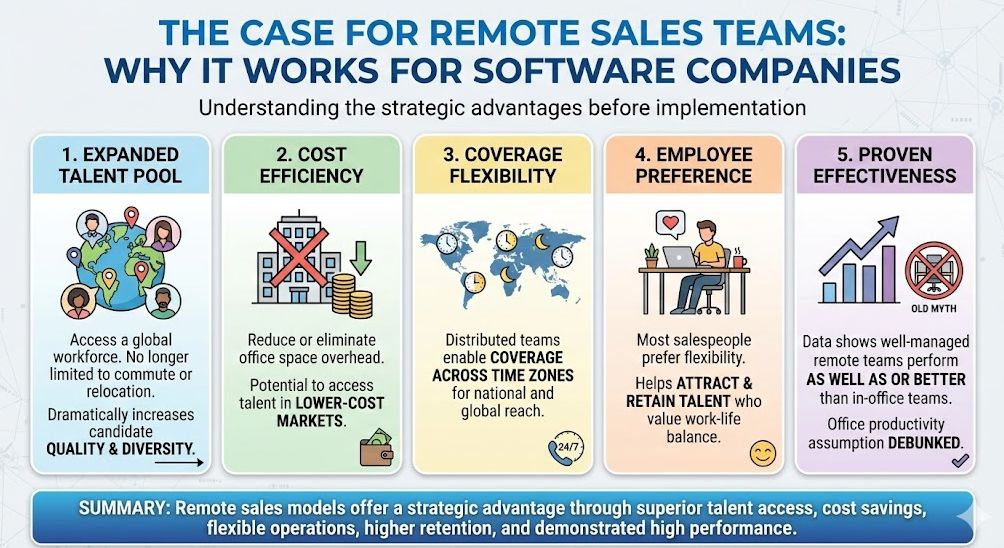
The Case for Remote Sales Teams
Before diving into how, it’s worth understanding why remote sales works particularly well for software companies.
Expanded talent pool. You’re no longer limited to candidates willing to commute to your office or relocate to your city. This dramatically increases the quality and diversity of candidates you can attract.
Cost efficiency. Remote teams reduce or eliminate office space costs. Depending on your compensation strategy, you may also access talent in lower-cost markets.
Coverage flexibility. Distributed teams can provide coverage across time zones, which matters if you sell nationally or globally.
Employee preference. Most salespeople prefer some remote flexibility. Offering it helps you attract and retain talent who might otherwise look elsewhere.
Proven effectiveness. Years of data now show that well-managed remote sales teams perform as well as or better than in-office teams. The old assumption that salespeople need to be in an office to be productive has been thoroughly debunked.
Hiring Remote Sales Candidates
Recruiting for remote roles requires adjustments to your normal process. Not everyone thrives working remotely, and identifying candidates who will succeed in a distributed environment is critical.
What to Look for in Remote Candidates
Beyond standard sales qualifications, evaluate candidates for remote-specific traits:
Self-motivation and discipline. Remote work requires internal drive. Without a manager walking by, reps need to hold themselves accountable for activity and results.
Communication skills. Remote sellers communicate primarily through written messages, video calls, and phone. Strong written communication becomes more important than in co-located teams.
Technology comfort. Remote reps need to navigate CRM systems, video conferencing, collaboration tools, and sales tech stacks without in-person IT support.
Time management. Without office structure, remote workers must organize their own days effectively. Look for evidence of strong personal organization.
Proactive problem-solving. When issues arise, remote reps can’t walk down the hall for help. They need to troubleshoot independently and know when to escalate.
Prior remote experience. Candidates who’ve successfully worked remotely before understand the challenges and have developed coping strategies.
Interview Questions for Remote Readiness
Probe for remote capabilities with questions like:
- Describe your ideal work environment. What conditions help you do your best work?
- Tell me about a time you had to stay motivated through a challenging period without much external support.
- How do you structure your typical workday when no one is watching?
- What tools and systems do you use to stay organized and on track?
- How do you handle communication with teammates and managers when you can’t meet in person?
- What’s the biggest challenge you’ve faced working remotely, and how did you address it?
Listen for specific examples and concrete strategies rather than vague assurances that they’ll be fine.
Assessing Remote Candidates Practically
Consider adding practical elements to your evaluation:
Asynchronous communication test. Send candidates a realistic scenario via email and evaluate how they respond in writing. This reveals communication clarity and responsiveness.
Video interview observation. Note their setup, professionalism on camera, and comfort with the medium. These are skills they’ll use daily with prospects.
Self-assessment. Ask candidates to honestly evaluate their fit for remote work. Those with realistic self-awareness about the challenges are often better prepared to handle them.
Onboarding Remote Sales Hires
Remote onboarding requires more structure and intentionality than in-office onboarding. New hires can’t absorb culture and process through osmosis when they’re not physically present.
Create Comprehensive Documentation
Document everything a new rep needs to know. This includes product information, sales process, tools and systems, company policies, and cultural norms. Make this documentation searchable and accessible so reps can reference it anytime.
Structure the First Weeks Carefully
Build a detailed schedule for the first few weeks. Don’t leave new hires guessing what they should be doing. Include training sessions, shadowing opportunities, practice exercises, and check-ins. Balance live sessions with self-directed learning.
Assign Onboarding Buddies
Pair new reps with experienced team members who can answer questions, provide context, and offer informal support. This relationship helps new hires feel connected even without physical proximity.
Overcommunicate Early
Increase communication frequency during onboarding. Daily check-ins during the first week, then tapering to several times weekly, helps catch problems early and ensures new hires don’t feel isolated.
Create Early Wins
Design onboarding so new reps experience success quickly. This might mean warm leads to practice with, small wins to celebrate, or early opportunities to contribute to team discussions. Early wins build confidence and connection.
For more detailed guidance, see our article on building an effective sales onboarding program.
Managing Remote Sales Performance
Managing remote sales teams requires shifting from presence-based management to results-based management. You can’t see whether reps are at their desks, so you have to focus on what they produce.
Define Clear Expectations
Be explicit about what you expect. This includes activity metrics like calls and meetings, pipeline targets, quota expectations, response time standards, and CRM hygiene requirements. When expectations are unclear, remote reps can drift without realizing it.
Implement Consistent Rhythms
Establish regular cadences for team and individual interaction:
- Daily standups. Brief check-ins to share priorities and surface blockers. Keep these short and focused.
- Weekly one-on-ones. Dedicated time for coaching, problem-solving, and connection with each rep.
- Weekly team meetings. Opportunities for group learning, announcements, and team building.
- Monthly or quarterly reviews. Deeper performance conversations and goal setting.
Consistent rhythms create structure that remote workers often lack on their own.
Focus on Outcomes Over Activity
While activity metrics matter, avoid micromanaging inputs at the expense of results. Trust reps to manage their time and focus on whether they’re hitting goals. Excessive monitoring erodes trust and autonomy, which are essential for remote success.
Use Technology Effectively
Your tech stack is the remote team’s office. Invest in tools that enable visibility and collaboration:
- CRM. Your single source of truth for pipeline and activity. Ensure reps keep it updated accurately.
- Communication tools. Slack or Teams for quick questions, Zoom or similar for meetings, email for formal communication.
- Call recording. Capture sales calls for coaching and quality assurance.
- Sales engagement platforms. Tools that track outreach and automate workflows.
- Project management. Systems for tracking initiatives and action items.
Ensure tools are integrated and that data flows between them. A fragmented tech stack creates friction for remote teams.
Maintain Visibility Without Hovering
Find the balance between visibility and trust. You need enough insight into activity and pipeline to catch problems early, but not so much oversight that reps feel surveilled. Regular one-on-ones and consistent CRM usage provide visibility without micromanagement.
Building Remote Culture
Culture doesn’t happen automatically in remote teams. It requires intentional effort to create connection and shared identity.
Create Opportunities for Social Connection
Schedule time for non-work interaction. Virtual coffee chats, team happy hours, and casual channels in Slack help replicate the informal bonding that happens naturally in offices. These aren’t mandatory fun but genuine opportunities for connection.
Recognize and Celebrate Success
Acknowledge wins publicly and frequently. Remote workers can feel invisible, so explicit recognition matters more. Celebrate closed deals, milestone achievements, and exceptional effort in team channels and meetings.
Bring People Together Periodically
If budget allows, gather the team in person occasionally. Annual or quarterly offsites create concentrated bonding time that sustains remote relationships. Even a few days together can significantly strengthen team cohesion.
Establish Cultural Norms
Be explicit about how your team operates. Document norms around communication, meeting etiquette, response times, and collaboration. New hires can’t observe these norms in action, so they need to be spelled out.
Guard Against Isolation and Burnout
Remote workers can feel disconnected and often struggle to separate work from personal life. Check in on wellbeing, not just performance. Encourage boundaries around work hours and model healthy behavior yourself.
Common Remote Management Mistakes
Avoid these patterns that undermine remote team effectiveness:
Insufficient communication. When in doubt, overcommunicate. Remote teams can’t pick up context from hallway conversations, so important information needs to be shared explicitly and repeatedly.
Inconsistent processes. Remote teams need clear, documented processes more than co-located teams. Ambiguity that might get resolved through quick conversations in an office creates confusion and inconsistency when everyone is remote.
Ignoring time zones. If your team spans multiple time zones, be thoughtful about meeting times and communication expectations. Rotating meeting times so the burden doesn’t always fall on the same people shows respect.
All-business interactions. Teams that only interact about work struggle to build trust and connection. Create space for informal conversation and relationship building.
Assuming tools solve everything. Technology enables remote work but doesn’t replace good management. Don’t rely on tools to do the work of leadership.
Hybrid Considerations
Many companies have settled on hybrid models where reps work remotely most of the time but come together periodically. If you’re running a hybrid team:
Be intentional about in-person time. Use office days for activities that benefit from physical presence, such as training, team building, and collaborative planning, rather than just individual work.
Maintain equity between remote and in-office. Ensure remote workers have equal access to information, opportunities, and advancement. Avoid creating two-tier systems where in-office presence is implicitly rewarded.
Standardize on remote-first practices. Even when some people are in the office, run meetings and communication as if everyone were remote. This prevents remote workers from becoming second-class participants.
Getting Started
If you’re building a sales team with remote roles, start with clear decisions about your model. Will roles be fully remote, hybrid, or location-flexible? What geographic constraints, if any, will you impose? How will compensation vary by location?
For help finding remote sales talent, consider working with a software recruiting firm experienced in distributed hiring. They can help you access candidates nationwide and evaluate remote readiness.
The Bottom Line
Remote sales teams are no longer experimental. They’re how most software companies now operate, and the companies that master remote hiring and management have a significant competitive advantage in attracting talent and scaling efficiently.
Success requires intentionality. You have to hire for remote capability, onboard with extra structure, manage toward outcomes, and actively build culture. The companies that treat remote as just “working from home” struggle. The ones that build deliberate systems for distributed teams thrive.
The opportunity is real. Access talent anywhere, reduce overhead, and build a team that performs regardless of location. But it takes work to get right.
Leave a Reply