


You’ve invested significant time and money to hire a new sales rep. Now the real work begins. How quickly they ramp to productivity determines how fast you see return on that investment, and whether they stick around long enough to make that return meaningful.
The stakes are high. According to research from The Bridge Group, effective onboarding can increase win rates by 15% and quota achievement by 14%. Companies with strong onboarding practices also see 39% higher employee engagement, which translates to better performance and lower turnover.
Yet many software companies treat onboarding as an afterthought. They hand new reps a laptop, point them toward some product documentation, and expect results. This approach wastes the recruiting investment and sets people up to fail.
Here’s how to build an onboarding program that actually works.
Understanding Ramp Time
Ramp time is the period from a new hire’s start date until they consistently hit quota. For SaaS companies, average ramp time runs between 3 to 6 months, depending on deal complexity and sales cycle length.
A common formula for estimating ramp time is your average sales cycle length plus 90 days for training and pipeline building. If your typical deal takes 60 days to close, expect roughly 5 months before a new rep is fully productive.
Several factors influence ramp time:
- Product complexity. Technical products with steep learning curves take longer to master.
- Sales cycle length. Reps selling enterprise deals with 9-month cycles obviously take longer to close their first deals than those with 30-day cycles.
- Target customer. Selling to technical buyers requires different preparation than selling to business buyers.
- Available support. Reps with sales engineering support, strong marketing materials, and established processes ramp faster.
- Prior experience. Someone who’s sold similar products to similar buyers will ramp faster than someone learning a new domain.
Understanding your expected ramp time helps you set realistic quotas for new hires and plan your hiring timeline accordingly.
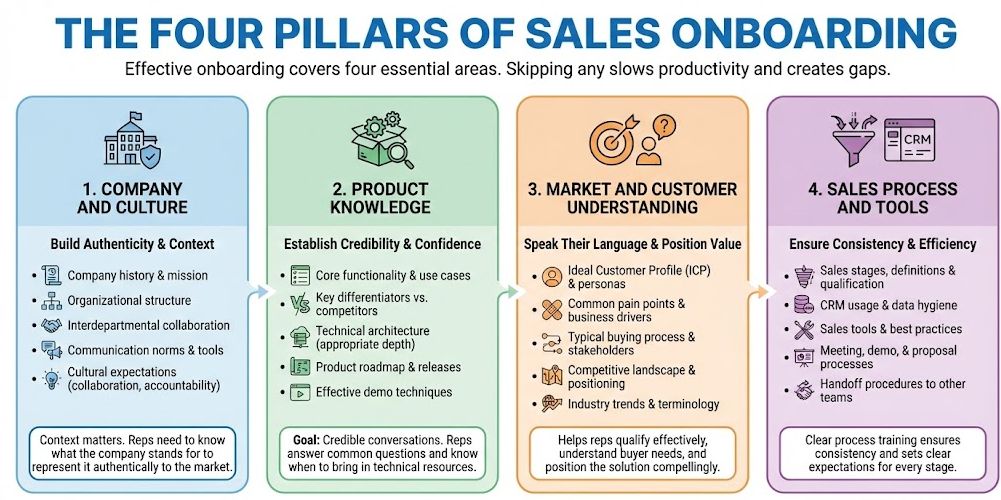
The Four Pillars of Sales Onboarding
Effective onboarding covers four essential areas. Skip any of these and you’ll have gaps that slow productivity.
Company and Culture
New reps need to understand the organization they’ve joined. This includes company history and mission, organizational structure, how departments work together, communication norms and tools, and cultural expectations around collaboration, transparency, and accountability.
This context matters because salespeople represent your company to the market. They need to understand what the company stands for and how it operates to represent it authentically.
Product Knowledge
Reps can’t sell what they don’t understand. Product training should cover core functionality and use cases, key differentiators versus competitors, technical architecture at an appropriate depth, common implementation patterns, product roadmap and recent releases, and how to demo effectively.
The goal isn’t to turn salespeople into engineers. It’s to give them enough understanding to have credible conversations, answer common questions, and know when to bring in technical resources.
Market and Customer Understanding
Knowing the product isn’t enough. Reps need to understand who buys it and why. This includes ideal customer profile and target personas, common pain points and business drivers, typical buying process and stakeholders involved, competitive landscape and positioning, industry trends and terminology, and customer success stories and use cases.
This knowledge helps reps qualify opportunities effectively, speak the customer’s language, and position your solution compellingly.
Sales Process and Tools
Finally, reps need to master your specific sales methodology and systems. This covers your sales stages and definitions, qualification criteria, CRM usage and data hygiene expectations, sales tools and how to use them, meeting and demo best practices, proposal and pricing processes, and handoff procedures to other teams.
Clear process training ensures consistency and helps reps know exactly what’s expected at each stage.
Structuring the First 90 Days
Break onboarding into phases rather than front-loading everything into week one. New hires can only absorb so much information at once, and they’ll forget most of what they learn if they don’t apply it quickly.
Week One: Foundation
Focus the first week on orientation and basics. Get administrative tasks completed, introduce the company and team, provide an overview of products and market, set up tools and systems, and begin product training. The goal is helping new reps feel welcomed, connected, and oriented.
Weeks Two and Three: Deep Dive
Shift to intensive product and process training. Cover product functionality in depth, shadow experienced reps on calls and demos, begin CRM and tool training, introduce sales methodology, and start learning competitive positioning. Include hands-on practice alongside instruction.
Weeks Four Through Six: Guided Practice
Move toward supervised selling activity. Have reps conduct calls with coaching support, practice demos and get feedback, start building their own pipeline, attend deal reviews to learn from others, and continue product certification if applicable. The emphasis shifts from learning to doing, with heavy coaching involvement.
Weeks Seven Through Twelve: Ramping Production
Transition to more independent work with ongoing support. Reps should carry reduced quotas appropriate to ramp, receive regular one-on-ones and coaching, continue developing skills through practice, participate fully in team activities, and build toward full quota attainment.
Essential Training Content
Create resources that reps can reference throughout onboarding and beyond:
Product documentation. Clear explanations of features, benefits, and use cases. Include videos and demos alongside written materials.
Competitive battle cards. Concise comparisons highlighting your strengths and how to handle competitor objections.
Buyer personas. Profiles of typical buyers including their roles, priorities, pain points, and how they evaluate solutions.
Objection handling guides. Common objections with suggested responses and supporting evidence.
Call recordings. Examples of strong discovery calls, demos, and closing conversations from top performers.
Case studies and references. Customer success stories organized by industry, use case, or company size.
Process documentation. Step-by-step guides for key activities from qualification to contract execution.
Make these resources easily searchable and accessible. Reps will refer back to them long after formal onboarding ends.
Role-Playing and Practice
Reading and watching only goes so far. Reps learn by doing, and practice in safe environments builds confidence before real customer conversations.
Build role-playing into your onboarding program:
Discovery call practice. Have reps conduct mock discovery calls with managers or peers playing the prospect. Provide feedback on questioning technique, active listening, and note-taking.
Demo practice. Reps should deliver multiple practice demos before presenting to real prospects. Evaluate their flow, handling of questions, and ability to connect features to business value.
Objection handling. Run scenarios where reps must respond to common objections. This builds the muscle memory needed to handle pushback smoothly.
Pitch practice. Have reps deliver their positioning and value proposition repeatedly until it sounds natural rather than scripted.
Video recording practice sessions allows reps to self-evaluate and see their own habits. It can be uncomfortable but it’s highly effective for improvement.
Measuring Onboarding Effectiveness
Track metrics to understand whether your program is working:
Time to first deal. How long until new reps close their first opportunity? Compare this across cohorts to see if you’re improving.
Ramp quota attainment. Track performance against ramp quotas at 30, 60, and 90 days. Identify reps who are struggling early.
Activity levels. Monitor leading indicators like calls made, meetings held, and pipeline created. Low activity often predicts poor outcomes.
Certification completion. If you have formal certifications or assessments, track completion rates and scores.
New hire retention. What percentage of new hires are still with you after 6 months? 12 months? High early turnover often signals onboarding problems.
Rep feedback. Survey new hires about their onboarding experience. Ask what was helpful, what was missing, and what they would change.
Use this data to continuously improve your program. Onboarding should evolve based on what’s working and what isn’t.
Common Onboarding Mistakes
Avoid these patterns that undermine onboarding effectiveness:
Information overload in week one. Cramming everything into the first few days overwhelms new hires. Space out learning and reinforce through repetition.
All classroom, no practice. Training without application doesn’t stick. Build in hands-on practice from the start.
No structured curriculum. Unstructured onboarding where reps figure things out on their own creates inconsistency and extends ramp time.
Ignoring ongoing reinforcement. Learning doesn’t end after 90 days. Continue coaching and skill development throughout a rep’s tenure.
One-size-fits-all approach. Experienced hires need different onboarding than those new to software sales. Customize based on what each person already knows.
Lack of manager involvement. If managers aren’t actively engaged in onboarding their new hires, the process loses effectiveness. Onboarding is a manager responsibility, not just an HR or enablement function.
Connecting Onboarding to Long-Term Success
Strong onboarding sets the foundation, but development shouldn’t stop there. The best sales organizations treat learning as continuous.
Connect your onboarding program to ongoing enablement including regular training sessions on new products or techniques, peer learning through deal reviews and best practice sharing, coaching programs that develop skills over time, and career development paths that give reps goals to work toward.
When reps see onboarding as the beginning of their development journey rather than a box to check, they’re more likely to engage fully and continue growing.
For guidance on building your broader sales organization, see our article on how to build a sales team from scratch. And for help finding the right people to put through your onboarding program, consider partnering with a software recruiting firm that understands what success looks like in software sales.
The Bottom Line
Effective sales onboarding transforms your hiring investment into productive capacity faster. It reduces the painful months of waiting for new reps to contribute, improves retention by setting people up for success, and creates consistency in how your team sells.
The companies that excel at onboarding treat it as a strategic priority, not an administrative task. They invest in content, dedicate manager time, track results, and continuously improve based on what they learn.
Your onboarding program is ultimately a reflection of how much you value the people you hire. Build one that shows you’re invested in their success, and you’ll see that investment returned in performance, engagement, and loyalty.
Leave a Reply