


Hiring enterprise software sales professionals requires a different approach than hiring for other sales roles.
These are the people who will manage six and seven figure deals, navigate buying committees with a dozen stakeholders, and represent your company to Fortune 500 prospects.
The wrong hire costs you more than a salary. It costs you pipeline, customer relationships, and months of lost momentum.
So how do you find the right people? You need to understand what makes enterprise software sales unique, know which competencies actually predict success, and build a hiring process that identifies top performers before your competitors snap them up.
This guide breaks down everything you need to know about enterprise software hiring, from evaluation criteria to sourcing strategies to the mistakes that derail most companies.
What Makes Enterprise Software Sales Hiring Different
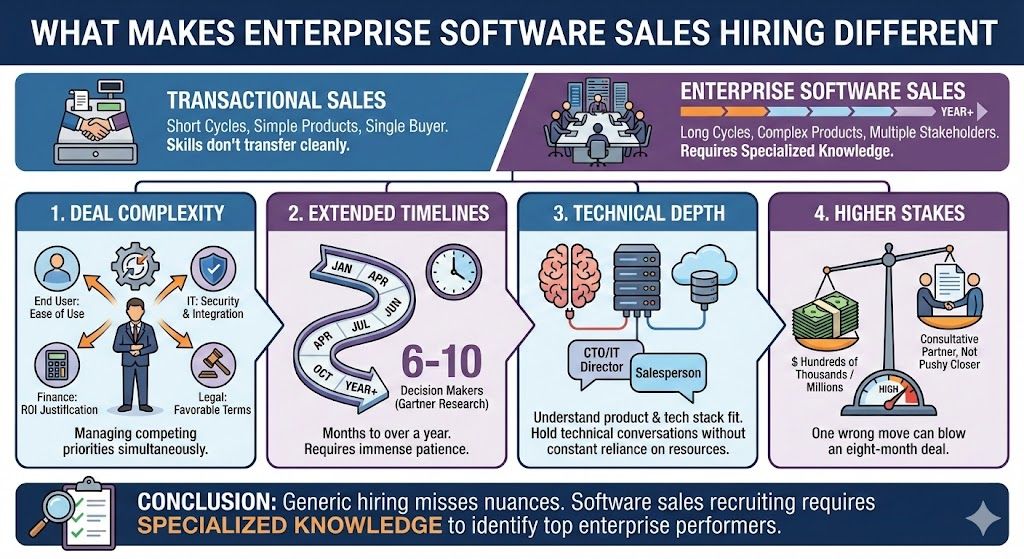
Enterprise software sales is not a typical sales job. The deal cycles stretch for months, sometimes over a year. The products are complex and often require deep technical knowledge to position effectively. The buyers are sophisticated, skeptical, and surrounded by gatekeepers.
A salesperson who thrived selling transactional products will often struggle in this environment. The skills don’t transfer as cleanly as most hiring managers assume.
Here’s what sets enterprise software sales apart:
Deal complexity. Enterprise deals involve multiple stakeholders with competing priorities. The end user wants ease of use. IT wants security and integration. Finance wants ROI justification. Legal wants favorable terms. The salesperson has to manage all of these relationships simultaneously while keeping the deal moving forward.
Extended timelines. According to research from Gartner, the average B2B buying process now involves 6 to 10 decision makers, each armed with independently gathered information. This extends sales cycles and requires patience that many salespeople simply don’t have.
Technical depth. Enterprise software salespeople need to understand not just what their product does, but how it fits into a prospect’s existing technology stack. They need to hold their own in conversations with CTOs and IT directors without constantly pulling in technical resources.
Higher stakes. When deals are worth hundreds of thousands or millions of dollars, the pressure is different. Prospects expect a consultative partner, not a pushy closer. One wrong move can blow a deal that took eight months to build.
This is why software sales recruiting requires specialized knowledge. Generic sales hiring practices miss the nuances that separate top enterprise performers from everyone else.
Key Competencies to Evaluate in Enterprise Software Candidates
Forget the standard sales interview questions about overcoming objections or your greatest weakness. Enterprise software sales demands specific competencies that you need to probe directly.
Complex deal management. Can this person juggle multiple threads within a single opportunity? Ask candidates to walk you through a deal with more than five stakeholders. How did they map the buying committee? How did they identify the economic buyer versus the technical evaluator? How did they handle conflicting priorities within the account?
Business acumen. Top enterprise salespeople understand business problems, not just product features. They can talk about ROI, total cost of ownership, and business outcomes in language that resonates with executives. Test this by asking how they would pitch your product to a CFO versus a CTO.
Patience and persistence. Enterprise deals stall constantly. Budgets freeze. Champions leave. Priorities shift. The best salespeople maintain relationships through these setbacks without becoming pushy or giving up. Ask about deals that took longer than expected and how they kept them alive.
Technical credibility. They don’t need to be engineers, but they need to hold their own in technical conversations. Can they explain complex concepts simply? Can they identify when a prospect’s technical concerns are legitimate versus when they’re smokescreens for other objections?
Consultative selling ability. Enterprise software buyers don’t want to be sold to. They want a partner who understands their problems and can help them build a business case internally. Look for candidates who ask more questions than they answer in the interview.
When evaluating candidates, assessments can provide valuable data beyond what you’ll learn in interviews alone.
Where to Find Qualified Enterprise Software Sales Talent
The best enterprise software salespeople are rarely job hunting. They’re employed, earning strong commissions, and fielding recruiter calls weekly. If you’re only posting jobs and waiting for applications, you’re fishing in the wrong pond.
Your competitors. This sounds obvious, but it’s worth stating. The people selling similar products to similar buyers already understand your market. They know the objections, the competitive landscape, and the buyer personas. The challenge is reaching them and convincing them your opportunity is worth the risk of switching.
Adjacent software categories. Let’s say you sell supply chain software. A salesperson who has been selling ERP or procurement software already understands your buyers and the enterprise sales motion. They’ll need to learn your product, but the foundational skills are there.
Your customers’ vendors. The salespeople who sold software to your existing customers have already built relationships with your target buyer personas. They understand the environment and may have contacts they can bring with them.
Referrals from your current team. Top performers know other top performers. If you have strong enterprise salespeople already, ask who they’ve worked with in the past that they’d recommend. Referral hires tend to ramp faster and stay longer.
Industry events and communities. Enterprise software sales professionals gather at conferences, belong to professional groups, and participate in online communities. Building relationships in these spaces takes time but creates a talent pipeline that pays dividends.
Most companies underinvest in proactive sourcing and overinvest in reactive job postings. Flip that ratio and your candidate quality will improve dramatically.
The Role of a Software Recruiting Firm in Enterprise Sales Hiring
There are times when handling enterprise software hiring internally makes sense. And there are times when working with specialists gets you better results faster.
A software recruiting firm adds value in several specific situations:
Speed matters. If you need to build out a sales team quickly to capture a market window or hit investor milestones, you probably don’t have time to build sourcing infrastructure from scratch. Specialized recruiters have existing networks and can surface qualified candidates within days instead of weeks.
The role is senior. VP of Sales and CRO searches require discretion and access to candidates who won’t respond to job postings. Executive recruiters know how to approach these conversations and can represent your opportunity professionally to people who receive dozens of outreach messages daily.
You’re entering a new market. If you’re expanding into a new vertical or geography, you may not know where the talent is. Recruiters with deep software industry experience can point you toward candidate pools you wouldn’t find on your own.
Internal recruiting is overwhelmed. Your talent acquisition team might be great at hiring engineers and marketers but lack the network and pattern recognition for enterprise sales specifically. Specialized support fills that gap without requiring a permanent headcount increase.
You keep making bad hires. If your enterprise sales turnover is high or new hires aren’t ramping successfully, something in your process is broken. An outside perspective can identify what you’re missing and help you calibrate your evaluation criteria.
The key is finding recruiters who genuinely specialize in software. A generalist agency that also happens to fill sales roles won’t have the depth you need.
Common Mistakes When Hiring Enterprise Software Salespeople
After watching companies hire for enterprise software sales roles over many years, certain patterns emerge. These mistakes are predictable and avoidable.
Overvaluing industry experience. Yes, industry knowledge helps. But a great salesperson from an adjacent space will outperform a mediocre one from your exact industry almost every time. Skills transfer more readily than most hiring managers believe. Product knowledge can be taught in weeks. Complex deal management takes years to develop.
Hiring based on interview polish. Enterprise sales interviews reward people who present well. That’s not nothing, but it’s not everything either. The candidate who gives the smoothest answers might struggle when deals get messy. Keeping interviews structured and bias-free helps you evaluate substance over style.
Not digging into specific deals. Generic questions get generic answers. Instead of asking “tell me about your biggest win,” ask candidates to walk you through one deal in excruciating detail. Who were the stakeholders? What were the objections? How did pricing negotiations go? Where did it almost fall apart? You’ll learn more from one deep dive than from ten surface-level success stories.
Ignoring the importance of ramp support. Hiring is only half the battle. Enterprise sales roles require significant onboarding support. If you’re hiring people and then expecting them to figure things out on their own, you’re setting them up to fail and then blaming them for the results.
Moving too slowly. Strong candidates have options. If your process takes six weeks from first interview to offer, you’ll lose people to competitors who move in three. Urgency signals that you’re serious and organized.
Relying on provided references. Of course candidates give you references who will say nice things. Back-channel references from people you find independently provide more honest signal. Former managers, former colleagues, even former customers can offer perspectives the candidate didn’t curate.
Building a Hiring Process for Enterprise Sales Roles
A good hiring process for enterprise software sales talent acquisition balances thoroughness with speed. Here’s a framework that works.
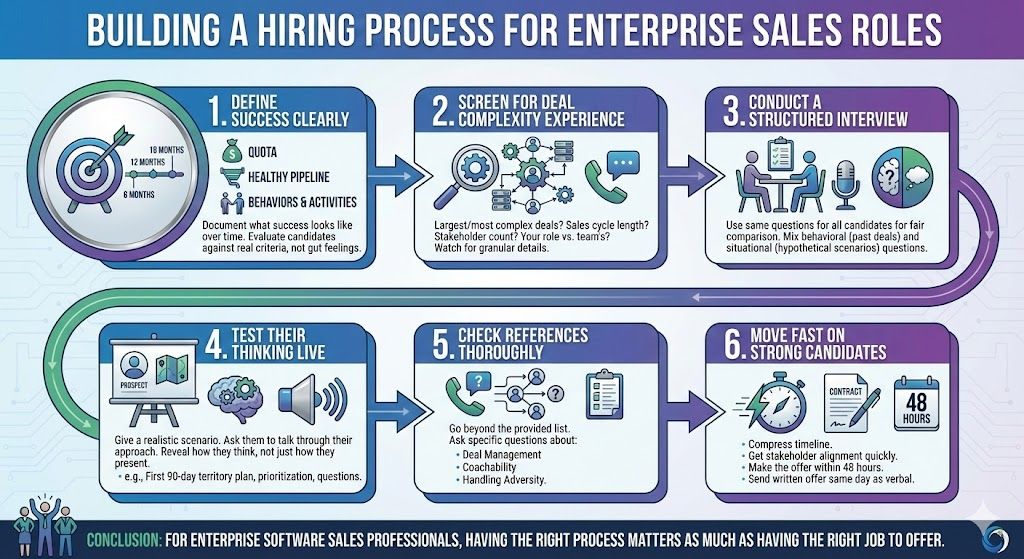
Step one: Define success clearly. Before you write the job description, document what success looks like at 6, 12, and 18 months. What quota will they carry? What does a healthy pipeline look like? What behaviors and activities should they demonstrate? This clarity helps you evaluate candidates against real criteria rather than gut feelings.
Step two: Screen for deal complexity experience. In your initial phone screen, ask about the largest and most complex deals the candidate has worked. Listen for specifics. How long was the sales cycle? How many stakeholders were involved? What was their role versus the team’s role? If they can’t get granular, that’s a red flag.
Step three: Conduct a structured interview. Use the same questions for every candidate so you can compare apples to apples. Include a mix of behavioral questions about past deals and situational questions about how they’d approach hypothetical scenarios at your company.
Step four: Test their thinking live. Give candidates a realistic scenario and ask them to talk through their approach. Imagine you’re selling your product. Here’s a prospect profile. Walk me through your first 90 days in the territory. How would you prioritize? What questions would you want answered? This reveals how they think, not just how they present.
Step five: Check references thoroughly. Go beyond the provided list when possible. Ask specific questions about deal management, coachability, and how the candidate handled adversity.
Step six: Move fast on strong candidates. When you find someone good, compress your timeline. Get stakeholders aligned quickly. Make the offer within 48 hours of your final interview. Send the written offer the same day you make the verbal one.
If you’re looking for enterprise software sales professionals, having the right process matters as much as having the right job to offer.
Finding the Right Fit for Your Team
Enterprise software hiring is high stakes. The right person can transform your pipeline, close anchor accounts, and raise the bar for your entire sales organization. The wrong person burns runway, damages prospect relationships, and creates months of setback.
The companies that hire well treat sales recruiting with the same rigor they apply to product development or customer acquisition. They define what they’re looking for, source proactively beyond job postings, evaluate thoroughly, and move quickly when they find the right fit.
If you’re building an enterprise software sales team and want to connect with candidates who are proven performers, working with specialists who understand this specific market can accelerate your results.
Take the time to get this right. Your revenue targets depend on it.
Leave a Reply