


Moving from SMB to enterprise sales requires mastering longer sales cycles, navigating multi-stakeholder deals, and developing a more consultative approach. The payoff is significant: enterprise deals often exceed $100,000, compared to SMB deals that typically close under $10,000. But the transition isn’t just about chasing bigger numbers. It’s about fundamentally changing how you sell.
Here’s what you need to know about making each jump successfully.
Understanding the Three Market Segments
Before mapping your transition, you need to understand what makes each segment distinct.
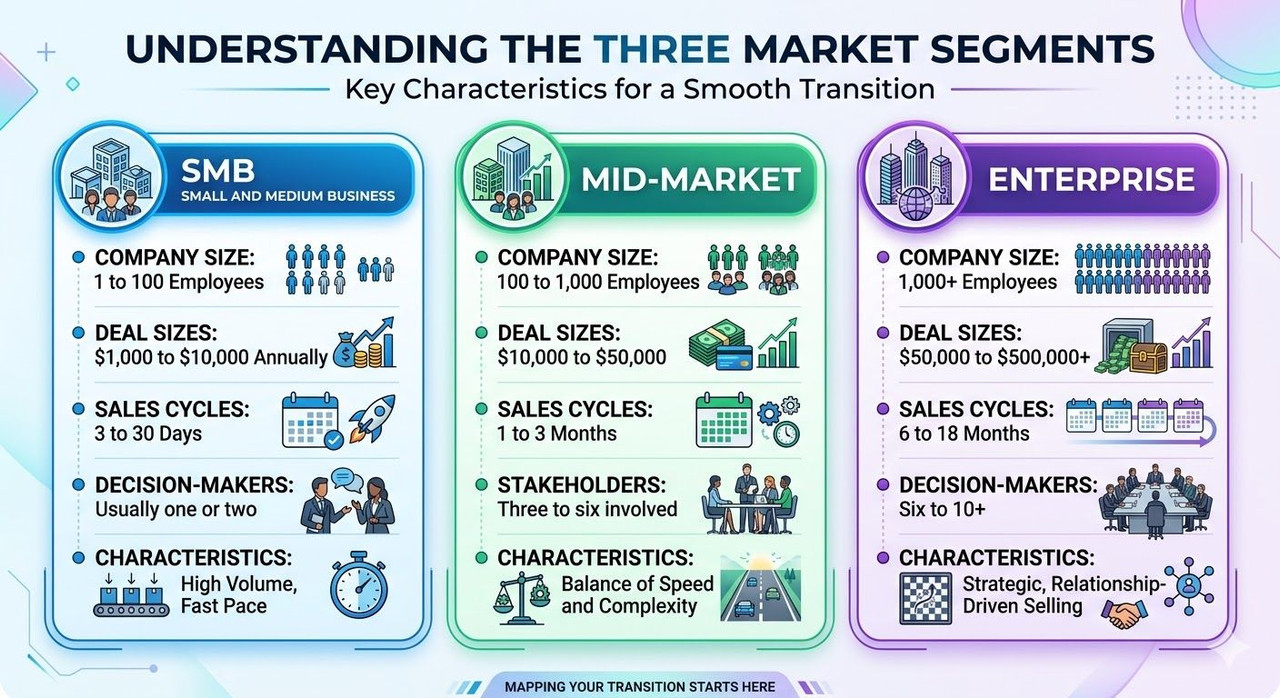
SMB (Small and Medium Business)
- Companies with 1 to 100 employees
- Deal sizes typically $1,000 to $10,000 annually
- Sales cycles of 3 to 30 days
- Usually one or two decision-makers
- High volume, fast pace
Mid-Market
- Companies with 100 to 1,000 employees
- Deal sizes of $10,000 to $50,000
- Sales cycles of 1 to 3 months
- Three to six stakeholders involved
- Balance of speed and complexity
Enterprise
- Companies with 1,000+ employees
- Deal sizes of $50,000 to $500,000+
- Sales cycles of 6 to 18 months
- Six to 10+ decision-makers
- Strategic, relationship-driven selling
According to Gartner, the typical enterprise buying group involves six to 10 stakeholders, each consulting four to five sources of information before making a decision. That complexity is the biggest adjustment you’ll face moving upmarket.
The SMB to Mid-Market Transition
This is usually the first move reps make, and it’s the gentler of the two transitions. You’re still closing deals relatively quickly, but you need to expand your approach.
What Changes
More stakeholders to manage. Instead of convincing one owner or decision-maker, you’ll work with department heads, end users, and at least one executive. Learning to multithread across multiple contacts becomes essential.
Longer evaluation periods. Mid-market buyers do more research, run more internal meetings, and require more justification. Patience becomes a virtue.
More structured sales processes. These companies have procurement procedures. You’ll encounter RFPs, security questionnaires, and formal vendor evaluations for the first time.
Higher expectations for ROI proof. A small business owner might buy on gut instinct. Mid-market buyers want data, case studies, and clear financial justification.
Skills to Develop
- Discovery depth. Your discovery calls need to uncover not just the main buyer’s pain, but the priorities of everyone who influences the decision.
- Business case building. Learn to quantify value in terms of revenue impact, cost savings, and productivity gains.
- Follow-up discipline. Deals take longer, so you need systems to stay engaged without being annoying.
- Proposal writing. Your one-pagers won’t cut it. Mid-market deals often require formal proposals and presentations.
Timeline
Most reps can make this transition after 12 to 24 months of strong SMB performance. If you’re consistently hitting 110%+ of quota and showing aptitude for more complex conversations, you’re ready.
The Mid-Market to Enterprise Transition
This is the harder jump. Enterprise sales is a different sport, not just a bigger version of what you’ve been doing.
What Changes
Massively longer sales cycles. You might work a deal for 6 to 18 months before it closes. That requires a completely different mindset and pipeline management approach.
Buying committees, not buyers. Enterprise deals involve IT, finance, procurement, legal, security, end users, and executive sponsors. Each group has different concerns and success metrics. Getting them aligned is often harder than proving your product’s value.
Political dynamics. Large organizations have internal politics. Your champion might have enemies. Decisions get made for reasons that have nothing to do with your product. Learning to read and work within these dynamics is critical.
Higher stakes, more scrutiny. Enterprise buyers are spending serious budget. They’ll dig into your company’s financial stability, security practices, implementation track record, and customer references.
Executive presence required. You’ll present to VPs and C-suite executives. If you’re not comfortable in those rooms, you’ll struggle.
Skills to Develop
- Strategic account planning. You need to map the entire organization: who influences what, who has budget authority, who might block the deal, who your champion is.
- Executive communication. Learn to speak the language of business outcomes, not product features. CFOs care about ROI. CIOs care about risk and integration.
- Patience and persistence. Enterprise deals go quiet for weeks. Contacts leave. Priorities shift. You need resilience and the ability to re-engage without starting from scratch.
- Negotiation sophistication. Enterprise compensation structures involve larger variable components because the deals are bigger but less predictable.
- Cross-functional collaboration. You’ll work with sales engineers, solution architects, legal, and customer success. Orchestrating your internal team becomes part of the job.
Timeline
Moving from mid-market to enterprise typically takes 2 to 4 years of strong mid-market performance. Companies want to see that you can manage complex deals before giving you their largest accounts.
Should You Make the Move?
Bigger deals sound appealing, but enterprise sales isn’t for everyone. Ask yourself honestly:
Move upmarket if you:
- Enjoy long-term relationship building over quick wins
- Get energized by strategic complexity
- Handle ambiguity and slow progress well
- Want fewer but larger deals
- Are comfortable presenting to senior executives
Stay in SMB or mid-market if you:
- Thrive on fast-paced, high-volume selling
- Prefer closing deals quickly and moving on
- Get frustrated by slow-moving processes
- Enjoy autonomy and don’t want to coordinate large internal teams
- Value predictable, consistent commission checks
There’s no shame in loving SMB sales. Plenty of top performers build excellent careers and incomes staying in faster-moving segments. Knowing what type of role fits you matters more than chasing prestige.
How to Position Yourself for the Transition
If you’ve decided to move upmarket, here’s how to set yourself up:
Build the Right Track Record
Quota attainment is table stakes. To move up, you need to demonstrate:
- Consistent overperformance (120%+ of quota)
- Experience with your segment’s more complex deals
- Ability to manage multi-stakeholder processes
- Strong relationships with customers who renew and expand
Develop Missing Skills Proactively
Don’t wait until you’re in a bigger role to learn enterprise skills. Start now:
- Ask to shadow enterprise reps on calls
- Volunteer to support larger deals in a secondary role
- Study your company’s enterprise sales process
- Take courses on strategic selling methodologies like MEDDIC or Challenger
- Read books on enterprise sales (The Challenger Sale, SPIN Selling)
Get Internal Visibility
Networking within your own company matters. Make sure sales leadership knows you want to move up. Ask your manager about the path. Express interest to enterprise managers. Volunteer for cross-functional projects.
Consider Changing Companies
Sometimes the fastest path upmarket is switching to a new company. If your current employer doesn’t have a clear internal promotion path, or if their enterprise team never promotes from within, a strategic job change might be your best option.
When interviewing, target companies that hire mid-market reps into junior enterprise roles or have formal development programs.
The Compensation Question
Moving upmarket generally means higher on-target earnings, but with more volatility. Enterprise reps might close only 3 to 6 deals per year. One slipped deal can tank your quarter.
Here’s what to expect:
- SMB: OTE of $70,000 to $100,000, more predictable payouts
- Mid-market: OTE of $120,000 to $180,000, moderate variability
- Enterprise: OTE of $200,000 to $400,000+, significant variability
Before making the jump, make sure you understand how the compensation structure works and whether you can handle the income swings.
Final Thoughts
Moving from SMB to enterprise sales is one of the most rewarding career progressions in the profession. It takes time, intentional skill development, and usually a few years of proving yourself at each level. But for reps who enjoy strategic selling and building deep customer relationships, it’s worth the investment.
The key is to be honest about whether enterprise sales actually fits your personality and work style, not just your income goals. The best enterprise reps genuinely enjoy the long game. If that’s you, start building the skills and visibility now.
Leave a Reply