


Relocating for a sales job can accelerate your career by opening doors to better opportunities, larger markets, and higher compensation. According to Allied Van Lines research, the most common reason people relocate for work is career advancement or the opportunity to make more money, cited by 37% of those who moved. But relocation is a major life decision that requires careful evaluation beyond just the job offer itself.
Here’s how to think through whether relocation makes sense and how to set yourself up for success if you decide to move.
When Relocation Makes Sense
Not every opportunity justifies uprooting your life. Consider relocating when:
The role represents a significant step up. Moving for a lateral position rarely makes sense. But if the new role offers a meaningful title change, larger territory, or substantially higher OTE, the disruption may be worthwhile.
The market offers better opportunities. Some cities have thriving tech scenes with abundant sales jobs. Others have limited options. Relocating to a stronger market can benefit your entire career, not just this one role.
The company wouldn’t otherwise be accessible. Some of the best sales organizations are concentrated in specific locations. If your dream company requires you to be in their headquarters city, relocation may be the only path.
You want a fresh start. Sometimes personal circumstances make relocation appealing regardless of the specific job. A new city can provide new energy and perspective.
Cost of living works in your favor. Moving from an expensive market to a more affordable one can dramatically improve your quality of life, even at the same salary.
When to Think Twice
Be cautious about relocating if:
The company is unproven. Moving across the country for an early-stage startup carries more risk than relocating for an established company. If the role doesn’t work out, you’re stuck in a new city without a network.
The role could go remote. With remote sales jobs increasingly common, some positions that require relocation today might not tomorrow. Understand why physical presence is necessary.
You’d be leaving a strong network. Your professional relationships take years to build. Leaving them behind has real costs that are easy to underestimate.
Family considerations are complex. Uprooting a spouse’s career or children’s schools creates stress that can undermine your performance in the new role.
The numbers don’t work. If the compensation increase doesn’t offset higher cost of living and relocation expenses, you may end up worse off financially.
Evaluating the Opportunity
Before deciding, dig into both the role and the location.
Assess the Company and Role
Apply the same scrutiny you’d use for any job search:
- Research the company thoroughly
- Watch for red flags during interviews
- Ask detailed questions about the sales organization
- Understand the territory you’d be covering
- Talk to current employees about the culture
A relocation amplifies the stakes. You can’t easily leave a bad situation when you’ve just moved your entire life.
Research the New Location
Beyond the job, evaluate the city itself:
Cost of living. Use online calculators to compare housing, taxes, and daily expenses. A higher salary in an expensive city may leave you with less take-home money.
Sales job market. What happens if this role doesn’t work out? Are there other companies you’d want to work for in the area?
Quality of life. Consider climate, culture, outdoor activities, dining, and whatever matters to you personally.
Personal connections. Do you know anyone in the area? Having even a few contacts makes the transition easier.
Partner considerations. If you have a spouse or partner, research job opportunities for them as well.
Run the Financial Numbers
Calculate the true cost of the move:
- Moving expenses (if not covered by the company)
- Temporary housing during the transition
- Security deposits and setup costs in the new location
- Travel back home to visit family and friends
- Any loss from selling your current home
- Difference in ongoing cost of living
Compare this against the compensation increase to understand the real financial impact.
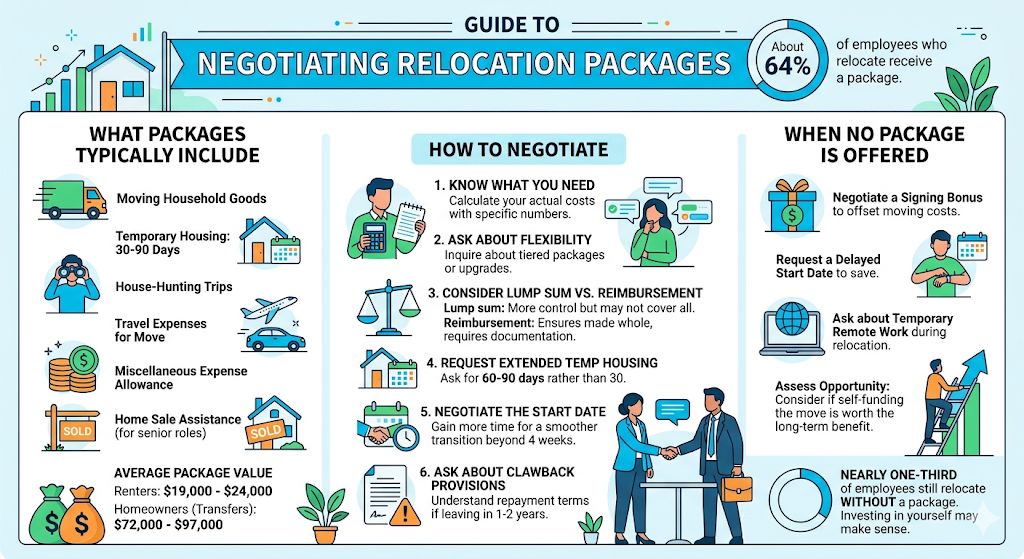
Negotiating Relocation Packages
Many companies offer relocation assistance to attract talent. About 64% of employees who relocate for work receive some form of relocation package.
What Packages Typically Include
Standard relocation packages may cover:
- Moving household goods
- Temporary housing for 30 to 90 days
- House-hunting trips
- Travel expenses for the move
- Miscellaneous expense allowance
- Home sale assistance (for more senior roles)
The average package for renters runs $19,000 to $24,000. For homeowners, packages can reach $72,000 to $97,000, especially for current employees being transferred.
How to Negotiate
Relocation packages are often negotiable, especially for experienced candidates.
Know what you need. Calculate your actual relocation costs before negotiating. Having specific numbers strengthens your position.
Ask about flexibility. Some companies offer tiered packages. If the standard package doesn’t meet your needs, ask if upgrades are available.
Consider lump sum vs. reimbursement. Lump sum payments give you more control but may not cover all expenses. Reimbursement ensures you’re made whole but requires more documentation.
Request extended temporary housing. Finding permanent housing takes time, especially in unfamiliar markets. Ask for 60 to 90 days rather than 30.
Negotiate the start date. Most companies give four weeks to relocate, but you can often negotiate more time for a smoother transition.
Ask about clawback provisions. Many packages require you to repay some or all relocation costs if you leave within one to two years. Understand these terms before accepting.
When No Package Is Offered
Some companies don’t offer formal relocation assistance, especially for junior roles. You have options:
- Negotiate a signing bonus to offset moving costs
- Request a delayed start date to give yourself time to save
- Ask about temporary remote work while you relocate
- Consider whether the opportunity is worth self-funding the move
Nearly one-third of employees still relocate without receiving a package. If the opportunity is strong enough, investing in yourself may make sense.
Making the Transition Successful
Once you’ve decided to relocate, set yourself up for success.
Before You Move
Build connections in advance. Connect on LinkedIn with people at your new company and in the local sales community. Having contacts before you arrive accelerates your integration.
Learn the territory. If you’ll be covering local accounts, study the market, key companies, and business environment before day one.
Secure housing strategically. Choose a location that makes your commute manageable and puts you near areas you’ll want to explore.
Handle logistics early. Update your driver’s license, vehicle registration, and other administrative details so they don’t distract you once you start.
During Your First 90 Days
The first three months are critical. You’re simultaneously learning a new job, building relationships, and adjusting to a new city.
Prioritize work initially. Your first 90 days set the tone for your tenure. Succeeding in your first 90 days or as an AE requires focus. Social life can come later.
Find your rhythm. Establish routines for work, exercise, and personal time. Structure helps when everything else is new.
Be patient with yourself. Homesickness is normal. The adjustment takes time. Don’t make major decisions during the first few months.
Build a local network. Attend local sales meetups, industry events, or professional groups. Creating connections outside work helps the city feel like home.
If You Have a Family
Relocating with a family adds complexity:
Involve your partner in the decision. Their career and happiness matter too. Make it a joint decision, not something they’re following you into.
Research schools thoroughly. If you have children, school quality may be the most important location factor.
Budget for family-related expenses. Childcare costs, school fees, and family activities vary significantly by location.
Plan for the transition period. Kids need extra support when everything around them changes. Be present during the adjustment.
Maintain connections. Regular video calls with grandparents and friends help children stay connected to their former community.
What If It Doesn’t Work Out?
Sometimes relocations fail. The job isn’t what you expected, the company struggles, or the city just doesn’t fit.
Warning Signs
Watch for these indicators that the situation isn’t working:
- Persistent unhappiness after the adjustment period (usually 6+ months)
- The role or company changed significantly from what you were promised
- Personal relationships are suffering without improvement
- Career trajectory isn’t what you expected
- You’re counting down to when the clawback period ends
Your Options
If you need to make a change:
Look locally first. You’ve already made the move. Explore other opportunities in your new city before relocating again.
Consider returning home. If you still have connections in your previous location, returning may be easier than starting over somewhere new.
Negotiate your departure. If you’re leaving before the clawback period ends, you may be able to negotiate a waiver, especially if you’re leaving on good terms.
Learn from the experience. Understand what went wrong so you make better decisions next time.
Final Thoughts
Relocating for a sales job is a significant commitment that can pay enormous dividends when done thoughtfully. The key is evaluating both the opportunity and the location honestly, negotiating a package that supports your transition, and giving yourself time to adjust once you arrive.
The best relocations happen when the job, the company, and the city all align with your career goals and personal life. When those elements come together, moving to a new place can be the catalyst for the next chapter of your career.
Leave a Reply