


Cultural fit matters in sales hiring, but it’s often misunderstood and poorly assessed. Done right, evaluating cultural alignment helps you hire salespeople who will thrive in your environment and stay long-term. Done wrong, it becomes a vague preference for people who “feel like us,” which introduces bias and limits diversity.
According to the Society for Human Resource Management (SHRM), poor cultural fit due to turnover can cost an organization between 50% and 60% of the person’s annual salary. For sales roles with high base salaries and extensive ramp periods, the true cost of a culture mismatch is even higher. Getting this right matters financially, not just philosophically.
What Cultural Fit Actually Means
Cultural fit doesn’t mean hiring people you’d want to grab a beer with. It means hiring people whose values, work style, and motivations align with how your organization operates.
Cultural fit includes:
- Values alignment: Do they share your organization’s core principles about how to conduct business?
- Work style compatibility: Does how they prefer to work match how your team operates?
- Communication preferences: Do they communicate in ways that mesh with your environment?
- Motivation match: Are they driven by what your organization offers and rewards?
- Adaptability: Can they thrive in your specific environment and stage of growth?
Cultural fit does not mean:
- Similar backgrounds, education, or demographics
- Shared hobbies or personal interests
- Identical personalities
- Agreement on everything
- “Someone I’d want to hang out with”
The goal is alignment on how work gets done, not homogeneity in who does it.
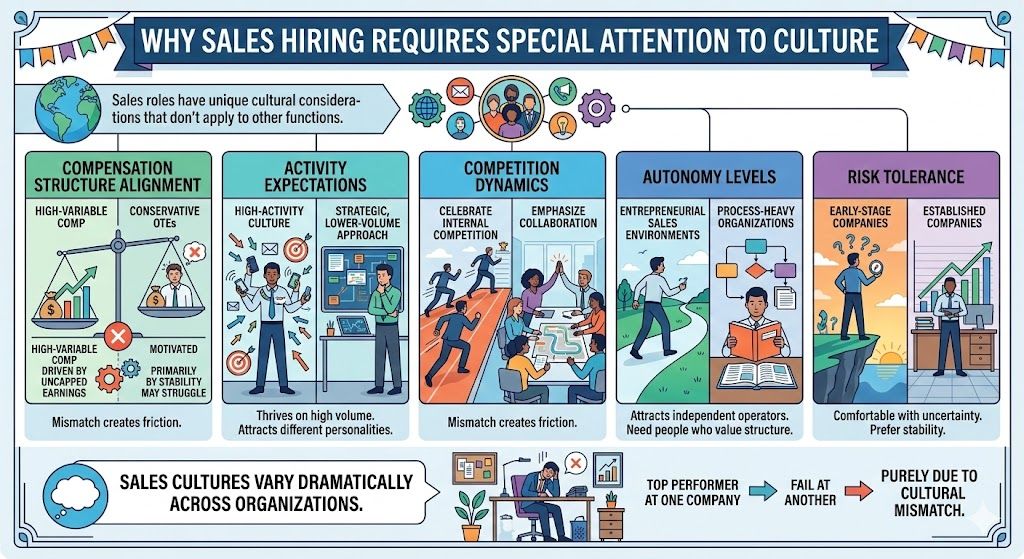
Why Sales Hiring Requires Special Attention to Culture
Sales roles have unique cultural considerations that don’t apply to other functions.
Sales-specific cultural factors:
- Compensation structure alignment: Someone motivated primarily by stability may struggle in a high-variable comp environment. Someone driven by uncapped earnings may feel constrained by conservative OTEs.
- Activity expectations: High-activity cultures require people who thrive on volume. Strategic, lower-volume approaches attract different personalities.
- Competition dynamics: Some sales cultures celebrate internal competition. Others emphasize collaboration. Mismatch here creates friction.
- Autonomy levels: Entrepreneurial sales environments attract independent operators. Process-heavy organizations need people who value structure.
- Risk tolerance: Early-stage companies require salespeople comfortable with uncertainty. Established companies attract those who prefer stability.
Sales cultures vary dramatically across organizations. A top performer at one company may fail at another purely due to cultural mismatch.
Defining Your Sales Culture Before You Hire
You can’t assess fit against something you haven’t defined. Before evaluating candidates, articulate your sales culture clearly.
Questions to answer:
- What behaviors do we reward and celebrate?
- How do we expect salespeople to treat customers?
- What’s our attitude toward competition (internal and external)?
- How much autonomy do we give versus structure we require?
- What does success look like beyond hitting quota?
- How do we handle failure and missed targets?
- What’s our pace and urgency level?
- How do we make decisions?
Involve your team: Don’t define culture from the top down. Talk to your current sales team about what makes someone successful in your environment. Their insights often differ from what leadership assumes.
Be honest: Don’t describe aspirational culture. Describe actual culture. Hiring someone for who you want to be rather than who you are creates mismatch.
Methods for Assessing Cultural Fit
Effective cultural assessment requires structured approaches, not vague impressions.
Behavioral interview questions: Ask about past situations that reveal values and work style.
- “Tell me about a time you disagreed with a company policy or approach. How did you handle it?”
- “Describe your ideal sales manager. What makes that relationship work?”
- “What was the culture like at your most successful role? What made it work for you?”
- “Tell me about a time you had to choose between what was easy and what was right.”
- “How do you prefer to be recognized for your work?”
Situational questions: Present scenarios relevant to your culture.
- “How would you handle a situation where a colleague was taking credit for your work?”
- “If you were behind on quota with two weeks left in the quarter, what would you do?”
- “How would you respond if a customer asked you to do something outside normal process?”
Values-based discussions: Explore their perspective on key principles.
- “What does integrity mean to you in a sales context?”
- “How do you balance aggressive pursuit of business with customer best interests?”
- “What’s your view on internal competition among sales reps?”
Work style assessment: Understand how they operate.
- “Walk me through a typical day when you’re performing at your best.”
- “How much direction do you prefer from your manager?”
- “How do you stay organized and manage your pipeline?”
The Team Interview
Having candidates meet potential peers provides valuable cultural insight.
Why team interviews matter:
- Peers evaluate cultural fit differently than managers
- Candidates reveal different aspects of themselves with peers
- Current team members develop ownership of the hire
- Red flags that managers miss sometimes surface with peers
Structure the team interview:
- Assign specific areas for each interviewer to assess
- Use consistent questions across candidates
- Gather feedback through scorecards before group discussion
- Weight team input appropriately (input, not veto power)
What to listen for:
- How does the candidate treat people without hiring authority?
- Do they ask genuine questions about the team and culture?
- Are they curious about how things work, or just selling themselves?
- Would current team members want to work alongside this person?
Avoiding Bias in Cultural Fit Assessment
Cultural fit assessment can easily become a vehicle for bias if you’re not careful.
Common bias traps:
- Affinity bias: Preferring candidates who remind you of yourself
- Similarity bias: Favoring shared backgrounds, schools, or experiences
- Confirmation bias: Interpreting ambiguous signals to confirm initial impressions
- Halo effect: Letting one positive trait color overall assessment
How to reduce bias:
- Use structured questions asked consistently of all candidates
- Define what “good” looks like for each cultural dimension before interviews
- Require specific evidence for cultural fit ratings, not just feelings
- Include diverse interviewers in the process
- Separate cultural fit assessment from skills assessment in your evaluation
- Review patterns in who you hire for cultural fit versus who you reject
Reframe from “fit” to “add”: Some organizations now assess “culture add” rather than “culture fit.” This shifts the question from “Do they match us?” to “What valuable perspective or approach do they bring?” This framing encourages diversity while still ensuring values alignment.
Red Flags That Indicate Poor Cultural Fit
Certain signals suggest a candidate won’t thrive in your environment.
Values misalignment:
- Describes previous success in ways that conflict with your values
- Justifies behavior you would consider problematic
- Expresses attitudes about customers, competition, or colleagues that don’t match your norms
Work style mismatch:
- Needs more structure than you provide, or less than you require
- Prefers communication styles that clash with your team
- Has expectations about management involvement that won’t be met
Motivation disconnect:
- Driven by things your environment doesn’t offer
- Indifferent to things your culture emphasizes
- Looking for something your organization isn’t
Adaptability concerns:
- Rigid about how things “should” be done
- Difficulty accepting that different approaches can work
- History of culture clashes at previous companies
One red flag might be explainable. Patterns across multiple signals deserve serious consideration.
When to Prioritize Skills Over Culture
Cultural fit matters, but it shouldn’t override everything else. Sometimes skills matter more.
Prioritize skills when:
- You need specific expertise that’s rare and hard to develop
- The role is specialized with limited cultural interaction
- You’re building something new that requires different perspectives
- Current culture is actually a problem you’re trying to change
Prioritize culture when:
- The role involves significant collaboration with existing team
- You have a strong, successful culture worth protecting
- Skills can be taught but values cannot
- Past culture mismatches have caused significant problems
The best hires typically score high on both dimensions. When forced to choose, consider the specific role and your organization’s current needs.
Involving the Candidate in Culture Assessment
Cultural fit is a two-way evaluation. Help candidates assess whether your culture works for them.
Be transparent about culture:
- Describe your environment honestly, including challenges
- Share how decisions get made and how conflict is handled
- Explain what success looks like and how it’s rewarded
- Discuss what hasn’t worked for people in the past
Create opportunities for assessment:
- Encourage candidates to ask questions about culture
- Offer to connect them with current team members
- Be honest about what’s hard about working there
- Describe the type of person who thrives versus struggles
Address concerns directly: If a candidate expresses hesitation about cultural aspects, explore it. Better to surface concerns now than after they start.
Making the Cultural Fit Decision
After gathering cultural fit data, integrate it into your hiring decision.
Weigh appropriately: Cultural fit should be one factor among several, not the only factor. A candidate who’s a perfect cultural fit but lacks critical skills isn’t a good hire. Neither is a skilled candidate who will clash with your team.
Require evidence: Don’t accept “I just don’t think they’re a fit” without specifics. What exactly gave that impression? What was said or done?
Consider the role: Customer-facing roles may require stronger cultural alignment than individual contributor roles. Leadership hires demand higher cultural fit than entry-level positions.
Trust patterns: If multiple interviewers independently raise cultural concerns, pay attention. When one person has a concern others don’t share, explore whether it’s insight or bias.
Leave a Reply