


A hiring scorecard transforms your sales interviews from gut-feel decisions into structured evaluations. Instead of debating whether a candidate “felt right,” your team rates candidates against specific, predefined criteria. This approach leads to better hires, faster decisions, and fewer expensive mistakes.
According to Google’s hiring research, structured interviews are more predictive of job performance than unstructured interviews. Google found that using standardized questions and scoring rubrics saved interviewers an average of 40 minutes per interview while producing better hiring outcomes. The same principles apply to sales hiring.
Why Scorecards Matter for Sales Hiring
Sales hiring is notoriously difficult. Candidates are professional persuaders, and many interview well regardless of their actual ability to sell. Scorecards help you cut through the performance.
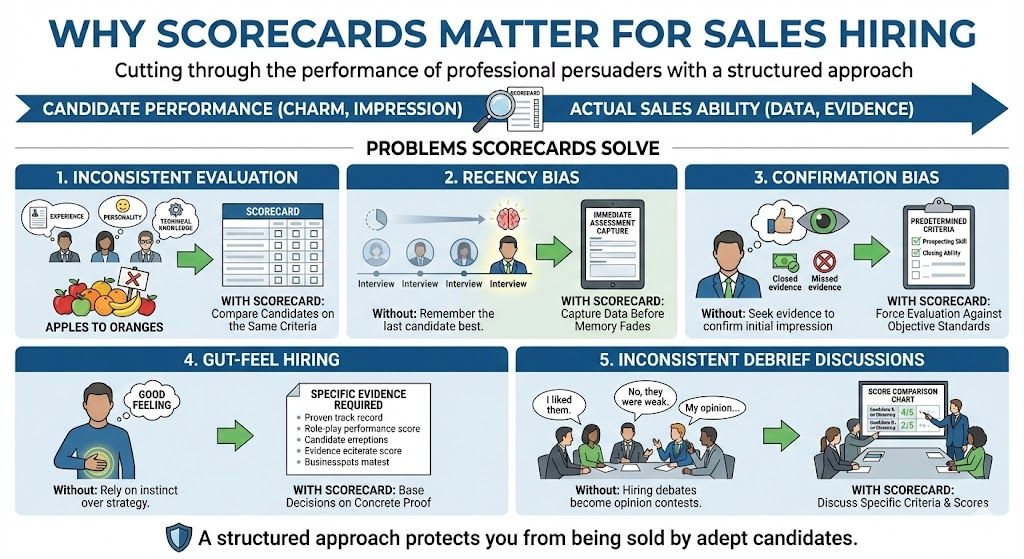
Problems scorecards solve:
- Inconsistent evaluation: Without a scorecard, different interviewers assess different things. One focuses on experience, another on personality, a third on technical knowledge. You end up comparing apples to oranges.
- Recency bias: Interviewers remember the last candidate best. Scorecards capture assessments immediately, before memory fades.
- Confirmation bias: Once we form an impression, we look for evidence to confirm it. Scorecards force evaluation against predetermined criteria.
- Gut-feel hiring: “I just had a good feeling about them” isn’t a hiring strategy. Scorecards require specific evidence.
- Inconsistent debrief discussions: Without scores, hiring debates become opinion contests. With scores, you discuss specific criteria.
Sales candidates are especially adept at creating positive impressions that don’t correlate with performance. A structured approach protects you from being sold.
What to Include in a Sales Hiring Scorecard
An effective sales scorecard covers the competencies that predict success in your specific sales role. Not every sales job requires the same skills.
Core competencies for most sales roles:
- Coachability: Can they receive feedback and adjust? This predicts long-term success more than current skill level.
- Curiosity: Do they ask good questions? Great salespeople are genuinely curious about prospects and problems.
- Work ethic: Are they willing to put in the effort? Sales requires consistent activity.
- Prior success: Have they achieved results in similar roles? Past performance predicts future performance.
- Intelligence: Can they learn your product and navigate complex conversations?
- Competitive drive: Do they want to win? Sales is fundamentally competitive.
Role-specific competencies to consider:
- For SDRs: Resilience, activity discipline, communication clarity, organization
- For AEs: Discovery skills, deal management, negotiation, business acumen
- For enterprise sales: Executive presence, multi-threading, patience, political navigation
- For sales managers: Coaching ability, hiring judgment, accountability, team development
Your scorecard should reflect what matters for your specific role, market, and sales motion.
Building the Scorecard Structure
A well-designed scorecard includes several key elements.
Rating scale: Most organizations use a 1-5 or 1-4 scale. A 1-4 scale forces a decision (no middle option), while a 1-5 scale allows for a neutral rating. Either works as long as you define what each number means.
Example rating definitions:
- 1 = Does not meet expectations; significant concerns
- 2 = Partially meets expectations; some concerns
- 3 = Meets expectations; solid performance
- 4 = Exceeds expectations; strong evidence of capability
- 5 = Exceptional; among the best candidates seen
Behavioral anchors: For each competency, define what good, mediocre, and poor look like. This ensures interviewers rate consistently.
Example for “Coachability”:
- 5 = Actively sought feedback during interview, asked how they could improve, provided specific examples of changing approach based on coaching
- 3 = Receptive to feedback when provided, acknowledged areas for growth, showed willingness to learn
- 1 = Defensive when challenged, blamed external factors for past failures, showed no evidence of adapting based on feedback
Evidence requirements: Require interviewers to note specific evidence supporting each rating. “Seemed coachable” isn’t enough. “When I pushed back on their approach to the role play, they paused, asked clarifying questions, and adjusted their approach” is evidence.
Assigning Competencies Across Interviews
Different interviewers should assess different competencies. This prevents redundancy and ensures comprehensive coverage.
Sample interview structure for an AE role:
Phone screen (recruiter or hiring manager):
- Basic qualifications (experience, compensation alignment, location)
- Communication clarity
- Initial culture fit
- Career motivations
First interview (hiring manager):
- Prior success and track record
- Discovery and questioning skills
- Business acumen
- Coachability
Second interview (peer or cross-functional):
- Collaboration and teamwork
- Technical aptitude
- Culture alignment
- Communication style
Final interview (executive or skip-level):
- Strategic thinking
- Competitive drive
- Long-term potential
- Executive presence (for senior roles)
Each interviewer focuses on their assigned competencies and completes only those sections of the scorecard. This keeps interviews focused and reduces fatigue.
Weighting Competencies
Not all competencies matter equally. Your scorecard should reflect relative importance.
High weight (essential): Competencies that are non-negotiable for success. A low score here should disqualify a candidate regardless of other strengths.
Medium weight (important): Competencies that significantly impact performance but can be developed or compensated for.
Low weight (nice to have): Competencies that add value but aren’t essential for the role.
Example weighting for an SDR role:
- High weight: Work ethic, coachability, resilience, communication clarity
- Medium weight: Curiosity, organization, technical aptitude
- Low weight: Prior sales experience, industry knowledge
For a VP Sales role, the weighting would look completely different, with experience, strategic thinking, and leadership carrying high weight.
Common Scorecard Mistakes
Companies frequently undermine their scorecards in predictable ways.
Too many criteria. If your scorecard has 15 competencies, each interview becomes overwhelming and scores become meaningless. Focus on 4-6 competencies per interview, 8-12 total across your entire process.
Vague definitions. “Good communication skills” means different things to different people. Define specifically what good looks like for your role. “Can clearly articulate complex technical concepts to non-technical buyers” is more useful.
Ignoring the scores. If you create a scorecard but make decisions based on gut feel anyway, you’ve wasted everyone’s time. Commit to using the data.
No calibration. Interviewers rate differently. One person’s 4 is another’s 3. Conduct calibration sessions where interviewers discuss the same candidate to align on standards.
Static scorecards. Your scorecard should evolve. When hires don’t work out, examine whether your criteria predicted the failure. When hires excel, check whether your scorecard captured their strengths. Adjust accordingly.
Scoring during the interview. Don’t rate candidates while they’re talking. Listen fully, take notes, and complete the scorecard immediately after.
Using Scorecards in Hiring Decisions
The goal isn’t to hire whoever has the highest score. Scorecards inform decisions; they don’t make them.
How to use scorecard data:
- Set minimum thresholds. Define scores below which candidates don’t advance. A candidate with a 2 on “coachability” probably shouldn’t move forward regardless of other strengths.
- Weight appropriately. A candidate with 5s on nice-to-have criteria and 3s on essential criteria is weaker than one with 4s across essentials.
- Look for red flags. Any 1 rating deserves serious discussion. What did the interviewer observe? Is this disqualifying?
- Compare candidates fairly. When choosing between finalists, review scores side by side. Where do they differ? Which differences matter most for this role?
- Discuss evidence, not opinions. Debrief meetings should focus on what interviewers observed, not how they felt.
The scorecard ensures you’re discussing the same criteria for every candidate. That’s the foundation for fair, consistent hiring.
Integrating Scorecards with Your Interview Process
Scorecards work best as part of a comprehensive interview process.
Before interviews:
- Share the scorecard with all interviewers
- Assign specific competencies to each interviewer
- Provide behavioral anchor definitions
- Train interviewers on rating standards
During interviews:
- Use questions designed to surface evidence for assigned competencies
- Take detailed notes on candidate responses
- Capture specific quotes and examples
After each interview:
- Complete the scorecard immediately while memory is fresh
- Provide specific evidence for each rating
- Submit scores before seeing other interviewers’ feedback
After all interviews:
- Collect all scorecards before the debrief meeting
- Review aggregate scores and identify patterns
- Discuss discrepancies between interviewers
- Make decisions based on evidence and criteria
This structure prevents groupthink and ensures each interviewer contributes independent judgment.
Getting Started
You don’t need a perfect scorecard to start. Begin with the basics and improve over time.
Week one: List the 8-10 competencies most important for success in the role you’re hiring for. Define what good and poor look like for each.
Week two: Create a simple scoring template. Assign competencies to interview stages. Train your interviewers on the approach.
Week three: Use the scorecard for your next round of candidates. Collect feedback from interviewers on what’s working.
Ongoing: Refine based on experience. Track whether scores correlate with new hire success. Adjust competencies and definitions as you learn.
A basic scorecard used consistently beats a sophisticated one that sits unused. Start simple and improve over time.
Leave a Reply