


Expanding sales internationally is a significant step for any software company. The decision to hire salespeople in EMEA, APAC, or other regions involves more than just finding good candidates. You need to determine timing, choose the right roles to hire first, and navigate regional differences in sales culture and compensation.
According to Statista, the U.S. generates approximately $222 billion of the global SaaS market, but Europe alone represents over $95 billion in 2025, with Asia Pacific growing at 16%+ annually. The opportunity outside North America is substantial, but capturing it requires thoughtful hiring.
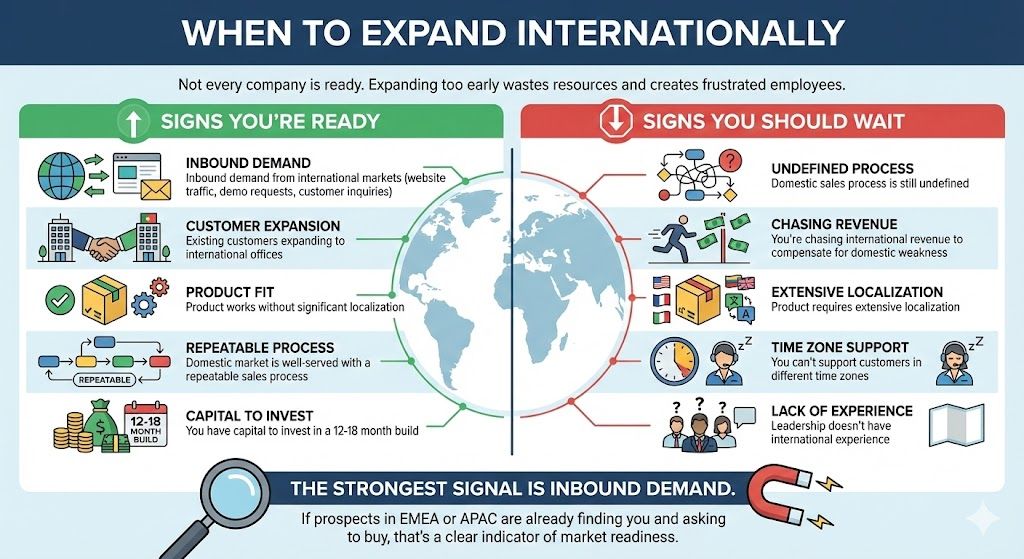
When to Expand Internationally
Not every company is ready for international sales. Expanding too early wastes resources and creates frustrated employees.
Signs you’re ready:
- Inbound demand from international markets (website traffic, demo requests, customer inquiries)
- Existing customers expanding to international offices
- Product works without significant localization
- Domestic market is well-served with a repeatable sales process
- You have capital to invest in a 12-18 month build
Signs you should wait:
- Domestic sales process is still undefined
- You’re chasing international revenue to compensate for domestic weakness
- Product requires extensive localization
- You can’t support customers in different time zones
- Leadership doesn’t have international experience
The strongest signal is inbound demand. If prospects in EMEA or APAC are already finding you and asking to buy, that’s a clear indicator of market readiness.
First Hires: Sequencing Matters
The sequencing of international hires significantly impacts success. Most companies follow a predictable pattern.
Option 1: Single country-based AE
Start with one Account Executive in a major market (London, Singapore, Sydney, Frankfurt). This person validates demand, closes early deals, and helps you understand the regional sales motion.
Best for: Companies with strong inbound demand in a specific country, lower-touch sales motions, deal sizes under $50K.
Option 2: Regional sales leader first
Hire a player-coach who can both sell and eventually build a team. They carry quota while establishing the foundation for growth.
Best for: Companies planning meaningful regional investment, enterprise sales motions, deal sizes over $50K.
Option 3: Inside sales from headquarters
Keep salespeople in your home market but have them cover international territories during overlapping hours.
Best for: Testing demand before committing to local presence, SMB and mid-market deals, companies not ready for full regional investment.
Most software companies start with option 1 or 3, then graduate to option 2 once they’ve validated demand.
Regional Considerations
Each region has distinct characteristics that affect hiring.
EMEA (Europe, Middle East, Africa):
- UK and Ireland often serve as initial entry points for US companies due to language and business culture similarities
- Germany, France, and Nordics typically require native-language speakers for enterprise sales
- GDPR and data sovereignty concerns are common in sales conversations
- Sales cycles can be longer than US equivalents
- Compensation expectations are typically lower than US, with stronger emphasis on base salary versus variable
APAC (Asia Pacific):
- Singapore and Australia are common starting points
- Japan requires local presence and Japanese-speaking sales staff for meaningful enterprise business
- Time zone challenges with US headquarters are significant
- Relationship-building often takes longer than in Western markets
- Each country has distinct business cultures; “APAC strategy” is often too broad
LATAM (Latin America):
- Brazil and Mexico are the largest markets
- Portuguese (Brazil) and Spanish language requirements
- Currency volatility affects pricing and compensation
- Growing SaaS adoption but smaller total market than EMEA or APAC
What to Look for in International Hires
International sales hires need specific capabilities beyond standard sales skills.
Essential qualities:
- Startup adaptability: International offices operate with less support than headquarters. Hires need to be self-sufficient and comfortable with ambiguity.
- Cultural bridge: They should understand both local business culture and how to work effectively with US-based leadership.
- Communication across time zones: Proactive communication matters more when you can’t solve problems with a quick hallway conversation.
- Local market knowledge: Understanding competitive landscape, buyer preferences, and regional nuances.
- Relevant deal-size experience: Someone who’s closed $20K deals won’t automatically succeed at $200K deals, regardless of region.
Red flags:
- Only worked at large, established companies with full regional infrastructure
- No experience working with remote headquarters
- Can’t articulate how the regional market differs from others
- Expects the same resources and support as domestic hires
The best candidates have often worked at companies during their international expansion phase. They understand the challenges of building in-region.
Structuring Compensation
International compensation requires balancing local market rates with internal equity.
Key considerations:
- Research local market rates; US compensation doesn’t translate directly
- Many international markets expect higher base-to-variable ratios (70/30 or 80/20 vs. US 50/50)
- Factor in statutory benefits that may be more extensive than US requirements
- Decide whether to pay in local currency or USD
- Understand tax implications of employer-of-record versus local entity
Common Mistakes
Software companies make predictable errors in international expansion.
Hiring before product readiness. If your product requires significant localization (language, compliance, payment methods), hiring salespeople first creates frustration. Make sure the product can actually be sold in-region.
Expecting immediate results. International territories typically take longer to develop than domestic ones. Plan for 12-18 months to meaningful revenue, not 6 months.
Hiring “international experience” without regional specificity. Someone who sold successfully in UK doesn’t automatically succeed in Germany. Regional experience matters.
Underinvesting in support. International salespeople without marketing support, solutions consulting help, or customer success resources struggle to succeed. Budget for more than just the sales hire.
Treating international as headquarters overflow. Companies sometimes hire international salespeople to work deals that domestic reps don’t want. This demoralizes international hires and doesn’t build a real regional business.
These overlap with general hiring mistakes but have international-specific dimensions.
Building Toward a Regional Team
Once your first hire proves out, think about the next phase.
Path to regional team:
- First hire validates demand and closes initial deals
- Add SDR support for pipeline generation
- Hire additional AEs as pipeline supports
- Promote or hire regional leader at 3-5 AEs
- Add solutions consulting and customer success locally
- Build toward regional self-sufficiency
Don’t rush the sequence. Each hire should be justified by pipeline and revenue, not just ambition.
Working With Recruiting Partners
Finding international candidates from US headquarters is challenging. Local recruiting firms or firms with international reach can help you access candidates you couldn’t find on your own.
When working with recruiters on international hires, be clear about:
- What level of headquarters interaction the role requires
- Whether you need someone who’s worked at US-based companies before
- Language requirements beyond English
- Your timeline and compensation parameters
Final Thoughts
International expansion is a commitment, not an experiment. The companies that succeed treat their international hires as foundational team members, not distant outposts. They invest in support, set realistic timelines, and hire people who can thrive with the ambiguity that comes with building something new.
Start with clear demand signals, hire the right first role for your stage, and build deliberately. The international opportunity is real, but capturing it requires patience and the right people.
Leave a Reply