


Hiring salespeople for enterprise deals requires a fundamentally different approach than hiring for SMB sales. The skills, experience, compensation, and even personality traits that make someone successful at closing $500K enterprise contracts have almost nothing in common with what makes someone effective at closing $5K SMB deals.
According to Gartner research, the typical B2B buying group now involves 6 to 10 stakeholders, with enterprise deals often including 11 or more decision-makers across multiple departments. This complexity shapes everything about how you hire, train, and compensate your sales team.
The Fundamental Differences
Before examining hiring implications, it’s worth understanding just how different these two motions are.
Enterprise sales characteristics:
- Deal sizes: $50K to $500K+ annually
- Sales cycles: 6-18 months
- Stakeholders: 6-15 people across multiple departments
- Process: Procurement, legal, security reviews, executive sign-off
- Relationship: Multi-year partnerships with ongoing engagement
- Churn: Typically under 10% annually
SMB sales characteristics:
- Deal sizes: $1K to $25K annually
- Sales cycles: 2 weeks to 3 months
- Stakeholders: 1-3 people, often a single decision-maker
- Process: Minimal procurement, quick approvals
- Relationship: Transactional, often self-service after sale
- Churn: Can reach 20%+ annually
These aren’t just quantitative differences. They require completely different selling approaches, which means you need different types of people.
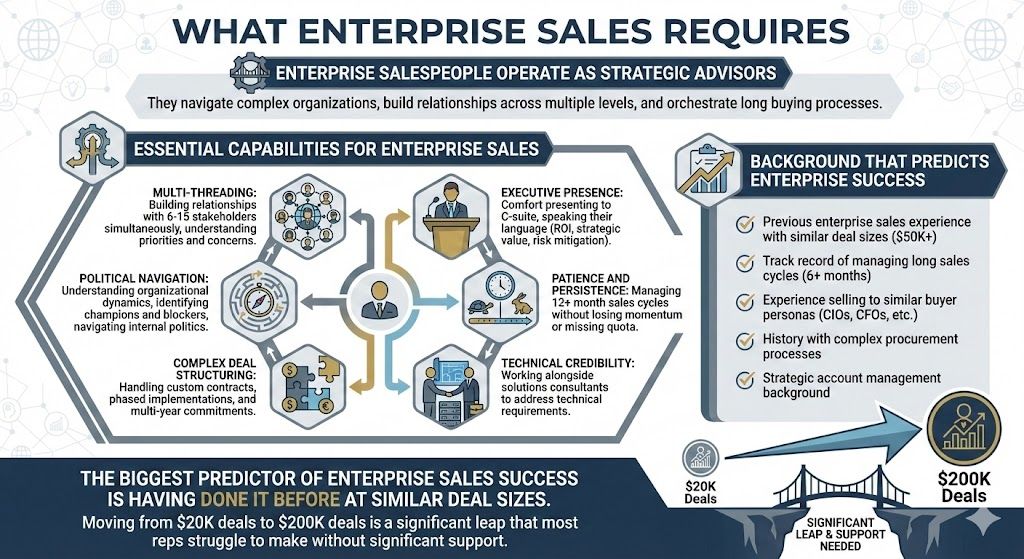
What Enterprise Sales Requires
Enterprise salespeople operate more like strategic advisors than traditional salespeople. They navigate complex organizations, build relationships across multiple levels, and orchestrate long buying processes.
Essential capabilities for enterprise sales:
- Multi-threading: The ability to build relationships with 6-15 stakeholders simultaneously, understanding each person’s priorities and concerns
- Executive presence: Comfort presenting to C-suite executives and speaking their language (ROI, strategic value, risk mitigation)
- Political navigation: Understanding organizational dynamics, identifying champions and blockers, and navigating internal politics
- Patience and persistence: Managing 12+ month sales cycles without losing momentum or missing quota
- Complex deal structuring: Handling custom contracts, phased implementations, and multi-year commitments
- Technical credibility: Working alongside solutions consultants to address technical requirements
Background that predicts enterprise success:
- Previous enterprise sales experience with similar deal sizes ($50K+)
- Track record of managing long sales cycles (6+ months)
- Experience selling to similar buyer personas (CIOs, CFOs, etc.)
- History with complex procurement processes
- Strategic account management background
The biggest predictor of enterprise sales success is having done it before at similar deal sizes. Moving from $20K deals to $200K deals is a significant leap that most reps struggle to make without significant support.
What SMB Sales Requires
SMB salespeople are efficiency machines. They handle high volumes of smaller deals, qualify quickly, and move prospects through the funnel fast. The job is as much about velocity as it is about selling skill.
Essential capabilities for SMB sales:
- Speed: Ability to handle 40-60 customer interactions daily
- Quick qualification: Identifying buyers versus tire-kickers within minutes
- Efficient communication: Getting to value proposition fast, without lengthy discovery
- Resilience: Handling high rejection rates and short attention spans
- Process discipline: Following a defined playbook consistently across many deals
- Self-sufficiency: Working independently without extensive support resources
Background that predicts SMB success:
- Inside sales or high-velocity sales experience
- Comfort with phone and video-based selling
- Track record hitting activity metrics (calls, demos, closes per day)
- Experience with transactional sales motions
- Ability to learn products quickly and explain them simply
SMB sales rewards people who can work fast and stay organized. The best SMB reps often come from backgrounds like retail, customer service, or SDR roles where high activity levels are normal.
Why Cross-Segment Hiring Rarely Works
One of the most common hiring mistakes software companies make is assuming that a great enterprise rep can sell SMB, or vice versa. This rarely works well.
Why enterprise reps struggle in SMB:
- They over-engineer deals that should be simple
- They can’t hit the activity levels required
- They find the smaller deals unfulfilling
- They spend too long on discovery when quick qualification is needed
- Their compensation expectations don’t align with SMB economics
Why SMB reps struggle in enterprise:
- They try to close too fast and alienate stakeholders
- They lack experience navigating complex organizations
- They get lost in long sales cycles without clear milestones
- They don’t have the executive presence for C-suite conversations
- They struggle with the patience required for 12+ month deals
The skills aren’t just different in degree. They’re different in kind. Hiring across segments can work if you provide extensive support and training, but treating it as a lateral move sets everyone up for failure.
Structuring Your Interview Process
Your interview process should test for segment-specific skills.
For enterprise candidates:
- Deal walkthrough: Have them describe their largest, most complex deal in detail. Who were the stakeholders? How long did it take? What obstacles did they overcome?
- Multi-threading exercise: Present a scenario with multiple stakeholders and ask how they would engage each one
- Executive presentation: Have them present to a mock executive buyer focused on business value
- References from champions: Talk to people who bought from them, not just managers
For SMB candidates:
- Mock cold call or demo: Test their ability to engage quickly and communicate value concisely
- Activity discussion: Understand their daily workflow. How many calls? How many demos?
- Qualification exercise: Give them sample leads and ask how they would prioritize
- Process adherence: Assess their comfort following a defined playbook
Ask every candidate about their deal sizes, sales cycles, and quota structures. If the numbers don’t roughly match what you’re hiring for, proceed with caution.
Compensation Differences
Compensation plans should reflect the different economics and behaviors of each segment.
Enterprise compensation:
- Higher base salaries ($100K-$150K+ base) to attract experienced talent
- Variable compensation tied to fewer, larger deals
- Often includes multi-year components (commissions on contract value, not just year-one)
- May include accelerators for deals above certain thresholds
- Quotas typically $800K-$2M+ annually
- Typical OTE: $200K-$400K+
SMB compensation:
- Lower base salaries ($50K-$80K base)
- Higher variable as percentage of OTE (often 50/50 split)
- Variable tied to volume metrics (number of deals, not just revenue)
- Monthly or quarterly commission cycles
- Quotas typically $400K-$800K annually
- Typical OTE: $100K-$150K
The ratio differences matter. Enterprise reps need higher bases because their commission events are less frequent. SMB reps can accept lower bases because they have more opportunities to earn commission.
Team Structure Considerations
How you structure your sales organization depends on which segments you serve.
Pure enterprise model:
- Account Executives own the full sales cycle
- Solutions Consultants support technical selling
- SDRs focus on account-based outreach, not high volume
- Customer Success owns post-sale relationship
- Low AE-to-manager ratio (4-6 reps per manager)
Pure SMB model:
- Inside sales reps handle high volume
- SDRs generate and qualify leads at scale
- Minimal solutions consulting (product should be self-explanatory)
- Customer success may be pooled or tech-touch
- Higher AE-to-manager ratio (8-10 reps per manager)
Hybrid model:
Many software companies serve both segments, which requires careful segmentation:
- Separate teams for each segment
- Clear rules for account assignment
- Different processes and tooling
- Segment-specific management
- Distinct career paths
The hybrid model is harder to execute. Without clear boundaries, you end up with enterprise reps working small deals (inefficient) or SMB reps struggling with complex accounts (unsuccessful).
Moving Up-Market: Hiring Considerations
Many software companies start in SMB and move up-market over time. This transition has significant hiring implications.
When moving from SMB to mid-market:
- Hire 1-2 experienced mid-market reps before scaling
- Accept that your SMB playbook won’t transfer directly
- Budget for longer ramp times (4-6 months vs. 2-3)
- Invest in solutions consulting capacity
- Expect your SMB reps to struggle with the transition
When moving from mid-market to enterprise:
- Hire experienced enterprise reps with relevant deal-size experience
- Consider a VP of Sales with enterprise background to lead the motion
- Build supporting infrastructure (legal, security, solutions consulting)
- Accept 12+ month payback on new hires
- Don’t expect mid-market reps to make the jump without significant support
The most dangerous assumption is that your current team can just “sell bigger deals.” Moving up a segment is almost like building a new sales function.
When to Specialize vs. Stay Generalist
Not every software company needs segment-specific sales teams. Here’s how to decide.
Stay generalist when:
- Your deal sizes cluster around a narrow range
- You’re pre-$5M ARR and still learning your market
- Your product naturally limits deal size variation
- You can’t support the overhead of multiple teams
Specialize when:
- Deal sizes span more than 5x (e.g., $10K to $50K+)
- Different segments require different sales motions
- Reps are either under-serving large accounts or over-working small ones
- You have enough volume in each segment to justify dedicated resources
The inflection point often comes around $5-10M ARR, when you have enough deal flow to support specialization and enough data to understand segment differences.
Working With Recruiting Partners
Finding the right salespeople for each segment often requires different sourcing strategies. A recruiting firm that specializes in software sales can help you identify candidates with the right segment experience.
Key questions to discuss with recruiters:
- What deal sizes has the candidate typically worked?
- What were their average sales cycles?
- How did their quota structure compare to what you’re offering?
- Can they provide references from customers at similar company sizes?
Segment fit is non-negotiable. A recruiter who understands this will save you from costly mis-hires.
Common Mistakes in Segment Hiring
Hiring enterprise reps too early. Enterprise sales requires product maturity, reference customers, and organizational infrastructure. Hiring expensive enterprise reps before you have these things wastes money and frustrates talent.
Assuming SMB experience translates up. Your best SMB rep probably isn’t your best enterprise candidate. Different skills, different pace, different psychology.
Creating hybrid roles. “Handle SMB and mid-market” sounds efficient but rarely works. Reps either neglect the smaller deals or flounder on the larger ones.
Ignoring segment in compensation design. Enterprise reps with SMB compensation plans will leave. SMB reps with enterprise compensation plans won’t hit activity levels.
Promoting based on personality, not segment fit. Just because someone is ambitious doesn’t mean they can handle enterprise sales. Test for the specific capabilities required.
Final Thoughts
Enterprise and SMB sales are different jobs that happen to share a title. The skills, experience, compensation, and personality traits that drive success in each segment have limited overlap.
When hiring, start by understanding which segment you’re hiring for and what that segment demands. Then evaluate candidates against those specific requirements. Resist the temptation to hire “great salespeople” without considering segment fit.
The companies that get this right build sales teams where the right people are in the right seats. The companies that get it wrong churn through expensive mis-hires and wonder why revenue isn’t scaling.
Leave a Reply