


Scaling a sales team is one of the highest-stakes decisions a software company makes. Hire too slowly and you leave revenue on the table while competitors gain ground. Hire too fast and you burn cash on reps who don’t have enough pipeline to work, crushing morale and efficiency.
According to The Bridge Group’s research, the average SaaS Account Executive takes 5.7 months to ramp to full productivity, up from 5.3 months in 2022. That means every hiring decision you make today won’t fully pay off for nearly six months. Getting the timing and sequencing right matters enormously.
When to Scale: The Signals That Matter
The decision to add salespeople should be driven by data, not intuition or investor pressure. Here are the signals that indicate you’re ready to scale.
Signs you should hire more reps:
- Existing reps are consistently hitting or exceeding quota (70%+ attainment across the team)
- You’re turning away or delaying qualified opportunities because reps are at capacity
- Pipeline coverage is strong (3-4x quota) and lead flow continues to grow
- Your sales process is documented and repeatable
- New reps from your last hiring cohort ramped successfully
- Unit economics support additional headcount (CAC payback under 18 months)
Signs you should wait:
- Current reps aren’t hitting quota and you don’t know why
- Lead generation can’t support additional reps
- Your sales process is still undefined or changing frequently
- Recent hires are struggling to ramp
- You’re hiring to “figure it out” rather than to scale what works
- Quota attainment is below 50% across the team
The key principle: scale what’s working. If your existing team isn’t productive, adding more people just multiplies the problem.
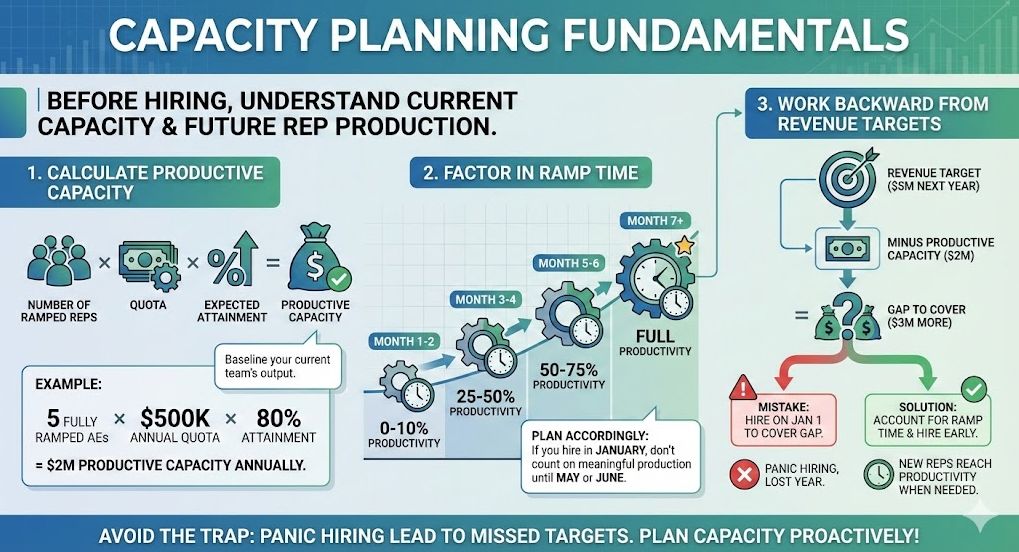
Capacity Planning Fundamentals
Before hiring, you need to understand your current capacity and what additional reps will actually produce.
Calculate your productive capacity:
Start with this formula: Productive Capacity = Number of Ramped Reps × Quota × Expected Attainment
For example, if you have 5 fully ramped AEs with $500K annual quotas and you expect 80% attainment, your productive capacity is $2M annually.
Factor in ramp time:
New hires don’t produce at full capacity immediately. Most SaaS companies see reps at roughly:
- Month 1-2: 0-10% productivity
- Month 3-4: 25-50% productivity
- Month 5-6: 50-75% productivity
- Month 7+: Full productivity
If you hire a rep in January, don’t count on meaningful production until May or June. Plan accordingly.
Work backward from revenue targets:
If you need to hit $5M next year and your productive capacity is $2M, you need $3M more. But you can’t just hire reps to cover the gap on January 1. You need to account for ramp time and hire early enough that new reps reach productivity when you need them.
This is where many companies make mistakes. They wait until they’re behind on targets, then hire in a panic. By the time those reps ramp, the year is lost.
The Right Hiring Sequence
Scaling isn’t just about adding reps. The sequence matters.
Stage 1: Prove the model (0-3 reps)
Your first few salespeople should be generalists who can do everything: prospect, demo, negotiate, close. At this stage, you’re still learning what works. Hire adaptable people who can help you figure it out, not specialists who need a defined playbook.
Stage 2: Add infrastructure (3-8 reps)
Once you have a repeatable process, start building support:
- SDRs to generate pipeline so AEs can focus on closing
- Basic sales operations to handle CRM hygiene, reporting, and process documentation
- Sales management once you have 5-6 reps (one manager can handle 6-8 direct reports effectively)
Stage 3: Specialize and segment (8-20 reps)
As you grow, specialization becomes valuable:
- Segment by deal size (SMB vs. mid-market vs. enterprise)
- Segment by function (new business vs. expansion/renewals)
- Add solutions consultants for technical sales support
- Build out sales operations for comp plans, territory design, and forecasting
Stage 4: Build a leadership layer (20+ reps)
Larger teams need management depth:
- Regional or segment leaders
- Director or VP level to own strategy and cross-functional coordination
- Dedicated enablement and training
The mistake companies make is skipping stages. They hire enterprise AEs before they have product-market fit in enterprise. They add managers before they have enough reps. They specialize before they understand their segments. Follow the sequence.
How Fast Is Too Fast?
There’s a practical limit to how quickly you can scale a sales team effectively.
Constraints on scaling speed:
- Management capacity: Each manager can effectively onboard and coach 2-3 new reps at a time. More than that and quality suffers.
- Training resources: Your onboarding program can only handle so many people simultaneously without diluting quality.
- Pipeline availability: New reps need leads to work. If lead generation can’t keep pace with hiring, reps sit idle.
- Cultural integration: Adding too many people at once dilutes culture and makes it harder to maintain standards.
A reasonable pace:
For most software companies, a sustainable scaling rate is doubling the sales team annually. That might mean:
- 5 reps → 10 reps in Year 1
- 10 reps → 20 reps in Year 2
- 20 reps → 40 reps in Year 3
Some companies grow faster, but they usually have exceptional demand, strong unit economics, and significant capital. Hypergrowth hiring (tripling or quadrupling the team) requires exceptional infrastructure and often results in high attrition and cultural strain.
Pipeline and Lead Generation Alignment
You cannot scale sales without scaling pipeline. This is where many companies fail.
The pipeline math:
Most sales teams need 3-5x pipeline coverage to hit quota. If you’re adding reps with $500K quotas, each rep needs $1.5M-$2.5M in pipeline annually. Before you hire, ask: where will that pipeline come from?
Lead generation options:
- Inbound marketing: Content, SEO, paid advertising. Takes time to build but scales efficiently.
- SDR outbound: More predictable but requires hiring and ramping SDRs ahead of AEs.
- Partnerships and referrals: Often high quality but hard to scale predictably.
- Product-led growth: Self-service signups that convert to sales-assisted deals.
The general rule: hire lead generation capacity 3-6 months ahead of AE capacity. If you’re planning to add 5 AEs in Q3, you should be adding SDRs or marketing spend in Q1.
Common Scaling Mistakes
Software companies make predictable errors when scaling sales teams. Avoid these.
Hiring ahead of product-market fit. If you haven’t proven that customers will pay for your product and stick around, adding salespeople won’t help. They’ll churn through leads and burn out trying to sell something the market doesn’t want.
Scaling before you have a repeatable process. If your best rep succeeds through personal relationships and heroic effort, that doesn’t scale. You need a documented process that average reps can follow before you hire more people.
Ignoring ramp time in planning. Companies consistently underestimate how long it takes new reps to become productive. Plan for 5-6 months of ramp time for AEs, not 2-3.
Hiring too many juniors. Junior reps are cheaper, but they need more management attention and take longer to ramp. A team of all junior reps will struggle without enough experienced people to model success.
Hiring too many seniors. Senior reps expect infrastructure, support, and defined territories. If you’re still figuring things out, expensive senior hires often get frustrated and leave.
Neglecting management. Every 6-8 reps need a dedicated manager. Waiting too long to hire managers means reps don’t get coaching and development, which hurts performance and retention.
Ignoring attrition in planning. Sales teams typically see 20-30% annual attrition. If you have 10 reps and lose 2-3 per year, you need to hire 2-3 just to stay flat, plus more to grow. Factor this into your hiring plan.
These overlap with other common sales hiring mistakes but deserve special attention when scaling.
Working With Recruiting Partners
Scaling quickly often requires external help. Internal recruiting teams struggle to keep pace when you need to hire 5-10 salespeople per quarter.
When to use external recruiters:
- Hiring velocity exceeds what internal recruiting can support
- You need specialized roles (enterprise AEs, sales engineers) where your network is thin
- Speed matters more than cost
- You’re entering new markets or segments where you lack connections
A good software recruiting firm can compress time-to-fill significantly. What might take 60 days internally can often be done in 30-35 days with a specialized recruiter.
Building Infrastructure to Support Scale
As you grow, you need systems that support a larger team.
Technology:
- CRM that’s actually used and maintained
- Sales engagement platform for outreach
- Conversation intelligence for coaching
- Forecasting and pipeline management tools
Processes:
- Documented sales process with stage definitions
- Clear handoff procedures between roles
- Territory and account assignment rules
- Compensation plans that scale
People:
- Sales operations to maintain systems and processes
- Sales enablement for training and content
- Management layer with appropriate span of control
Companies that invest in infrastructure scale more smoothly. Companies that try to run a 20-person team with the same systems they used at 5 people create chaos.
Measuring Success as You Scale
Track these metrics to know if your scaling is working.
Leading indicators:
- Pipeline coverage (should stay above 3x as you add reps)
- Ramp time (are new hires reaching productivity on schedule?)
- Activity levels (are new reps doing the work?)
- Quota attainment by cohort (how do recent hires compare to tenured reps?)
Lagging indicators:
- Revenue per rep
- CAC and CAC payback
- Sales efficiency (revenue divided by total sales cost)
- Rep attrition
If you’re scaling well, you should see quota attainment stay stable or improve, ramp times stay consistent, and efficiency metrics hold. If you’re scaling poorly, you’ll see quota attainment drop, ramp times extend, and efficiency decline.
Final Thoughts
Scaling a sales team is a balance between ambition and discipline. The companies that do it well hire ahead of need but not too far ahead, build infrastructure to support growth, and maintain quality standards even when moving fast.
Start with clear signals that you’re ready. Do the capacity planning math. Hire in the right sequence. Build pipeline ahead of headcount. And measure constantly to catch problems early.
The goal isn’t just more salespeople. It’s more productive salespeople generating more revenue efficiently. Keep that outcome in mind and scaling becomes a growth lever rather than a source of chaos.
Leave a Reply